
Non-FictionBusiness BriefStablecoins
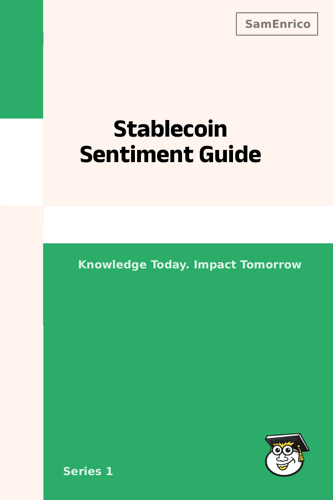
Stablecoin Sentiment Guide eBook
Track dry powder waiting to deploy into crypto.
by Bardin Leif
Track dry powder waiting to deploy into crypto.
Formats
Free sample
Chapter 1: The Silent Reservoir...--–- The first lie they tell you in crypto is that cash is trash. The second lie is that you must always be deployed to win. Both have drained more portfolios than any bear market ever could.Every morning, millions of crypto traders open their screens and see the same red or green candles. They chase pumps. They panic during dumps.
They leverage their positions to the hilt, borrowing against their last dollar to catch the next 100x moonshot. And almost all of them share one devastating blind spot: they have no idea how much dry powder is sitting on the sidelines, waiting to enter the market.This book is about that blind spot.Stablecoin Sentiment Guide is not another book about Bitcoin’s halving cycles, Ethereum’s technical roadmap, or the latest meme coin sensation. Those narratives capture attention, but they do not capture the liquidity that actually moves prices. The crypto market does not run on hype alone. It runs on digital dollars – stablecoins – parked in wallets, exchanges, and De Fi protocols, waiting for the right moment to deploy.That waiting capital is called dry powder.In traditional finance, private equity firms and venture capitalists talk about dry powder constantly.
It is the money they have raised but not yet invested – their ammunition for the next opportunity. In crypto, the concept is the same but the stakes are higher. Crypto moves faster. The leverage is greater. And when dry powder finally deploys, it creates explosions of volatility that can double or halve your portfolio in a single weekend.Yet remarkably, almost no retail traders track dry powder systematically.
They watch price. They watch volume. They watch Twitter influencers. But they do not watch the one metric that predicts where price is going: the flow of stablecoins into and out of exchanges.This chapter will change that. It will dismantle the myth that holding cash is a sin in crypto culture.
It will introduce you to the three categories of dry powder that will serve as the foundation for every strategy in this book. And it will show you why patient capital – the capital that sits quietly while others panic – is the most powerful force in the crypto universe.By the time you finish this chapter, you will never look at a stablecoin the same way again.The Myth of "Cash is Trash"Crypto culture has a problem with cash.From the earliest days of Bitcoin forums to the frenzied comments sections of today’s trading groups, the dominant ethos has been clear: holding fiat currency is for suckers. Inflation is eating your purchasing power. Central banks are printing money into oblivion. The government is debasing your savings.
The solution, according to the gospel of crypto, is to convert every dollar into Bitcoin, Ethereum, or the latest altcoin as soon as possible.This philosophy produced millionaires during the 2017 and 2021 bull runs. It also produced bankrupts during the 2018 and 2022 bear markets.The problem with "cash is trash" is not the observation that inflation erodes purchasing power. That is mathematically true. The problem is the conclusion that you must therefore remain fully deployed at all times. This conclusion ignores a basic reality of all financial markets: opportunity cost is not the only cost.
The cost of being forced to sell at the bottom is much higher.Imagine two traders at the start of 2022.Trader A believes "cash is trash." They convert their entire $100,000 portfolio into Bitcoin at $69,000 (the all-time high) in November 2021. By June 2022, Bitcoin falls to $17,600. Trader A has lost roughly 75% of their portfolio. They have no dry powder left to buy the dip because every dollar is already deployed. They can either sell at a catastrophic loss or wait years for recovery – hoping they do not need the money in the meantime.Trader B also believes in crypto but respects dry powder.
They keep 50% of their portfolio in USDC – a stablecoin pegged to the dollar. When Bitcoin falls from $69,000 to $40,000, they deploy 10% of their dry powder. When it falls to $30,000, they deploy another 15%. When it hits $20,000, they deploy 25%. By the bottom at $17,600, Trader B has deployed most of their dry powder at an average entry price around $28,000 – less than half of Trader A’s entry.
When Bitcoin recovers to $60,000 in 2024, Trader B has doubled their money. Trader A is still down.The difference between these two traders is not intelligence. It is not trading skill. It is the willingness to hold dry powder – to keep cash-like assets ready for the moment when everyone else is panicking.This is the myth we must kill first: the belief that holding cash is always a losing strategy.In reality, holding stablecoins during a bear market is not capitulation. It is optionality.
It is the financial version of keeping a loaded weapon in a safe – you are not using it now, but when the moment comes, you will be ready while everyone else is empty-handed.What Are Stablecoins? A Brief History of Digital Dollars Before we can track dry powder, we must understand the containers that hold it. Stablecoins are cryptocurrencies designed to maintain a stable value – typically pegged to the US dollar at a 1:1 ratio. Unlike Bitcoin, which can swing 10% in a single day, stablecoins aim to be boring. That boringness is precisely what makes them useful as dry powder.The first stablecoin of significance was Tether (USDT) , launched in 2014 under the original name "Realcoin." Its founders – Brock Pierce, Reeve Collins, and Craig Sellars – saw a problem that no one else was solving.
In the early days of crypto, moving money between exchanges was a nightmare. You could not wire dollars to most exchanges quickly. And even when you could, the process took days. In a market that moves 24/7, days are an eternity.Tether solved this problem by creating a digital token that lived on the Bitcoin blockchain (via the Omni Layer) and claimed to be backed 1:1 by US dollars held in reserve. If you wanted to move "dollars" from one exchange to another, you could simply send USDT.
The transaction took minutes instead of days. No banks required.The innovation was seismic. Tether became the unofficial central bank of crypto – not because it was regulated or trusted, but because it worked. Exchanges that listed USDT saw liquidity explode. Traders who used USDT could arbitrage price differences across markets instantly.
By 2017, Tether was the lifeblood of the crypto economy.But there was a catch. Tether’s reserves were opaque. The company did not provide regular audits. It made claims about being fully backed, but it took years for any meaningful verification to emerge. In 2019, the New York Attorney General launched an investigation into Tether and its sister exchange, Bitfinex, alleging that they had covered up $850 million in missing funds.
Tether eventually settled, paid a fine, and agreed to provide quarterly reports – but to this day, questions about the quality of their reserves linger.Circle’s USDC entered the market in 2018 as the regulated alternative. Circle positioned itself as the compliant, transparent, audited stablecoin. Where Tether operated from the British Virgin Islands and Hong Kong, Circle was headquartered in Boston and subjected to US regulation. USDC grew rapidly…
This is the end of the free sample. Get the eBook to keep going. Buy now
About this book
Details
- Author
- Bardin Leif
- Publisher
- SamEnrico
- Language
- English
- Genre
- Non-Fiction, Business Brief, Stablecoins
- Released
- 2026-06-06
- Pages (approx.)
- 157
- Available as
- eBook, Audiobook

Read better in the ZLOADR app
Your eBooks on your phone or tablet. Sign in with your SamEnrico account and start reading.
More by Bardin Leif
 The Self Compassionate AchieverBardin Leif$11.99
 Loneliness Physical Health GuideBardin Leif$11.99
 Academic Stress for First Gen StudentsBardin Leif$11.99
 The Caravels of the Cosmos: Portugal's Stellar NavigatorsBardin Leif$11.99
 How to Produce Baby Mobile AccessoriesBardin Leif$11.99
 SAFe Adoption Warning SignsBardin Leif$12.99
 Service Desk EngineerBardin Leif$11.99
 Ultimate Handbook Guide to Chaohu : (China) Travel GuideBardin Leif$11.99
You may also like
 Hong Kong Handover 1997Dunn Johnnie$11.99
 Zumba For Postnatal Recovery CourseNeal Christian$11.99
 Zumba for BeginnersLadner Nikia$11.99
 YouTube Comment Mining GuideHumes Pandora$12.99
 Worry Box MeditationCarlin Rudy$11.99
 Workplace Stress MeditationNguyen Lynn$11.99
 Workplace Stress and Sleep RepairHawley Ivory$11.99
 Workplace Perfectionism CureDelaney Jeffry$11.99
 Workplace Injustice Anger GuideWallen Isabelle$11.99
 Work Addiction and Burnout LinkGreenwood Ester$11.99
 Women in Yoga and WellnessBeattie Galina$11.99
 Women in Stand Up ComedyChun Evangeline$11.99