
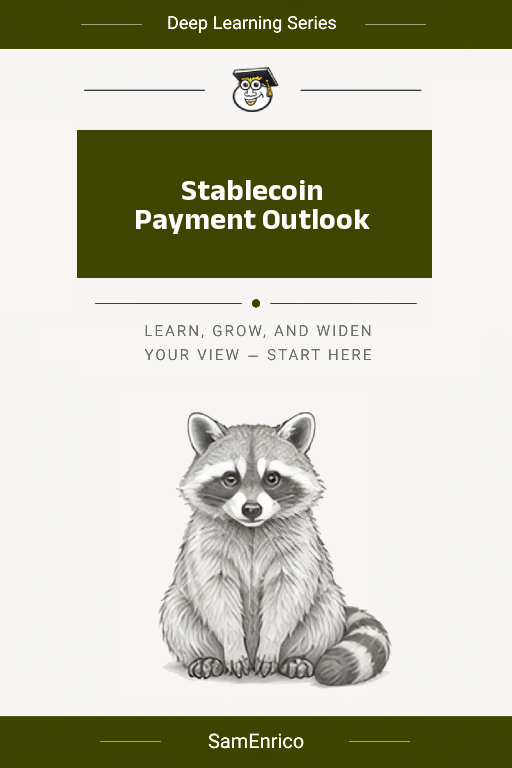
Non-FictionForecast & OutlookStablecoins
Stablecoin Payment Outlook eBook
Project USDC, USDT adoption for commerce, regulato
Project USDC, USDT adoption for commerce, regulatory framework, and traditional finance integration through 2030.
Formats
Free sample
Chapter 1: The Trillion Dollar Shell...--The first time most people heard about stablecoins, they weren't listening.It was 2021. Bitcoin was hitting sixty-nine thousand dollars. NFTs of cartoon apes were selling for millions. Elon Musk was on Saturday Night Live. And somewhere in the background, a quiet, almost boring financial instrument called "USDC" processed its first billion-dollar settlement day.
Nobody noticed. Why would they? Stablecoins were the accountants of crypto—useful, necessary, but deeply unsexy.That was the mistake.By 2024, the stablecoin market had swelled to over 150billion.USDTand USDCtogetherweresettlingmoredailyvolumethan American Express.Andby2030,dependingonwhichanalystyoutrust,stablecoinswillmovesomewherebetween150 billion. USDT and USDC together were settling more daily volume than American Express. And by 2030, depending on which analyst you trust, stablecoins will move somewhere between 150billion.USDTand USDCtogetherweresettlingmoredailyvolumethan American Express.Andby2030,dependingonwhichanalystyoutrust,stablecoinswillmovesomewherebetween3.7 trillion and $56 trillion annually.
That range—from the size of Germany's economy to nearly half of global GDP—is not a sign of bad math. It is a sign of uncertainty. And where there is uncertainty, there is opportunity.This chapter is about how we got here. Not the hype cycles, not the celebrity endorsements, not the exchange wars. This chapter is about the boring, brutal, beautiful mechanics of the payment stablecoin—why it emerged, why it survived every crypto winter, and why it is now poised to become the most important financial infrastructure you have never thought about.The Prehistory: Bit USD and the Dream of a Stable Crypto To understand stablecoins, you must first understand a problem that haunted early cryptocurrency: volatility.Bitcoin, for all its revolutionary promise, is terrible as a medium of exchange.
Not because it's slow—though it can be—but because its value fluctuates wildly. A cup of coffee that costs 0.0001 BTC today might cost 0.00015 BTC tomorrow, not because the coffee changed, but because Bitcoin did. No merchant wants to accept payment in an asset that might lose ten percent of its value before the credit card receipt prints.Early crypto builders knew this. They dreamed of a "stablecoin"—a cryptocurrency that maintained a fixed value, typically pegged to the U.S. dollar.
The first serious attempt was Bit USD, launched in July 2014 on the Bit Shares network. Bit USD used a novel mechanism: users would lock up Bit Shares' native token (BTS) as collateral, then mint Bit USD against it. If the value of the collateral fell below a certain threshold, the system would automatically liquidate it to maintain the peg.It worked, sort of. Bit USD maintained its dollar peg for months at a time. But it suffered from a fatal flaw: it was only as good as the demand for Bit Shares itself.
When crypto winter hit, collateral values collapsed, liquidations cascaded, and the peg broke. Bit USD never fully recovered.The lesson of Bit USD was brutal but clear: algorithmic stability is fragile. No mathematical formula can conjure dollars out of thin air. A stablecoin is only as stable as the assets backing it.The First Breakthrough: Tether's Controversy-Laden Rise Enter Tether (USDT), launched in 2014 by a group of Bitcoin early adopters including Brock Pierce and Reeve Collins. Tether made a radical simplification: instead of algorithmic collateral, Tether claimed to hold one U.S.
dollar in a bank account for every USDT in circulation. The peg was not maintained by code, but by a promise—and a bank account.This "fiat-collateralized" model was revolutionary in its simplicity. A user sends 1to Tether;Tethermints1USDTonthe Bitcoinblockchain(viathe Omni Layer,latermovingto Ethereum,Tron,and Solana).Theusercanthensendthat USDTanywhereintheworld,instantly,forpennies.Whentheuserwantsdollarsback,theyredeem USDTwith Tether,whichsends1 to Tether; Tether mints 1 USDT on the Bitcoin blockchain (via the Omni Layer, later moving to Ethereum, Tron, and Solana). The user can then send that USDT anywhere in the world, instantly, for pennies. When the user wants dollars back, they redeem USDT with Tether, which sends 1to Tether;Tethermints1USDTonthe Bitcoinblockchain(viathe Omni Layer,latermovingto Ethereum,Tron,and Solana).Theusercanthensendthat USDTanywhereintheworld,instantly,forpennies.Whentheuserwantsdollarsback,theyredeem USDTwith Tether,whichsends1 from its reserves.The model worked brilliantly from a usability perspective.
By 2017, USDT had become the de facto stablecoin for crypto trading, powering billions in daily volume on exchanges like Binance and Bitfinex (whose leadership shared ownership with Tether—a conflict of interest that would later draw regulatory scrutiny).But questions about Tether's reserves never went away. For years, Tether provided only vague attestations, not audited financial statements. It claimed to hold "cash equivalents," but refused to specify what those equivalents were. In 2019, the New York Attorney General's office revealed that Tether had, at various points, backed only 74 cents of every dollar of USDT in circulation, using the rest for loans to affiliated entities.Tether survived. In fact, it thrived.
By 2025, USDT's market cap exceeded $100 billion, dominating trading corridors in emerging markets where access to U.S. dollars is restricted. But the controversies left the door open for a competitor that would prioritize compliance over convenience.The Compliant Challenger: Circle's USDC Gamble In September 2018, Circle Internet Financial, a Boston-based fintech backed by Goldman Sachs, launched USD Coin (USDC). Circle's bet was simple: create a stablecoin that regulators would love.Where Tether was opaque, Circle promised transparency. USDC would be fully reserved one-to-one with U.S.
dollars held at regulated banks. Circle would publish monthly attestations from top-tier accounting firms. It would submit to regular examinations. It would integrate with traditional finance, not try to replace it.The strategy worked. By 2020, USDC had partnered with Visa to pilot a corporate credit card that allowed businesses to spend USDC directly, settling on Visa's network.
By 2021, USDC was integrated with Stripe for online payments. By 2023, Black Rock—the world's largest asset manager—had invested in Circle and agreed to manage its reserve portfolio.USDC's growth was steady rather than explosive. But by 2025, it had captured the institutional market: banks, hedge funds, and corporations chose USDC for treasury management, cross-border payments, and settlement because they trusted its compliance more than they trusted Tether's liquidity.The duopoly was born. Two stablecoins—one for the regulated world, one for the unregulated world—would come to dominate 90 percent of the market.Why Now? The Two Engines Driving Adoption For years, stablecoins were dismissed as "crypto trading tools"—useful for moving between Bitcoin and Ethereum, but irrelevant to the real economy.
That narrative has collapsed. Two structural trends have transformed stablecoins from a niche instrument into a mainstream payment rail.Engine One: Rising Interest Rates When interest rates are zero, holding U.S. Treasury bills generates no yield. When rates are five percent, holding T-bills generates a five percent yield. This seems obvious, but its implications for stablecoins are profound.A stablecoin issuer like Circle or Tether takes user dollars, deposits them in T-bills (or other reserve assets), and earns yield.
Under the U.S. GENIUS Act—and as will be detailed in Chapter 3—stablecoin issuers are prohibited from passing that yield to holders. The prohibition is designed to prevent stablecoins from becoming unlicensed securities or uninsured bank deposits.A critical clarification is necessary here, as confusion around this point has led to widespread misunderstanding. Under the GENIUS Act, the yield from T-bill reserves accrues entirely to the issuer, not to the holder. If you hold 1,000of USDCforayear,youwillstillhave1,000 of USDC for a…
This is the end of the free sample. Get the eBook to keep going. Buy now
About this book
Details
- Author
- Richey Bailey
- Publisher
- SamEnrico
- Language
- English
- Genre
- Non-Fiction, Forecast & Outlook, Stablecoins
- Released
- 2026-06-01
- Pages (approx.)
- 148
- Available as
- eBook, Audiobook

Read better in the ZLOADR app
Your eBooks on your phone or tablet. Sign in with your SamEnrico account and start reading.
More by Richey Bailey
 LSE Online Graduate TestimonialsRichey Bailey$11.99
 Voyageurs National Park MissingRichey Bailey$11.99
 IBS And Anxiety Cycle GuideRichey Bailey$11.99
 Sexual Anorexia Warning SignsRichey Bailey$11.99
 The Last Queen of Sheba: A Journey Through Myth and EmpireRichey Bailey$11.99
 The Crown and the Codebreaker: How a Math Genius Cracked the Royal SecretsRichey Bailey$11.99
 Facebook Group Launch PrimerRichey Bailey$12.99
 Understanding Hunter–carpenter–McDonald SyndromeRichey Bailey$17.99
 How to Start a Shrimp Production (post-larvae), Freshwater Business (Beginners Guide)Richey Bailey$11.99
 Research ChemistRichey Bailey$11.99
You may also like
 Hong Kong Handover 1997Dunn Johnnie$11.99
 Zumba For Postnatal Recovery CourseNeal Christian$11.99
 Zumba for BeginnersLadner Nikia$11.99
 YouTube Comment Mining GuideHumes Pandora$12.99
 Worry Box MeditationCarlin Rudy$11.99
 Workplace Stress MeditationNguyen Lynn$11.99
 Workplace Stress and Sleep RepairHawley Ivory$11.99
 Workplace Perfectionism CureDelaney Jeffry$11.99
 Workplace Injustice Anger GuideWallen Isabelle$11.99
 Work Addiction and Burnout LinkGreenwood Ester$11.99
 Women in Yoga and WellnessBeattie Galina$11.99
 Women in Stand Up ComedyChun Evangeline$11.99