
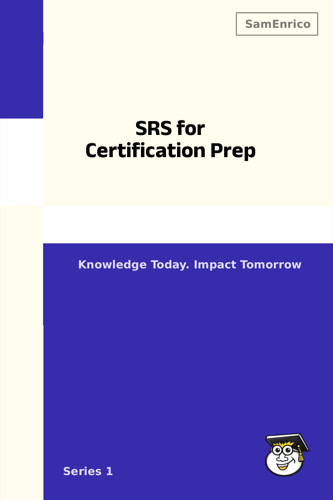
SRS for Certification Prep eBook
IT certs and project management exams.
by Chun Sang
IT certs and project management exams.
Formats
Free sample
Chapter 1: The Baseline Betrayal--–- Imagine studying for months, memorizing every process group, every ITIL term, every Agile manifesto value. You walk into the certification exam feeling prepared. Then you see it: a question about a document you barely considered—the Software Requirements Specification, or SRS. The question describes a project spinning out of control. The sponsor is angry.
The team is confused. And buried in the text is a single sentence: “The requirements baseline was never formally approved.” You stare at the answer choices, realizing that everything you studied about scope management collapses without this one foundational artifact.This scenario plays out every day in certification testing centers around the world. Candidates who master earned value management, risk registers, and communication models still fail questions about the SRS—not because the SRS is technically difficult, but because they misunderstand its role as a governance weapon, not just a technical document. Chapter 1 exists to close that gap permanently.The Software Requirements Specification is not a mere checklist or a handoff from business analysts to developers. In the world of certification exams—PMP, CAPM, ITIL, COBIT, and even Agile-adjacent tests like PMI-ACP—the SRS functions as a baseline and a controlled document.
These two words determine whether a project manager passes or fails situational questions. A baseline means the document is frozen, approved, and changeable only through formal process. A controlled document means every version, every edit, every access leaves an audit trail. Miss this distinction, and you will answer the exam question incorrectly—even if you know the textbook definition.This chapter opens with a deceptively simple question that appears on multiple certification exams in various forms: “Who owns the SRS after it is approved?” The answer is no single person. The SRS becomes a shared baseline owned by the Change Control Board.
That answer separates those who treat the SRS as a living document (wrong for governance exams) from those who treat it as a frozen contract (correct).By the end of this chapter, you will understand why the SRS sits at the intersection of product management and project management. You will distinguish between product requirements and project requirements—a distinction tested relentlessly on PMP and Business Analysis exams. You will see how ITIL and COBIT treat the SRS as an audit artifact. And you will learn why an unauthorized change to the SRS can kill a project faster than any technical failure. This is not theory.
These are the exact concepts that separate passing from failing.The Two Faces of the SRS: Baseline and Controlled Document Certification exams love duality. The SRS presents a perfect duality: it is simultaneously a baseline (in PMI language) and a controlled document (in ITIL/COBIT language). Candidates who understand both sides of this duality answer questions correctly. Those who only know one side fall into traps.The SRS as a Baseline in PMIThe Project Management Institute (PMI) defines a baseline as a frozen reference point against which performance is measured. The PMBOK Guide identifies three primary baselines: scope baseline, schedule baseline, and cost baseline.
The scope baseline is composed of three components: the Project Scope Statement, the Work Breakdown Structure (WBS), and the WBS dictionary. But where does the SRS fit?Here is the critical insight that exam questions test: the SRS is not explicitly listed as a scope baseline component in the PMBOK. However, the SRS is the primary input to creating the scope baseline. In practical terms, the SRS contains the detailed product requirements that the WBS decomposes into deliverables. Exam questions will present a scenario where a project manager updates the SRS without formal approval.
The correct answer is almost always that the scope baseline has been violated—even if the WBS itself remained unchanged.Consider this actual exam-style question that appears in PMP prep materials:You are managing a software development project. The business analyst sends you an email with a revised SRS attachment, noting that she clarified three requirements based on a stakeholder conversation yesterday. What should you do FIRST?The trap answers include: “Review the changes and update the WBS,” “Thank the business analyst for being proactive,” and “Document the changes in the lessons learned register.” The correct answer is: “Determine whether the SRS has been baselined and whether formal change control is required.” If the SRS was already approved (baselined), the business analyst has just violated scope management. If the SRS was still in draft, no harm done. The exam tests your ability to ask about baseline status before taking action.A baseline SRS means: no changes without a change request, impact analysis, and Change Control Board (CCB) approval.
Every certification exam reinforces this principle because scope creep is the number one cause of project failure cited in the Standish Group Chaos Report. The SRS baseline is your first line of defense against scope creep. When the SRS is baselined, it becomes a contract between the project team and the stakeholders. Anyone who changes it without authorization is breaking that contract.The SRS as a Controlled Document in ITIL and COBITWhile PMI focuses on baselines, ITIL and COBIT focus on control. A controlled document is any document subject to version control, access logging, and formal change management.
In ITIL Service Design, the SRS feeds into the Service Design Package (SDP). In COBIT, the SRS is evidence for the “Manage Requirements Definition” process (APO03).The exam implication is different here. ITIL and COBIT questions rarely ask about the content of the SRS. Instead, they ask about its integrity. For example:An auditor requests to see the change history of the SRS for a critical service that failed its last review.
The project manager produces the current version but cannot locate previous versions or show who approved changes. According to COBIT, this represents a failure in which process?The answer is not “requirements management” but change management (or specifically, COBIT’s “Manage Change” process). The inability to produce a controlled document’s audit trail is a governance failure, not a technical failure. Candidates who study the SRS only as a requirements document miss this entirely.The SRS as a controlled document means: every version is numbered, every change is logged, every approval is recorded, and every access is traceable. Certification exams test this distinction by presenting scenarios where a project manager has the right SRS content but the wrong version history.
The correct answer always prioritizes control over content when the question mentions audits or compliance.Key exam distinction: PMI asks about baseline changes and scope creep. ITIL/COBIT ask about version control and audit trails. Chapter 1 teaches both because the same SRS serves both masters in real projects—and in integrated exams like the PMP, which now includes substantial ITIL and COBIT content.The Critical Distinction: Product Requirements vs. Project Requirements One of the most frequently missed distinctions on certification exams is the difference between product requirements and project requirements. This distinction appears on PMP, CAPM, CBAP, and even Prince2 exams.
Yet candidates routinely confuse them because both types of requirements appear in project documentation.Product requirements describe what the product or service must do, be, or provide. These belong in the SRS. Examples include: “The system…
This is the end of the free sample. Get the eBook to keep going. Buy now
About this book
Details
- Author
- Chun Sang
- Publisher
- SamEnrico
- Language
- English
- Genre
- Non-Fiction, Self-Help, Certifications
- Released
- 2026-06-10
- Pages (approx.)
- 146
- Available as
- eBook, Audiobook

Read better in the ZLOADR app
Your eBooks on your phone or tablet. Sign in with your SamEnrico account and start reading.
More by Chun Sang
 Stress Diathesis Model of MDDChun Sang$11.99
 School Morning Prep StationChun Sang$11.99
 Opioid Withdrawal Clinical GuideChun Sang$11.99
 Psychodynamic TherapyChun Sang$11.99
 Anger Self Talk RewiringChun Sang$11.99
 Wine In Moderation GuideChun Sang$11.99
 Reptile Pet Loss GuideChun Sang$11.99
 Whispers in the Marid’s Veil: A Djinn’s Deadly GameChun Sang$11.99
 Themistocles: The Athenian Gambit That Saved GreeceChun Sang$11.99
 How to Produce TimberChun Sang$11.99
 How to Produce Hunting EquipmentChun Sang$11.99
 Factoring for Telecom DistributorsChun Sang$12.99