
Non-FictionSelf-HelpReading System
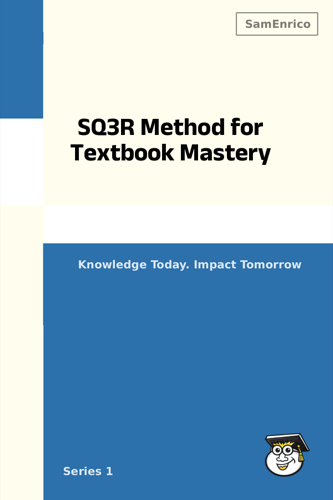
SQ3R Method for Textbook Mastery eBook
Teaches survey, question, read, recite, review sys
Teaches survey, question, read, recite, review system for comprehension.
Formats
Free sample
Chapter 1: The Blueprint Heist--–- The fluorescent lights of the university library hummed their usual death rattle at 11:47 PM. Across a scarred wooden table, a sophomore named Marcus stared at page 147 of his biology textbook. He had been staring at that same page for forty-three minutes. His highlighter was running out of ink. His coffee was cold.
And when he finally turned to page 148, he realized with a sickening jolt that he could not remember a single thing he had just read.Marcus was not lazy. He was not unintelligent. He had a 3.4 GPA, showed up to every lecture, and took notes that his classmates occasionally borrowed. But that night, sitting among the ruins of his good intentions, he did something that thousands of students do every day without realizing its significance. He reread the first paragraph of page 147.
Then he reread it again. Then he highlighted three more sentences. Then he turned to page 148 and repeated the ritual.This is not a story about failure. It is a story about a broken system. And Marcus, though he did not know it yet, was about to learn the single most important truth about textbook reading: you cannot read a textbook the way you read a novel, and if you try, the textbook will win every time.The Silent Epidemic of Passive Reading Let us name the enemy.
It is not your textbook. It is not your professor. It is not your limited time or your overflowing syllabus. The enemy is what cognitive scientists call passive reading—the act of moving your eyes across words while your brain remains disengaged. Passive reading is the default setting of the human mind when confronted with dense, unfamiliar, or boring text.
It feels like reading. Your eyes track left to right. You turn pages. You might even whisper the words under your breath. But when you reach the bottom of the page and realize you have absorbed nothing, you have just experienced passive reading in its purest form.Here is what passive reading looks like in the wild.
A student opens a textbook to Chapter 4. She reads the first sentence. Then the second. By the third sentence, her mind has drifted to the argument she had with her roommate. By the fifth sentence, she is planning what to eat for dinner.
By the end of the paragraph, she has no idea what the paragraph said. So she rereads it. This time, she highlights two sentences. The highlighting feels productive—her brain releases a small hit of dopamine, mistaking the physical act of marking text for the cognitive act of learning it. She turns the page and repeats the process.
Two hours later, she closes the book, exhausted, and tells herself she studied. But when she takes a practice quiz the next morning, she remembers almost nothing.This is not a character flaw. This is not a failure of willpower. This is the predictable outcome of using the wrong tool for the job. You would not use a hammer to screw in a lightbulb.
You would not use a kitchen knife to shovel snow. Yet every day, millions of students use passive reading—a tool designed for entertainment and narrative absorption—to try to learn complex, hierarchical, unfamiliar information. And then they blame themselves when it does not work.The research is devastatingly clear. In a landmark study published in 2006, cognitive scientists Henry Roediger and Jeffrey Karpicke demonstrated that rereading is one of the least effective study strategies available. Students who reread a passage four times performed worse on recall tests than students who read the passage once and then tested themselves.
Even more troubling, students who reread consistently overestimated their mastery. They felt more confident—and were more wrong. This is the fluency illusion: the mistaken belief that because something feels familiar, you have learned it.Fluency illusion is the reason you can watch a movie twice and still miss key plot points. It is the reason you can read a chapter three times and still fail the quiz. Familiarity is not mastery.
Recognition is not recall. And highlighting, despite its near-universal adoption, does almost nothing to bridge this gap. A comprehensive meta-analysis by Dunlosky and colleagues (2013) ranked highlighting as one of the least effective learning techniques, with a utility rating of "low." The problem is not that highlighting is bad. The problem is that highlighting replaces thinking. When you highlight, you outsource the decision about what is important to a colored piece of plastic.
You stop asking "What does this mean?" and start asking "Should this be yellow?"The Cognitive Scaffold You Were Never Taught If passive reading is the disease, the SQ3R method is the cure. Developed in 1946 by educational psychologist Francis P. Robinson at Ohio State University, SQ3R is a five-step system designed to force active engagement with text at every stage of the reading process. The acronym stands for Survey, Question, Read, Recite, Review. Each step is deliberately structured to counteract a specific failure mode of passive reading.But here is what most study guides get wrong about SQ3R.
They present it as a linear checklist, a sequence of boxes to check off. Survey. Okay, done. Question. Okay, done.
Read. Okay, done. This is like treating a recipe as a grocery list. The power of SQ3R is not in the individual steps but in their integration. Surveying without questioning leaves you with a map but no destination.
Reading without reciting is just passive reading with better lighting. And reviewing without spacing is cramming by another name.The SQ3R method is not a sequence. It is a cognitive scaffold—a temporary framework that supports your brain while it builds the permanent structure of knowledge. You use the scaffold to lift yourself out of passivity and into active construction. And just as a construction scaffold is removed once the building stands on its own, the SQ3R steps become automatic and internalized over time.
The goal is not to follow the steps forever. The goal is to follow them until you no longer need to.Before we dive into the first step—Survey—you need to understand what makes this system different from every other study advice you have heard. Most study tips are what psychologists call surface strategies. "Find a quiet place to study." "Use flashcards." "Get enough sleep." These are not wrong, but they are not transformative. They tinker around the edges of a broken process.
SQ3R is a deep strategy. It changes not just what you do but how your brain engages with text. It exploits the fundamental mechanisms of memory: attention, encoding, retrieval, and consolidation. It does not ask you to work harder. It asks you to work smarter by aligning your behavior with how your brain actually learns.The Survey: Your First Three Minutes of Power Let us begin at the beginning.
The first step of SQ3R is Survey, and if you do nothing else from this entire book, do this. It will take you three to five minutes per chapter. It will double your comprehension. And almost no one does it.The Survey is exactly what it sounds like: a preview…
This is the end of the free sample. Get the eBook to keep going. Buy now
About this book
Details
- Author
- Longoria Galen
- Publisher
- SamEnrico
- Language
- English
- Genre
- Non-Fiction, Self-Help, Reading System
- Released
- 2026-06-07
- Pages (approx.)
- 156
- Available as
- eBook, Audiobook

Read better in the ZLOADR app
Your eBooks on your phone or tablet. Sign in with your SamEnrico account and start reading.
More by Longoria Galen
 Lewis SNCC LeadershipLongoria Galen$11.99
 Sheppard Jailhouse ConfessionLongoria Galen$11.99
 The Language Learner Memory GuideLongoria Galen$11.99
 Infertility ConversationLongoria Galen$11.99
 Pet Loss and GuiltLongoria Galen$11.99
 Five Year Vision PlanningLongoria Galen$11.99
 Morning Reading HabitsLongoria Galen$11.99
 The Kikuyu Kings: Kenya's Bloodline of Crime and PowerLongoria Galen$11.99
 The Golden City of the Sun: The Rise of the Kingdom of MapungubweLongoria Galen$11.99
 Staff Security TrainingLongoria Galen$12.99
 Create a Digital Product WaitlistLongoria Galen$12.99
 How to Start a Coast Guards Administration and Operation Business (Beginners Guide)Longoria Galen$11.99
You may also like
 Hong Kong Handover 1997Dunn Johnnie$11.99
 Zumba For Postnatal Recovery CourseNeal Christian$11.99
 Zumba for BeginnersLadner Nikia$11.99
 YouTube Comment Mining GuideHumes Pandora$12.99
 Worry Box MeditationCarlin Rudy$11.99
 Workplace Stress MeditationNguyen Lynn$11.99
 Workplace Stress and Sleep RepairHawley Ivory$11.99
 Workplace Perfectionism CureDelaney Jeffry$11.99
 Workplace Injustice Anger GuideWallen Isabelle$11.99
 Work Addiction and Burnout LinkGreenwood Ester$11.99
 Women in Yoga and WellnessBeattie Galina$11.99
 Women in Stand Up ComedyChun Evangeline$11.99