
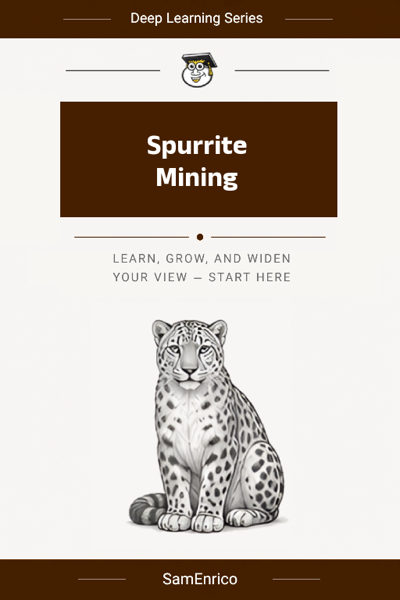
Spurrite Mining eBook
A Coursebook on Spurrite Mining
A Coursebook on Spurrite Mining
Formats
Free sample
Chapter 1: The Mountain’s Secret…–- The first time I held a piece of spurrite, I thought it was a mistake of nature. The rock sat in my palm, unremarkable at first glance—a grayish-blue mass veined with white, like limestone that had been struck by lightning. But then the sunlight caught its cleavage planes, and the whole thing sparkled with an internal fire, a thousand tiny mirrors reflecting a history written in heat and pressure and the slow, violent chemistry of the Earth. That specimen came from a quarry in Riverside County, California, a place called Crestmore, where miners had spent nearly a century chasing marble for countertops and stumbled upon something far stranger: a mineral so rare that most geology textbooks barely mention it, yet so useful that it could decarbonize the cement industry—if anyone could figure out how to mine it economically. This book is about that mineral, those deposits, and the stubborn men and women who have learned, through trial and catastrophic error, to extract value from one of the most temperamental rocks on the planet.Spurrite is not a household name, nor will it ever be.
It lacks the glamour of gold, the industrial heft of iron, the geopolitical drama of lithium. But spurrite occupies a peculiar and fascinating niche in the world of industrial minerals. Chemically, it is calcium silicate carbonate—Ca₅(Si O₄)₂CO₃, to be precise—a compound that violates the usual rules of mineralogy because it contains both a silicate anion and a carbonate anion in the same crystalline structure. Most minerals choose one or the other. Silicates build the Earth’s mantle and crust.
Carbonates give us limestone, chalk, and the dramatic cliffs of Dover. Spurrite refuses to choose. It is a hybrid, a mongrel, a rock that exists only in a vanishingly narrow window of temperature and pressure where carbon dioxide gas is trapped inside a silicate lattice instead of escaping to the atmosphere.That window—500 to 700 degrees Celsius, less than three kilobars of pressure—occurs almost exclusively in contact metamorphic aureoles, the baked rims of limestone that have been intruded by hot magma. Think of it as the geological equivalent of a perfect sear on a steak: heat high enough to transform, low enough not to destroy. When a basaltic or dioritic magma pushes upward through the crust and encounters a thick sequence of limestone, the carbonate minerals begin to break down, releasing CO₂.
In most cases, that gas escapes, leaving behind lime (Ca O) and silicate minerals like wollastonite. But if the intrusion is deep enough to contain the pressure, and if the limestone is impure enough to supply silica from clay layers, the CO₂ gets trapped inside a growing silicate crystal. The result is spurrite: a timestamp of a specific geological moment when heat and pressure and chemistry balanced perfectly for a few thousand years before temperatures dropped and the system froze.That is why spurrite is rare. Not because its constituent elements are uncommon—calcium, silicon, oxygen, and carbon are among the most abundant elements in the crust—but because the conditions required for its formation are so narrowly constrained. The Earth has produced spurrite only in scattered localities: the contact aureoles of Scawt Hill in Northern Ireland (where it was first described in 1908 by the mineralogist Arthur Russell), the Crestmore quarry in California, a handful of skarns in Mexico, Italy, Greece, Japan, and the Russian Urals.
You could fit all the known spurrite deposits in the world inside a single football stadium, and you would still have room for the bleachers.And yet, for all its rarity, spurrite has a secret superpower: it is almost perfectly suited for making cement. Portland cement, the binder that holds modern civilization together, is produced by heating limestone and clay to 1450°C, driving off carbon dioxide and forming calcium silicates. That process is responsible for roughly eight percent of global CO₂ emissions—more than the entire aviation industry. The chemistry is inescapable: for every ton of cement clinker produced, approximately 0.9 tons of CO₂ are released, half from the fuel burned to heat the kiln and half from the limestone itself as it decomposes. Spurrite offers a way around that second half.
Because it already contains both calcium and silicon in a 2.5-to-1 ratio—almost exactly what cement clinker needs—and because its carbonate component is already locked into a silicate structure, it requires less energy to break down. Instead of 1450°C, spurrite calcines at around 900°C. Instead of releasing 0.9 tons of CO₂ per ton of product, it releases roughly 0.25 tons. The theoretical savings are enormous. The practical challenges are even larger.This book is about those challenges.
Mining spurrite is not like mining coal or copper or even other industrial minerals like limestone or gypsum. Spurrite deposits are small, discontinuous, and notoriously heterogeneous. A drill core that returns 90 percent spurrite over three meters might be flanked by pure marble that assays at zero percent. The ore bodies are lenses, pods, and irregular masses that pinch and swell without warning. They are often embedded in active quarries where the primary target is dimension stone, and the mine plan prioritizes block sizes and fracture spacing over chemical grade.
Spurrite miners have to be nimble, opportunistic, and relentlessly analytical. They use hand lenses and X-ray diffraction the way a poker player uses tells and probabilities. They map skarn assemblages with the care of a crime scene investigator. They drill, sample, assay, and then drill again because the rock has a cruel habit of changing its mind.The title of this chapter is “The Mountain’s Secret” because that is what spurrite feels like: a secret hidden inside ordinary limestone, visible only to those who know how to look. In the pages that follow, I will teach you how to look.
You will learn the mineralogical fingerprints of spurrite—its twinning, its birefringence, its effervescence in dilute acid. You will learn the geological settings where it forms, from the alkaline intrusions of the Monteregian Hills to the ophiolite belts of the Mediterranean. You will learn how to explore for it using satellite imagery, gravity surveys, and geochemical pathfinders. You will learn how to estimate resources, design selective mining methods, and build beneficiation flowsheets that separate spurrite from calcite, quartz, garnet, and idocrase. And you will learn when to walk away—because sometimes the secret is not worth the cost of digging it up.But before we descend into the technical details, let me tell you a story.
It is a story about a quarry, a mineralogist, and a mistake that launched a hundred years of confusion. It is also a story about why spurrite mining is not just a technical problem but a human one, full of egos, hunches, and the occasional act of sheer luck.The Crestmore Puzzle In 1910, two years after Arthur Russell described spurrite from Scawt Hill, a mining engineer named Frank R. Van Horn was examining a peculiar blue-gray rock that had been uncovered during routine quarrying at the Crestmore lime plant in Riverside County, California. The rock was hard, dense, and unlike the usual marble that the quarry produced for cement and agricultural lime. Van Horn…
This is the end of the free sample. Get the eBook to keep going. Buy now
About this book
Details
- Author
- Schmidt Yvonne
- Publisher
- SamEnrico
- Language
- English
- Genre
- Non-Fiction, Informative, Educational
- Released
- 2026-05-11
- Pages (approx.)
- 157
- Available as
- eBook, Audiobook

Read better in the ZLOADR app
Your eBooks on your phone or tablet. Sign in with your SamEnrico account and start reading.
More by Schmidt Yvonne
 Alcoholism Harm Reduction GuideSchmidt Yvonne$11.99
 The Caretaker AdultSchmidt Yvonne$11.99
 Dream Alchemy MethodSchmidt Yvonne$11.99
 Anger Master WorkbookSchmidt Yvonne$11.99
 Galileo's Celestial Symphony: The Music of the SpheresSchmidt Yvonne$11.99
 Internet Reliability and InfrastructureSchmidt Yvonne$12.99
 How to Produce Contact CleanerSchmidt Yvonne$11.99
 Ultimate Handbook Guide to Zaria : (Nigeria) Travel GuideSchmidt Yvonne$11.99