
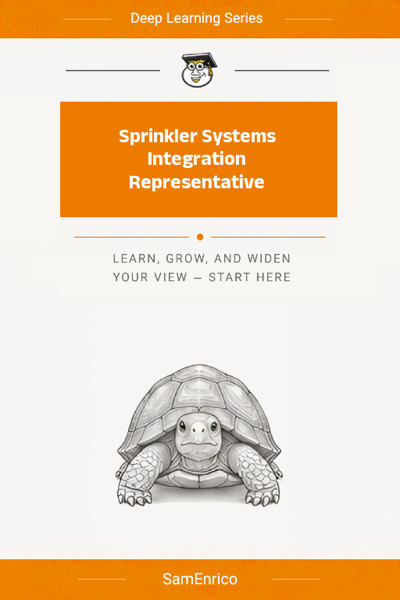
Sprinkler Systems Integration Representative eBook
A Coursebook on Sprinkler Systems Integration Repr
A Coursebook on Sprinkler Systems Integration Representative
Formats
Free sample
Chapter 1: Three Languages, One Professional--The sprinkler pipe ran straight and true—perfectly threaded, perfectly hung, perfectly useless. The general contractor had signed off on the installation. The local authority having jurisdiction had stamped the drawings. Every weld had been inspected, every hanger torque-checked, every sprinkler head verified for correct temperature rating and K-factor. And yet, when the fire alarm control panel was powered up for the first time, nothing happened.
Not because the sprinkler system was broken—it would still flood the room if a fire melted a bulb. But because no one had bothered to connect the flow switch to the fire alarm panel. The mechanical system was complete. The electronic system was silent. The digital model showed a beautifully rendered pipe network that had no relationship to the physical sensors on the wall.The Integration Representative was called in three weeks after that failed startup, during a tense meeting where the electrical subcontractor blamed the fire alarm contractor, who blamed the sprinkler fitter, who blamed the design engineer, who blamed the general contractor for not specifying who was responsible for the wires between the flow switch and the panel.
The room was full of highly skilled professionals, each excellent in their own domain. Not one of them owned the space between the pipe and the panel.This book is written for the person who will own that space.The Integration Gap: Where Systems Die Every construction project generates what industry veterans call the "integration gap"—the gray area between mechanical completion and digital functionality. It is the space where pipes end and wires begin, where mechanical drawings meet electrical schematics, where physical reality collides with Building Information Modeling. In traditional project delivery, the integration gap is often not assigned to any trade. The sprinkler contractor believes their job ends at the last threaded connection.
The electrical contractor believes their job starts at the fire alarm panel. The flow switch—that humble device clamped to a pipe with two wires hanging out—belongs to no one and everyone.This organizational blind spot is not merely an inconvenience. It is a life-safety risk of the first order. Consider the sequence: A fire starts, heating the air beneath a sprinkler head. The glass bulb bursts at its rated temperature (say, 155°F).
Water flows through the open head at a rate determined by the K-factor (say, 5.6 gallons per minute per square root of pressure). That water movement deflects a paddle inside a flow switch. The flow switch's internal contacts close, completing a circuit. That circuit must reach a fire alarm control panel, which must interpret the closure as an alarm, which must activate notification appliances (horns, strobes) and transmit a signal to a monitoring station. The entire chain, from melting bulb to ringing bell, depends on every link being present, properly installed, correctly configured, and electrically continuous.Break any link, and the system becomes what engineers call a "silent sentinel"—present, visibly imposing, but functionally mute.
Occupants see sprinkler heads in the ceiling and believe they are protected. They are not. Not fully. Not without the integration that turns water flow into an alarm.Defining the Sprinkler Systems Integration Representative The Integration Representative is a new professional category that has emerged in response to this gap. The title appears in job postings, project specifications, and service contracts with increasing frequency, but its definition remains fluid.
Some organizations treat the Integration Representative as a specialized electrician who understands sprinkler systems. Others view the role as a sprinkler technician who has learned to wire sensors. Still others expect a software engineer who can configure BACnet objects and Modbus registers.This book takes the position that the Integration Representative is none of these exclusively—and all of them simultaneously. The Integration Representative is the professional who stands at the intersection of three historically separate domains: mechanical engineering (the physics of water flowing through pipes), electrical supervision (the signals generated by flow switches, pressure transducers, and tamper switches), and digital coordination (the software that monitors, logs, and displays those signals). The Integration Representative does not need to be a master of any one domain.
They need to be competent in all three and fluent in the translations between them.The Mechanical Foundation The Integration Representative must understand how water behaves in pipes. Not at the depth of a licensed professional engineer performing hydraulic calculations, but sufficiently to answer questions like: Why does this pressure sensor read 43 psi when the pump curve says it should be 50 psi? Could it be a sensor calibration error, or is there 15 feet of elevation gain between the pump and the sensor? Why does this flow switch trip intermittently at 2 AM? Is it a real flow event, or is turbulence from a nearby valve causing paddle chatter?
Why does this pressure sensor show a spike every time the city main experiences a pressure surge, but the other three sensors in the building do not?These are not purely mechanical questions. They are integration questions that require mechanical knowledge. The Integration Representative does not need to derive the Hazen-Williams equation from first principles, but they must know that friction loss increases with the 1.85 power of flow velocity—meaning a small increase in flow creates a much larger increase in pressure drop. They must know that water pressure changes by 0.433 psi per foot of elevation change. They must know that a pressure sensor installed downstream of a partially closed valve will read lower pressure not because the system is failing but because the valve is creating an artificial restriction.
These mechanical fundamentals are the substrate upon which all integration work rests.The Electrical Bridge The mechanical foundation alone is insufficient. The Integration Representative must also understand how sensors convert physical phenomena into electrical signals, and how those electrical signals travel from the sensor to the controller or panel. This is not electrical engineering at the level of designing printed circuit boards or sizing service entrance conductors. It is the practical knowledge of installing, wiring, and troubleshooting low-voltage circuits in a fire alarm or building automation context.The Integration Representative must know the difference between a 4-20 m A current loop (where the sensor varies the current between 4 and 20 milliamps to represent a measured value) and a dry contact closure (where the sensor simply opens or closes an electrical path). They must know why a 4-20 m A sensor requires a power supply (typically 24 volts DC) while a dry contact requires only a supervision voltage from the panel.
They must know what an end-of-line resistor does (allows the panel to distinguish between an open circuit, a short circuit, and a normal state) and how to select the correct resistance value for a given circuit.They must also understand the practical realities of field wiring. Voltage drop over long cable runs can cause a 4-20 m A signal to degrade, especially if the wire gauge is too small. Shielded cable may be required in electrically noisy environments (near variable frequency drives or radio transmitters). Polarity matters on some sensor types but not others. Ground loops—unintended current paths between different grounded components—can introduce noise or cause complete failure.
The Integration Representative does not need to calculate voltage drop over 5,000 feet of 24 AWG wire using the NEC…
This is the end of the free sample. Get the eBook to keep going. Buy now
About this book
Details
- Author
- Cantu Kandace
- Publisher
- SamEnrico
- Language
- English
- Genre
- Non-Fiction, Informative, Educational
- Released
- 2026-05-08
- Pages (approx.)
- 156
- Available as
- eBook, Audiobook

Read better in the ZLOADR app
Your eBooks on your phone or tablet. Sign in with your SamEnrico account and start reading.
More by Cantu Kandace
 Nutrition for Alcoholism Recovery CookbookCantu Kandace$11.99
 Work Addiction Mindfulness PlanCantu Kandace$11.99
 Dad Burnout Self Care PlanCantu Kandace$11.99
 Call Protection Terms GuideCantu Kandace$11.99
 How to Become a Maintenance MechanicCantu Kandace$11.99
 Cross Border Payment Denied GuideCantu Kandace$12.99
 How to Produce an AlarmCantu Kandace$11.99