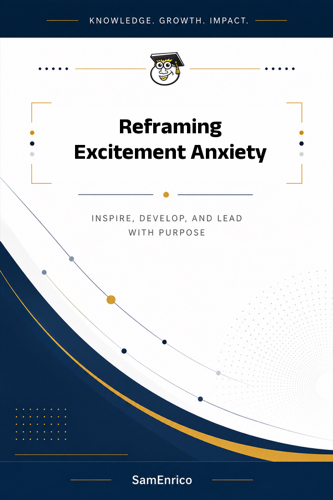
Spotlight Visual Reframe eBook
See harsh stage lights as warm sun not exposing in
by Blunt Shizue
See harsh stage lights as warm sun not exposing interrogation beams.
Formats
Free sample
Chapter 1: The Scrutiny Squint--–- You have felt it before. The moment the lights come up—whether in a boardroom, on a stage, or even on a video call where someone suddenly turns on their ring light—your face tightens. Your eyes narrow. Your shoulders rise toward your ears. And without a single word spoken, your brain has already decided: I am being interrogated.This is not a metaphor.
It is a physiological event.For years, you may have called this “stage fright” or “performance anxiety” or simply “hating being the center of attention.” But those labels miss the root cause. The root cause is not the audience. It is not your lack of preparation. It is not even your fear of judgment—although that fear is real. The root cause is your brain’s ancient, automatic, and utterly predictable response to intense, focused light on your face.Welcome to the Scrutiny Squint.The Evolutionary Ambush Let us go back sixty thousand years.
You are standing on an open savanna. The sun is high. Suddenly, a pair of eyes glints from the tall grass. Your pupils dilate. Your peripheral vision narrows to a tunnel.
Your amygdala—the brain’s smoke alarm—floods your system with cortisol and adrenaline. You do not stop to think. You react. You squint, you brace, you prepare to fight or flee.That hardware is still inside your skull. And it cannot tell the difference between a predator in the grass and a follow-spot in a theater.Here is the cruel irony: the lighting designer who turns up the intensity is trying to help you.
They want you to be seen, to be clear, to be larger than life. But your ancient brain reads that generosity as a threat. The brighter the light, the louder the alarm. The more focused the beam, the narrower your vision becomes. That narrowing—that physical squint—is not just a facial expression.
It is a neurological event called attentional tunneling, and it is the single greatest enemy of confident performance.Dr. Amy Cuddy, whose work on presence and posture informs much of this book, describes the phenomenon this way: when we feel threatened, we make ourselves small. The scrutiny squint is the facial equivalent of making yourself small. You are literally trying to reduce the amount of light hitting your retinas because your brain has classified that light as dangerous.But here is what the savanna brain does not know: the light is not a predator. The light is not a weapon.
The light is just light.And you can teach your brain to see it differently.Spotlight Anxiety vs. Sunlight Confidence Before we go any further, we need to name two distinct states. Most people lump all discomfort under bright lights into a single category called “nerves.” But nerves are not all the same. There is a world of difference between spotlight anxiety and visual glare, and confusing the two is why so many public speaking tips fail you.Spotlight Anxiety is the fear of being judged, evaluated, or found wanting. It lives in the stories you tell yourself about the audience.
They think I am boring. They can see my hands shaking. They are waiting for me to fail. This anxiety is social. It is about eyes, not lumens.
And it responds beautifully to techniques that reframe the audience’s intentions—which we will cover in depth in Chapter 3.Visual Glare is the physical discomfort of bright light on your face. It is the squint, the tearing up, the sensation of being blinded. This has nothing to do with judgment and everything to do with raw sensory input. Visual glare triggers the same primal response as staring into the sun. And it responds best to physiological techniques—peripheral softening, amber filtering, breath control—which we will cover in Chapter 4.Here is the crucial insight that most books miss: you can have one without the other, or both at the same time.
Some people feel perfectly safe with their audience but cannot physically tolerate bright lights. Others love bright lights but crumble under judgmental stares. And many poor souls get hit with both barrels at once.The Scrutiny Squint is the name we give to the combination of these two responses when they happen simultaneously. Your eyes narrow from the glare. Your mind races from the social threat.
And you cannot tell which is which, so you assume you are simply “bad at public speaking.”You are not bad at public speaking. You are having an ancient, automatic, two-pronged response to a modern situation. And once you understand the two prongs, you can address each one separately.The Neuroscience of the Squint Let us get specific about what happens inside your skull the moment bright lights hit your face.First, light enters your retina. The optic nerve sends a signal not only to the visual cortex (where you “see”) but also directly to the amygdala. That is right: there is a high-speed pathway from your eyeballs to your fear center that bypasses conscious thought entirely.
You do not decide to be afraid of bright light. By the time you know what is happening, the amygdala has already sounded the alarm.Second, the amygdala activates the sympathetic nervous system—your fight-or-flight response. Your heart rate increases. Your breathing becomes shallow. Your pupils constrict (which, paradoxically, makes bright lights feel even harsher).
And crucially for our purposes, your peripheral vision narrows. This is the “tunnel vision” that soldiers describe in combat and that speakers describe on stage. The narrowing is the brain’s way of focusing all available resources on the perceived threat. But on a stage, that narrowing means you lose sight of the friendly faces in the audience, the exits, the visual cues that would tell you that you are safe. You become trapped in a tunnel of light with no context.Third, cortisol suppresses the prefrontal cortex—the part of your brain responsible for executive function, creativity, and impulse control.
This is why you forget your words. This is why you cannot find that clever metaphor you rehearsed. This is why you say “um” eighteen times in a row. Your smart, capable brain has been temporarily hijacked by a light bulb.And here is the kicker: the entire sequence takes less than half a second.By the time you take your first breath on stage, your brain has already decided that you are in danger, that the audience is a threat, and that you should either run or freeze. You are not nervous because you are unprepared.
You are neurologically compromised.But neuroplasticity—the brain’s ability to rewire itself—is on your side.The Soft Gaze: Your First Tool Before we teach you to reframe the light (that begins in Chapter 2), we need to establish one foundational physical practice. I call it the Soft Gaze.The Soft Gaze is the opposite of the Scrutiny Squint. Where the squint is tight, narrow, and focused on the center of the light, the Soft Gaze is relaxed, wide, and inclusive of the entire visual field. It keeps your eyes open—because closing your eyes, while temporarily relieving, actually reinforces the brain’s belief that the light is…
This is the end of the free sample. Get the eBook to keep going. Buy now
About this book
Details
- Author
- Blunt Shizue
- Publisher
- SamEnrico
- Language
- English
- Genre
- Non-Fiction, Mental Wealth, Reframing
- Released
- 2026-06-08
- Pages (approx.)
- 128
- Available as
- eBook, Audiobook

Read better in the ZLOADR app
Your eBooks on your phone or tablet. Sign in with your SamEnrico account and start reading.
More by Blunt Shizue
 Remote Lunch and Learn GuideBlunt Shizue$11.99
 Venture Debt Database 2024Blunt Shizue$11.99
 No Phone At Dinner TableBlunt Shizue$11.99
 Silk and Spice: How the Dutch East India Company Styled the WorldBlunt Shizue$11.99
 Pentagonite MiningBlunt Shizue$11.99
 How to Start a Logging Business (Beginners Guide)Blunt Shizue$11.99
 How to Produce Cement, Mortar and Concrete MixesBlunt Shizue$11.99
 Claims Process After Climate DisasterBlunt Shizue$12.99