
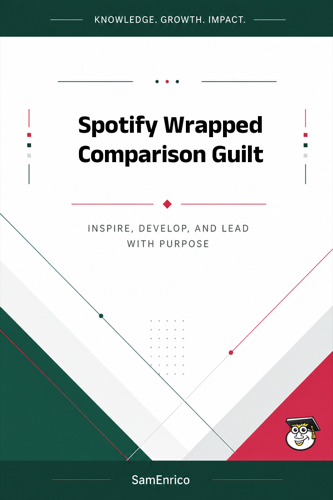
Non-FictionSelf-HelpMusic Psychology
Spotify Wrapped Comparison Guilt eBook
Analyzes how year-end listening stats create music
Analyzes how year-end listening stats create musical taste anxiety.
Formats
Free sample
Chapter 1: The December Reckoning...--It happens every year, like clockwork, and yet somehow it always feels like a surprise.You wake up on the first Wednesday of December—because Spotify has learned that midweek engagement peaks on Wednesdays, and every detail of this ritual has been optimized—and there it is, waiting for you. A notification. Bright. Playful. Impossible to ignore.Your 2024 Wrapped is here.Your thumb hovers.
Your heart does something strange—a flutter, a skip, a small spike of something that is not quite excitement and not quite dread but some unholy hybrid of the two. You tap the notification before you can talk yourself out of it. The screen explodes in color. A gradient of neon purple and electric green. A font that looks like it belongs on a festival lineup poster.
A voice—is that a celebrity voiceover this year?—welcomes you to your year in music.And for the first thirty seconds, it is pure dopamine. The animation is gorgeous. The transitions are seamless. The little facts about your listening habits feel like horoscopes—vague enough to apply to anyone but specific enough to feel personal. You listened to 47,000 minutes of music this year.
Wow. Your top genre was indie sleaze revival. Interesting. Your listening peak was 3 AM on a Tuesday in March. Oh.Then comes the moment.The moment you forgot about.
The moment you were not prepared for. The moment that turns a delightful little year-end recap into a psychological event.Your top five songs. Your top five artists. Your "top fan" percentage.And suddenly, the question that will haunt you for the rest of the week:Is this good enough?--The Scroll of Shame You close the Wrapped app—you have not even finished the slideshow, you just closed it, you will come back later—and you open Instagram. Or Tik Tok.
Or Twitter. Or whatever hellsite currently owns your attention. You tell yourself you are just checking messages. You tell yourself you are not looking for anything in particular.But you are. You know you are.
You are looking for everyone else's Wrapped.And there they are. A wall of neon. A cascade of share cards. Your friend from college—the one who always seemed a little cooler than you—has posted hers. Top 0.05% fan of some experimental electronic artist you have never heard of.
Your coworker—the one who always has an opinion about everything—has posted his. 124,000 minutes listened. That is nearly three months of continuous music. That is more than you slept this year. Your ex—you should not look, but you look—has posted theirs.
Top artist: the band you introduced them to three years ago.Your stomach clenches.You look back at your own Wrapped. The numbers that felt warm and personal thirty seconds ago now feel small. Embarrassing. Your top artist is someone mainstream. Your top songs are from that one month you were really sad and listened to the same album on repeat.
Your total minutes—which felt like a lot—are dwarfed by your coworker's.You consider not posting yours. You consider posting it but with a joke attached to soften the blow. Haha guess I'm basic this year. You consider deleting your listening history and starting over next year, as if that would somehow make this feeling go away.You do none of these things. You post it anyway, because not posting feels like hiding, and hiding feels like losing.
You add a self-deprecating caption. You get twelve likes. Your friend who posted the obscure electronic artist gets two hundred.You put your phone down. You are not sure why you feel this way. You are not sure what just happened to you.This book is about what just happened to you.--The Secret History of a Feeling Let us be clear about something from the very beginning: You are not weak for feeling this way.
You are not vain. You are not shallow. You are not addicted to validation in some unique and shameful way that sets you apart from the rest of humanity. You are a normal person who has been placed inside a system that was designed, deliberately and with great intention, to make you feel exactly this.The feeling has a name, though you have probably never heard it spoken aloud. In the research that underpins this book—drawing on interviews with dozens of Spotify users, internal platform documents, and decades of psychological literature on social comparison—we call it Algorithmic Shame.Algorithmic Shame is the specific, queasy sensation that occurs when a machine reduces your messy, contradictory, context-dependent human experience to a set of numbers, and then ranks those numbers against other people's numbers, and then invites you to share those numbers with everyone you know.
It is the feeling of being seen by an algorithm that does not understand you, and then judged by a social network that does not care to try.It is a new feeling. It could not have existed twenty years ago. It requires three specific conditions to emerge:First, quantification. Your life must be turned into data. Every song you play, every skip you make, every time you fall asleep with your headphones on and let the same lullaby playlist run for eight hours—all of it becomes a number.
Spotify does not experience your year as a story. It experiences your year as a spreadsheet.Second, socialization. Those numbers must become public. Or at least public-adjacent. The platform must give you a button that says "Share" and make that button bright and appealing and culturally mandatory.
You do not have to post your Wrapped. But everyone else does. And so you do too.Third, comparison. The numbers must be rankable. You must be able to see that someone else listened to more minutes than you.
That someone else is a bigger fan of a cooler band. That someone else's taste is weirder, deeper, more obscure, more adventurous, more something than yours.When these three conditions converge, Algorithmic Shame is not a bug. It is not an accident. It is the inevitable emotional result of a system that treats your inner life as a competitive sport.The chapters ahead will show you, in granular detail, exactly how that system works. You will learn about the economics of streaming, the psychology of recommendation algorithms, and the history of how music went from a gift to a scorecard.
But before we go anywhere else, we need to sit with the feeling itself. We need to give it a name. We need to understand what it is doing to us.Because you cannot escape a prison until you know you are inside one.--The Author's Confession I have to stop here and tell you something that is not easy to admit.I am the person who wrote this book. I have spent two years researching Spotify Wrapped, interviewing users, reading leaked internal documents, and talking to psychologists about social comparison theory. I know, intellectually, that the numbers do not mean anything.
I know that my listening minutes do not reflect my value as a human being. I know that the algorithm is not actually…
This is the end of the free sample. Get the eBook to keep going. Buy now
About this book
Details
- Author
- Qualls Wilhemina
- Publisher
- SamEnrico
- Language
- English
- Genre
- Non-Fiction, Self-Help, Music Psychology
- Released
- 2026-06-05
- Pages (approx.)
- 145
- Available as
- eBook, Audiobook

Read better in the ZLOADR app
Your eBooks on your phone or tablet. Sign in with your SamEnrico account and start reading.
More by Qualls Wilhemina
 Burnout Prevention For Pilates InstructorsQualls Wilhemina$11.99
 Teamster Boss Hoffa Antitrust Battles GuideQualls Wilhemina$11.99
 Stock Market Crash StressQualls Wilhemina$11.99
 Government OKR GuideQualls Wilhemina$11.99
 The Workplace Belonging WorkbookQualls Wilhemina$11.99
 Remote Pomodoro MethodQualls Wilhemina$11.99
 Runner Injury GuideQualls Wilhemina$11.99
 The Sydney Poisoner: Australia's Deadly Domestic ConspiracyQualls Wilhemina$11.99
 The Battle of Kurukshetra: The Epic War of DharmaQualls Wilhemina$11.99
 Growing BrillantaisiaQualls Wilhemina$11.99
 EU VAT on Accommodation and EventsQualls Wilhemina$12.99
 AI Assisted Capital Expenditure AnalysisQualls Wilhemina$12.99
You may also like
 Hong Kong Handover 1997Dunn Johnnie$11.99
 Zumba For Postnatal Recovery CourseNeal Christian$11.99
 Zumba for BeginnersLadner Nikia$11.99
 YouTube Comment Mining GuideHumes Pandora$12.99
 Worry Box MeditationCarlin Rudy$11.99
 Workplace Stress MeditationNguyen Lynn$11.99
 Workplace Stress and Sleep RepairHawley Ivory$11.99
 Workplace Perfectionism CureDelaney Jeffry$11.99
 Workplace Injustice Anger GuideWallen Isabelle$11.99
 Work Addiction and Burnout LinkGreenwood Ester$11.99
 Women in Yoga and WellnessBeattie Galina$11.99
 Women in Stand Up ComedyChun Evangeline$11.99