
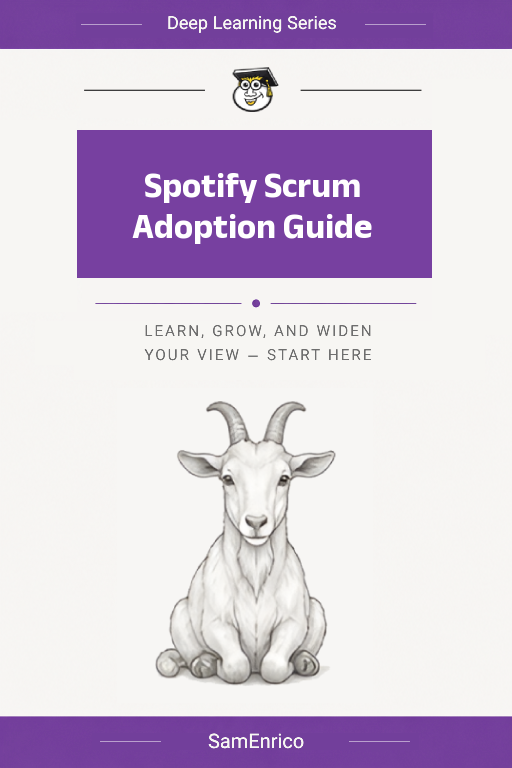
Spotify Scrum Adoption Guide eBook
Learn how Spotify scaled agile using squads tribes
Learn how Spotify scaled agile using squads tribes and guilds without heavyweight SAFe overhead.
Formats
Free sample
Chapter 1: The Spotify Illusion--–- In the autumn of 2012, two blog posts changed the way the software industry thought about scaling Agile. Henrik Kniberg and Anders Ivarsson, both Agile coaches at Spotify, published a set of diagrams and explanations describing how the music streaming company organized its engineering teams. The posts were simple, almost casual. They showed colorful circles representing "Squads," clusters of circles called "Tribes," dotted lines for "Chapters," and cloud-like shapes for "Guilds." Within months, these images had spread across the internet like wildfire. Consultants printed them on posters.
Trainers built two-day workshops around them. Companies spent millions re-organizing their engineering departments to look exactly like the pictures.There was just one problem.What Kniberg and Ivarsson described was never intended to be a framework. It was a snapshot. A photograph. A single moment in the continuous evolution of a single company's engineering culture.
Spotify did not design the "Spotify Model" as a reusable template any more than a bird designs its nest for mass production. The nest works for the bird, in that tree, during that season. Copy it exactly, place it in a different forest, and you will likely find it empty.This chapter is called The Spotify Illusion because the first and most important step in adopting the Spotify model is understanding what it is not. It is not a framework like SAFe, which comes with certifications, role descriptions, and a brand. It is not a methodology like Scrum, with its prescribed ceremonies and accountabilities.
It is not a template you can download and implement over a weekend. The Spotify model, to the extent that such a thing exists, is a set of principles that emerged from a specific culture at a specific time. Those principles are valuable. The specific practices that embodied them in 2012 are not.The Origin Story You Haven't Heard Let us go back to 2011. Spotify was growing faster than its organization could handle.
The company had started with a single team of engineers building a music streaming service. By 2011, that team had multiplied into dozens, and the communication overhead was becoming unbearable. Dependencies between teams were causing delays. Integration problems were multiplying. The simple, beautiful product was becoming harder to change.Spotify did not hire a consulting firm to fix this.
They did not purchase a scaling framework. They did not send their leaders to a certification course. Instead, they experimented. Henrik Kniberg, already an experienced Agile coach, worked with the engineering organization to try different structures. Some worked.
Most did not. The ones that worked were documented, shared internally, and evolved continuously.The 2012 blog posts were not a declaration of "the Spotify way." They were a retrospective. A "here is what seems to be working for us right now, but it will probably change." The posts explicitly said this. But the software industry, hungry for an alternative to the heavyweight Scaled Agile Framework, ignored the caveats and seized the diagrams.The result was a classic case of map-territory confusion. The map (the blog post diagrams) was not the territory (Spotify's actual, messy, evolving organization).
Companies that tried to implement the map found that it did not work in their territory. They blamed the map. They blamed themselves. They blamed Spotify for not providing more documentation. What they should have blamed was the act of copying without understanding.The Principles Beneath the Practices If the specific practices of the 2012 Spotify model are not reusable, what is?
The answer is the principles that generated those practices. A principle is a underlying truth that remains constant across contexts. A practice is a specific implementation of a principle that works in a specific context. Copy practices, and you fail. Copy principles, and you adapt.The Spotify model, properly understood, rests on three core principles.Principle One: Autonomy with Alignment Most organizations face a false choice between autonomy and alignment.
Give teams too much autonomy, the thinking goes, and they will run in different directions. Force too much alignment, and teams lose the ability to adapt quickly. Spotify rejected this trade-off. They believed it was possible to have both: highly autonomous teams that were also highly aligned on mission and strategy.The mechanism for achieving both was not a process. It was a culture.
Autonomous teams were given clear, inspiring missions and then trusted to find their own way. Alignment came from shared context, transparent communication, and a strong sense of purpose—not from centralized control. When alignment failed, the response was more communication, not more process.This principle is universal. Any organization can aspire to autonomy with alignment. But the specific practices Spotify used to achieve it—the Trio, the Squad mission, the Health Check—are context-dependent.
Your organization may need different practices to achieve the same principle.Principle Two: Matrix-Free Scaling Traditional matrix organizations give employees two bosses: a functional manager (e.g., "Director of Frontend Engineering") and a project manager (e.g., "Program Manager for Initiative X"). This creates a predictable set of problems: conflicting priorities, diluted accountability, and endless negotiation between managers. Spotify avoided matrix management entirely by separating concerns differently.People management (hiring, firing, career development, performance reviews) belonged to Chapters. Work assignment (what to build, how to build it, when to deliver) belonged to Squads and the Trio. These two domains were intentionally kept separate.
A Chapter Lead could not assign work to a Squad member. A Product Owner could not fire a developer. The result was clarity: everyone knew who had authority over what.This principle is also universal. Separating people management from work assignment reduces conflict and increases accountability. But the specific Chapter structure Spotify used is just one implementation.
Your organization might use a different structure to achieve the same separation.Principle Three: Continuous Evolution The most important principle underlying the Spotify model is that the model itself was expected to change. Spotify did not have a "Spotify model" that they protected and certified. They had a set of current practices that they continuously improved. When a practice stopped working, they changed it. When a new practice emerged, they adopted it.
The organization evolved as fast as the product.This principle is the hardest for most organizations to adopt. Companies are used to stability. They want a framework they can implement once and then run for years. Spotify refused this stability. They understood that organizational design, like software design, requires continuous refactoring.The Cultural Soil Requirements Principles do not operate in a vacuum.
They require a supporting environment—what this book calls "cultural soil." You can plant the seeds of the Spotify model in poor soil, but they will not grow. Worse, you will blame the seeds when the real problem is the soil.The cultural soil requirements for the Spotify model are specific and demanding.Psychological Safety Psychological safety is the belief that you will not be punished or humiliated for speaking up with ideas, questions, concerns, or mistakes. In psychologically safe teams, people feel safe to take risks. In psychologically unsafe teams, people hide their mistakes, avoid challenging authority, and prioritize self-protection over collective success.The Spotify model requires high psychological safety because it asks people to take risks. Squads deploy to production without approval.…
This is the end of the free sample. Get the eBook to keep going. Buy now
About this book
Details
- Author
- Witte Bridgette
- Publisher
- SamEnrico
- Language
- English
- Genre
- Non-Fiction, Startup Guide
- Released
- 2026-05-29
- Pages (approx.)
- 150
- Available as
- eBook, Audiobook

Read better in the ZLOADR app
Your eBooks on your phone or tablet. Sign in with your SamEnrico account and start reading.
More by Witte Bridgette
 Discussing Living Will And Advance DirectivesWitte Bridgette$11.99
 The Interruption Recovery CourseWitte Bridgette$11.99
 IBS Elimination Diet PlanWitte Bridgette$11.99
 Teen Self Esteem and ADHDWitte Bridgette$11.99
 Postpartum Anxiety Self Monitoring LogWitte Bridgette$11.99
 Anger Exit Strategy CardsWitte Bridgette$11.99
 Resistance Band Workout for Arthritis PainWitte Bridgette$11.99
 Weekend Driver FrustrationWitte Bridgette$11.99
 The Frozen Odyssey: The Lost Expedition of the *Vityaz* in AntarcticaWitte Bridgette$11.99
 The Phantom of the Phish: How a Teen Hacker Fooled the World’s Biggest BanksWitte Bridgette$11.99
 The Blacksmith Who Armed the Samurai: Masamune's Legendary BladesWitte Bridgette$11.99
 Understanding AngiostrongyliasisWitte Bridgette$17.99
You may also like
 Hong Kong Handover 1997Dunn Johnnie$11.99
 Zumba For Postnatal Recovery CourseNeal Christian$11.99
 Zumba for BeginnersLadner Nikia$11.99
 YouTube Comment Mining GuideHumes Pandora$12.99
 Worry Box MeditationCarlin Rudy$11.99
 Workplace Stress MeditationNguyen Lynn$11.99
 Workplace Stress and Sleep RepairHawley Ivory$11.99
 Workplace Perfectionism CureDelaney Jeffry$11.99
 Workplace Injustice Anger GuideWallen Isabelle$11.99
 Work Addiction and Burnout LinkGreenwood Ester$11.99
 Women in Yoga and WellnessBeattie Galina$11.99
 Women in Stand Up ComedyChun Evangeline$11.99