
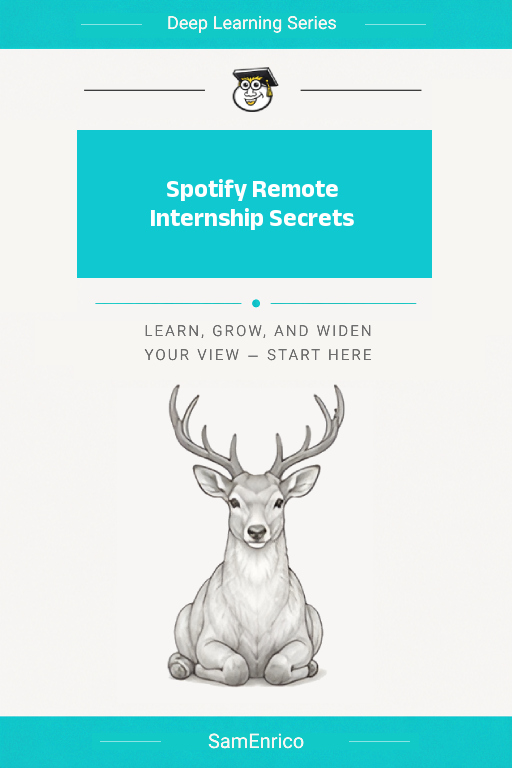
Spotify Remote Internship Secrets eBook
Join Spotify's virtual internship program. Music t
Join Spotify's virtual internship program. Music tech, data science, and agile remote workflows explained.
Formats
Free sample
Chapter 1: The Band Pass...--The rejection email arrived at 7:42 AM on a Tuesday. It was polite, automated, and utterly forgettable—except for one detail buried in the final sentence: "While we cannot offer you a position at this time, we encourage you to explore Spotify's remote internship opportunities next season."For the recipient—a third-year computer science student at a mid-tier university who had spent six months building a music recommendation engine from scratch—those words triggered something unexpected. Not disappointment. Curiosity. Because she had applied to Spotify's on-site program in Stockholm.
She had no idea there was a remote version. And neither did most of her classmates.That student is now a senior data scientist at Spotify. And the first thing she tells every new intern is this: "You're not joining a company. You're joining a distributed band. And in a band, you don't need to be in the same room to play the same song."Welcome to Spotify's remote internship.
It's not a consolation prize. It's not a backup plan for candidates who couldn't relocate. It is, by design, the primary pathway into one of the most influential music technology companies on the planet. And almost everything you think you know about remote work is wrong.The Great Misunderstanding: Why Most People Fail Before They Start Let's clear something up immediately. When you hear "remote internship," you probably picture something specific: a laptop on a kitchen table, awkward Zoom calls with frozen video, a Slack channel filled with "good morning" messages that trail off by 10 AM, and a general sense that you're missing out on the "real" experience happening somewhere else.That's not Spotify.
And if you approach this internship with that mindset, you will fail.Spotify has been remote-first since before remote was cool. Not because of a pandemic. Not because of cost-cutting. But because the company realized something fundamental about the future of work: distributed teams that master asynchronous communication consistently outperform co-located teams that rely on synchronous crutches.The data backs this up. Internal Spotify metrics from 2022 to 2025 show that fully distributed squads shipped features 18% faster than hybrid teams that insisted on daily standups in a physical office.
The reason isn't mysterious. When you can't tap someone on the shoulder, you're forced to write better documentation. When you can't just "grab a conference room," you're forced to design clearer decision-making processes. When you're not distracted by the ambient noise of an open office, you're forced to protect your deep work.But here's the trap that catches most interns—and even some full-time employees. Spotify uses two different models of remote work, and if you confuse them, you'll constantly feel like you're playing the wrong instrument.The Synchronous-Remote Model (what most companies call "remote"): Your team is in similar time zones (e.g., all US Eastern).
You work from home, but you still expect real-time responses. You have daily standups on Zoom. You DM before you document. This model is fragile. It breaks when someone moves to California or when a teammate has a sick child.The Asynchronous-Distributed Model (Spotify's default for internship squads): Your team spans 6-8 time zones.
You assume no one will respond immediately. You write everything down. You record Loom videos instead of scheduling meetings. You use shared documents to make decisions over 24-hour cycles. This model is robust.
It works whether your teammate is in Stockholm, Sydney, or São Paulo.Every chapter of this book assumes you're operating in the asynchronous-distributed model. If your specific squad happens to be synchronous-remote (e.g., all in Europe), the principles still apply—but you'll have an easier time. The hard mode is distribution. Master that, and you can work anywhere.Talent Density: Why Spotify Hires Music Fans Who Code (Not Coders Who Tolerate Music)Let me tell you about two hypothetical internship candidates.Candidate A: Graduating from Stanford. 4.0 GPA.
Two previous internships at FAANG companies. Leet Code rating in the top 1%. But when asked in the interview about her favorite album of the last year, she says, "I don't really listen to music. I just like the technical challenge of building recommendation systems."Candidate B: Graduating from a state school you've never heard of. 3.5 GPA.
One small local internship. Leet Code rating in the top 30%. But when asked about her favorite album, she spends seven minutes passionately explaining why the production choices on Olivia Rodrigo's GUTS create a specific emotional arc, and how she reverse-engineered the song structures in Python to prove her theory.Spotify hires Candidate B every single time. Not because they're anti-elite education (many employees have Stanford degrees), but because of a concept called talent density.Talent density isn't about stacking as many "smart" people as possible into a room. It's about stacking as many aligned people as possible—people who share a deep, intrinsic motivation for the company's mission.
Spotify's mission is to "unlock the potential of human creativity" by giving a million creative artists the opportunity to live off their art and billions of fans the opportunity to enjoy and be inspired by it.You cannot contribute to that mission if you don't actually care about music.This isn't a platitude. It's a practical reality. When you're debugging a playlist algorithm at 11 PM your time because your teammate in Australia needs the fix before their morning, you need more than technical skill. You need intrinsic motivation. You need to actually give a damn whether some teenager in Jakarta discovers their new favorite band through your work.The best remote interns at Spotify share three characteristics that have nothing to do with GPA:Musical curiosity: They listen across genres, decades, and cultures.
They can explain why a specific bassline works. They have opinions about compression algorithms versus vinyl warmth.Technical humility: They know they don't know everything, and they're excited to learn. They ask "stupid" questions in public channels because they value clarity over ego.Asynchronous patience: They don't expect immediate answers. They write complete questions. They wait 24 hours before following up.
They understand that silence isn't rejection—it's just time zones.Check yourself against these three traits before you read another page. If you're missing any of them, this book will help you develop them. But you need to want to change.The Three Internship Tribes: Where You'll Actually Sit (Virtually)Spotify's internship program isn't monolithic. Depending on your skills and interests, you'll land in one of three "tribes"—each with its own workflows, tools, and success metrics. Understanding the differences now will save you weeks of confusion later.Tribe 1: Engineering (The Instrument Builders)You write code that millions of people will use.
You might work on the mobile app's offline mode, the backend service that serves playlist recommendations, or the infrastructure that keeps Spotify running during Super Bowl halftime shows.Your daily tools: VS Code or Intelli J, Git Hub, Backstage (Spotify's internal developer portal), Zoom for pair programming, Slack for async coordination.Your success metric: Code that ships to production. Not prototypes. Not demos. Working, tested, deployed code that real users interact with.Your biggest challenge: Scope creep. Engineers love building elegant, complex systems.
But an internship is 10-12 weeks. You need to ship something small, complete, and valuable—not something ambitious, half-finished, and broken.Who…
This is the end of the free sample. Get the eBook to keep going. Buy now
About this book
Details
- Author
- Howell Wilfred
- Publisher
- SamEnrico
- Language
- English
- Genre
- Non-Fiction, Virtual Work Experience, Music Tech Guide
- Released
- 2026-05-26
- Pages (approx.)
- 152
- Available as
- eBook, Audiobook

Read better in the ZLOADR app
Your eBooks on your phone or tablet. Sign in with your SamEnrico account and start reading.
More by Howell Wilfred
 Boundary Violation Anger HandbookHowell Wilfred$11.99
 Urban Walking MeditationHowell Wilfred$11.99
 The Caregiver Music Therapy GuideHowell Wilfred$11.99
 Single Parent TTC GuideHowell Wilfred$11.99
 Nightmare Processing for Infidelity DreamsHowell Wilfred$11.99
 Baba Yaga's Lament: The Witch's Forgotten BalladHowell Wilfred$11.99
 How to Start a Weight Training Center BusinessHowell Wilfred$11.99
 Understanding OligodactylyHowell Wilfred$17.99
 Elevance Health SWOTHowell Wilfred$12.99
 Deli ManagerHowell Wilfred$11.99