
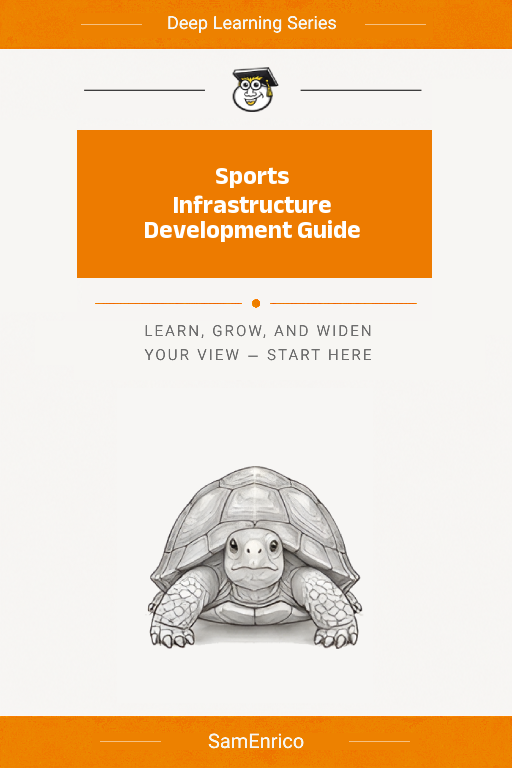
Non-FictionForecast & OutlookSports Venues
Sports Infrastructure Development Guide eBook
Discover stadium modernization, training facilitie
by Baird Renea
Discover stadium modernization, training facilities, and hosting rights for major events.
Formats
Free sample
Chapter 1: The Concrete Mirage...–- On a humid July evening in 2016, the people of Rio de Janeiro danced on Copacabana Beach. Fireworks painted the sky green and yellow. The International Olympic Committee had just awarded them the 2016 Games. Politicians wept tears of joy. Promises rained down like confetti: new stadiums, gleaming infrastructure, a transformed city, and an economic miracle that would lift millions out of poverty.
Seven years later, those same stadiums stood empty, their grass overgrown. Aquatic centers bred mosquitoes. Handball arenas became dusty warehouses. And the promised economic miracle had devolved into a $13 billion debt that Brazil's taxpayers will still be paying when their grandchildren grow old. The dancing on the beach was not the beginning of a triumph.
It was the opening scene of a tragedy that has repeated itself in Montreal, Athens, Sochi, and dozens of smaller cities whose names you have never heard. This book exists because that tragedy is not inevitable. It is a choice. And this chapter will show you how to stop making it.Every four years, the world watches host cities roll out their ribbon-cutting ceremonies. We see the gleaming facades, the flawless turf, the smiling mayors.
What we do not see are the quiet meetings where feasibility studies get inflated, the community hearings where genuine concerns are dismissed as NIMBYism, and the boardrooms where public money gets redirected into private hands. The modern sports facility has become the most expensive illusion in urban development: a concrete mirage that promises prosperity but too often delivers debt, displacement, and decay.But here is the truth that the fireworks obscure: done right, sports infrastructure can be a genuine engine of human flourishing. Done wrong, it becomes a generational curse. The difference between these two outcomes is not luck. It is not budget size.
It is not even the quality of the architecture. The difference is a set of principles, frameworks, and hard-won lessons that have been scattered across academic journals, insider memoirs, and confidential post-event audits. This book gathers those lessons into a single, practical guide.The Death of the Single-Use Stadium For most of the twentieth century, sports facilities were designed with stunningly narrow ambitions. A stadium hosted football games. An arena hosted basketball.
A velodrome hosted cycling – perhaps twice a year. The remaining 350 days, these cathedrals of sport sat empty, consuming security costs, accruing maintenance debt, and contributing nothing to the community that subsidized them. This model, which we will call the "Trophy Venue" approach, treated facilities as monuments rather than tools. And monuments, as any economist will tell you, are terrible investments.The shift began in the 1990s, almost accidentally. When Baltimore built Camden Yards, they did not set out to revolutionize stadium economics.
They simply wanted a baseball park that did not look like a concrete doughnut. But by integrating the stadium into the city's existing warehouse district – by making it walkable, by connecting it to bars and businesses – they stumbled upon a radical insight: a stadium could be a neighborhood anchor rather than an isolated fortress. The Baltimore model spread, unevenly. Some cities copied the aesthetic without understanding the economics. Others built "entertainment districts" that were really just parking lots with expensive facades.The true revolution came when operators realized that the stadium itself – the physical structure – could generate revenue on non-game days.
Conference facilities. Concert halls. E-sports arenas. Medical clinics. Grocery stores.
The most innovative projects began treating their venues as 365-day assets, not 10-day liabilities. Atlanta's Mercedes-Benz Stadium, which this book will return to repeatedly, integrated a neighborhood grocery store into its footprint – not as charity, but as a revenue-generating tenant that also solved a food desert problem. London's O2 Arena, built on a polluted former millennium dome site, transformed itself into a live music and entertainment powerhouse that hosts over 200 events annually, generating more economic activity than any sports venue in European history.The Typology Problem: Not All Facilities Are Created Equal Before we go any further, we must address a confusion that has derailed countless projects. A public stadium, a private training ground, a university arena, and a multi-use convention center are not the same thing. They have different funding sources, different governance structures, different community obligations, and different risk profiles.
Yet most books on sports infrastructure treat them as interchangeable. This book will not.Public Stadiums are owned by municipalities or public authorities. They are funded through bonds, hotel taxes, or direct appropriations. Their primary obligation is to the public good, though in practice that obligation is often forgotten the moment the ribbon is cut. The community has a legitimate claim on how these facilities are used, and for what price.
When a public stadium sits empty while a youth soccer league pays thousands of dollars for field access, something has gone wrong.Private Training Facilities are owned by teams, corporations, or private investors. They have minimal public obligation beyond complying with local zoning laws. Their primary purpose is performance optimization and player recruitment. The community has no inherent right to access these facilities, though many smart organizations choose to offer limited public access as a goodwill gesture. This book will treat these facilities differently from public stadiums, because their success metrics are fundamentally different.University Arenas occupy a hybrid space.
They are technically public (if state-funded) or non-profit, but their primary obligation is to students and athletic programs, not the general public. However, university facilities are increasingly expected to serve as community assets, hosting graduations, concerts, and youth camps. The tension between the university's internal mission and its external obligations is real, and this book will address it head-on.Multi-Use Convention Center Hybrids are the newest category. These facilities blur the line between sports venue and event space, often featuring retractable seating, modular walls, and convertible floor surfaces. They are the Swiss Army knives of infrastructure – capable of hosting a basketball game on Friday, a trade show on Saturday, and a vaccine clinic on Sunday.
Their flexibility makes them less likely to become white elephants, but their complexity makes them more expensive to operate. We will explore the trade-offs throughout this book.For the remainder of this chapter – and as a framing device for the entire book – we will focus primarily on the public stadium and the multi-use hybrid, because these are the facilities that most often generate the tragedies described in the opening paragraph. Private training facilities and university arenas will receive dedicated treatment in Chapters 4 and 11 respectively, with clear signposts when recommendations diverge.Introducing City X: A Case Study in What Could Go Right To make this book concrete rather than abstract, we will follow a single fictional city through all twelve chapters. Let us call it City X. It is a mid-sized metropolis – think Indianapolis, Brisbane, or Bilbao – with a struggling downtown, a passionate but frustrated sports fan base, and a political class hungry for a signature achievement.
City X's existing stadium was built in 1983. Its roof leaks. Its concourses are dangerously narrow. Its luxury suites, such as they are, resemble airport lounges from the 1970s. The local team, let us call them the City X Pioneers, has threatened to relocate unless the city builds a new facility…
This is the end of the free sample. Get the eBook to keep going. Buy now
About this book
Details
- Author
- Baird Renea
- Publisher
- SamEnrico
- Language
- English
- Genre
- Non-Fiction, Forecast & Outlook, Sports Venues
- Released
- 2026-06-01
- Pages (approx.)
- 135
- Available as
- eBook, Audiobook

Read better in the ZLOADR app
Your eBooks on your phone or tablet. Sign in with your SamEnrico account and start reading.
More by Baird Renea
 Parental Stress Reduction WorkbookBaird Renea$11.99
 Polish Mental Hospital SheltersBaird Renea$11.99
 Zombie Phobia Media Literacy GuideBaird Renea$11.99
 Stress and Osteoporosis ConnectionBaird Renea$11.99
 Group Work Grading AI AssistBaird Renea$11.99
 The Beat That Broke Barriers: How 'We Will Rock You' Became a Global AnthemBaird Renea$11.99
 Order Management AssociateBaird Renea$11.99
 Remote Review Real World ExamplesBaird Renea$12.99
 Understanding Martinez–monasterio–pinheiro SyndromeBaird Renea$17.99
 How to Become a District Extension Service AgentBaird Renea$11.99
You may also like
 Hong Kong Handover 1997Dunn Johnnie$11.99
 Zumba For Postnatal Recovery CourseNeal Christian$11.99
 Zumba for BeginnersLadner Nikia$11.99
 YouTube Comment Mining GuideHumes Pandora$12.99
 Worry Box MeditationCarlin Rudy$11.99
 Workplace Stress MeditationNguyen Lynn$11.99
 Workplace Stress and Sleep RepairHawley Ivory$11.99
 Workplace Perfectionism CureDelaney Jeffry$11.99
 Workplace Injustice Anger GuideWallen Isabelle$11.99
 Work Addiction and Burnout LinkGreenwood Ester$11.99
 Women in Yoga and WellnessBeattie Galina$11.99
 Women in Stand Up ComedyChun Evangeline$11.99