
Non-FictionInformativeEducational
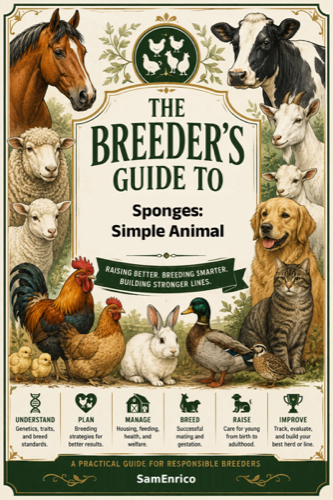
Sponges: Simple Animal
This wildlife publication, published by SamEnrico,
by Kay Ozie
This wildlife publication, published by SamEnrico, covers Sponges: Simple Animal
Formats
About this book
Free sample
Chapter 1: The Invisible Animal...-- Imagine pressing your hand against a wet, rubbery rock in a tide pool. The water is cold, the barnacles are sharp, and this thing beneath your palm—yellowish-brown, immobile, unresponsive—feels like nothing at all. A plant, perhaps. A fungus. A piece of marine debris shaped like a misshapen brain.
You would not, in that moment, think you were touching an animal. You would not guess that this silent, motionless blob belongs to the same kingdom as the dolphin gliding beyond the breakers, the eagle soaring above the cliffs, or the dog waiting for you in the car. And yet it does. You are touching one of the oldest, strangest, most successful animals on Earth. You just cannot see it.The Question That Offends the Intuition What makes an animal an animal?
Most people answer this question with a list of behaviors: animals move, animals eat, animals have faces or at least heads, animals react to stimulus, animals breathe air or water with dedicated organs. A child asked to draw an animal draws a cat, a fish, a bird, a bug. No child has ever drawn a sponge. No adult, confronted with a sponge affixed to a pier piling, has ever instinctively said, "There goes an animal." The sponge offends our intuition so thoroughly that for most of human history, we classified it as a plant. Aristotle, the father of biology, placed sponges among the zoophytes—the "animal-plants"—a taxonomic dumping ground for everything that defied easy categorization.
Linnaeus, the Swedish botanist who gave us the modern system of naming living things, waffled. He moved sponges back and forth between the animal and plant kingdoms, finally leaving them in a group called Chaos because he genuinely did not know what else to do with them.This chapter solves that ancient confusion. It does so not by arguing that sponges are animals despite their strangeness, but by showing that their strangeness is precisely what makes them such important animals. To understand why a sponge belongs in the same kingdom as a whale, we must first understand what…
This is the end of the free sample. Get the eBook to keep going. Buy now
Contents
- Chapter 1
- Chapter 2
- Chapter 3
- Chapter 4
- Chapter 5
- Chapter 6
- Chapter 7
- Chapter 8
- Chapter 9
- Chapter 10
- Chapter 11
- Chapter 12
Details
- Author
- Kay Ozie
- Publisher
- SamEnrico
- Language
- English
- Genre
- Non-Fiction, Informative, Educational
- Released
- 2026-05-25
- Pages (approx.)
- 148
- Available as
- eBook, Audiobook

Read better in the ZLOADR app
Your eBooks on your phone or tablet. Sign in with your SamEnrico account and start reading.
More by Kay Ozie
 Collaborative Analogies GuideKay Ozie$11.99
 Teeth in Aircraft AccidentsKay Ozie$11.99
 Student Evacuation PlansKay Ozie$11.99
 Meditation Flow State BridgeKay Ozie$11.99
 Learning Before ScrollingKay Ozie$11.99
 Digital Body Language GuideKay Ozie$11.99
 Acupuncture for Low LibidoKay Ozie$11.99
 Self Hypnosis for EndometriosisKay Ozie$11.99
 The Silent Witness: The DNA Breakthrough That Solved a 30-Year-Old MurderKay Ozie$11.99
 The Golden Voice of Shanghai: Li Xianglan’s Secret War of SongKay Ozie$11.99
 A Collector's Handbook to the Wartburg TouristKay Ozie$11.99
 How to Produce Pillow FormsKay Ozie$11.99
You may also like
 Hong Kong Handover 1997Dunn Johnnie$11.99
 Zumba For Postnatal Recovery CourseNeal Christian$11.99
 Zumba for BeginnersLadner Nikia$11.99
 YouTube Comment Mining GuideHumes Pandora$12.99
 Worry Box MeditationCarlin Rudy$11.99
 Workplace Stress MeditationNguyen Lynn$11.99
 Workplace Stress and Sleep RepairHawley Ivory$11.99
 Workplace Perfectionism CureDelaney Jeffry$11.99
 Workplace Injustice Anger GuideWallen Isabelle$11.99
 Work Addiction and Burnout LinkGreenwood Ester$11.99
 Women in Yoga and WellnessBeattie Galina$11.99
 Women in Stand Up ComedyChun Evangeline$11.99