
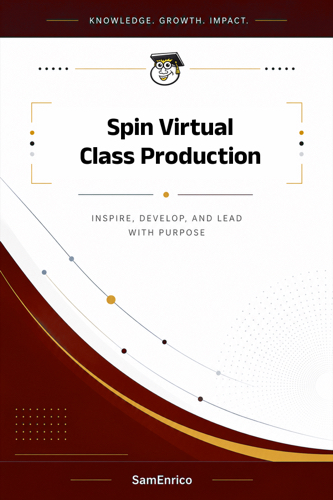
Non-FictionHealth & Wellness / Virtual Fitness
Spin Virtual Class Production eBook
Stream high-energy cycling sessions with camera an
Stream high-energy cycling sessions with camera angles, audio mixing, and on-screen metrics.
Formats
Free sample
Chapter 1: The Virtual Tipping Point...--–- When the lights dimmed in the cycling studio on March 15, 2020, no one knew they would never turn back on. Alex had been teaching indoor cycling for seven years. Their classes were packed—thirty bikes, a waitlist, the kind of sweaty, euphoric energy that made riders drive across town just to be in the room. Alex could feel the class. They could hear the collective breath, see the fatigue in a rider's shoulders, feed off the roar when the beat dropped.
The room was a feedback loop of energy, and Alex was the conductor. Then the pandemic came. The studio closed. The bikes went silent. And Alex was handed a laptop, a ring light, and a mandate: "Stream your classes.
Figure it out." The first stream was a disaster. Alex pointed the laptop camera at their bike, pressed "Go Live," and taught to a lens. They couldn't see the riders. They couldn't hear the riders. They couldn't feel the room.
Twenty people watched. Twelve stayed to the end. Eight left comments like "Can't hear the music" and "Camera is shaky" and "What resistance are we at?" Alex wanted to quit. But they didn't. Instead, they started learning.
They learned about camera angles and audio mixing and on-screen metrics. They learned that virtual production is not a compromise—it is a different art form. Within six months, Alex's virtual classes were drawing 2,000 live viewers. They had riders in seventeen countries. And they had discovered something surprising: virtual production, done right, could create a connection that was different from the studio—not better or worse, just different.
This is not a story about Alex. This is a story about a revolution. The virtual tipping point has arrived for indoor cycling, and the instructors and studios who embrace production as the core of their craft will thrive. The ones who don't will be left behind.The Three Trends That Changed Everything Indoor cycling did not become virtual overnight. The shift was driven by the convergence of three long-building trends, each accelerating the others.
Understanding these trends is essential for understanding why production quality is now the difference between a class that captivates and a class that fades into algorithmic obscurity.Trend One: The Democratization of High-Quality Video Equipment. Ten years ago, producing a broadcast-quality stream required a television studio. Cameras cost tens of thousands of dollars. Switchers were the size of suitcases. Audio mixers required engineering degrees.
Today, a DSLR or mirrorless camera that shoots 4K video costs less than $1,000. Streaming software like OBS is free. A three-camera setup with professional audio can be assembled for $5,000. The barrier to entry has collapsed, which means the barrier to excellence has risen. Anyone can stream.
Not everyone can stream well.Trend Two: The Rise of Connected Fitness Devices. Smart trainers, power meters, heart rate monitors, and interactive bikes have transformed the rider's home into a data-rich training environment. Riders no longer guess at their effort—they see it in watts, cadence, and heart rate. This data creates an expectation: the virtual class must display metrics that are accurate, responsive, and readable. A rider who spends $2,000 on a smart bike will not tolerate a class that shows the wrong power output or displays cadence with a two-second lag.
The hardware has raised the bar for the software.Trend Three: The Global Shift Toward Home-Based Exercise. The COVID-19 pandemic accelerated a trend that was already in motion. Peloton's revenue grew 172% in 2020. Zwift's user base tripled. Apple Fitness+ launched.
But the pandemic did not create the desire for home fitness—it simply removed the barriers of habit and inertia. Once riders discovered that they could get a great workout without commuting, without changing in a locker room, without scheduling around studio hours, many never went back. The home is now the primary fitness venue for millions of people. And the home demands production.These three trends did not just change where people ride. They changed how people ride.
The virtual rider is not a studio rider who happens to be at home. The virtual rider is a different species—data-informed, production-aware, and utterly unforgiving of technical flaws.Why Indoor Cycling Is Not Outdoor Cycling Moved Indoors Joe Friel, one of the most respected voices in endurance sports, made this point forcefully in his book Ride Inside (Velo Press, 2020). Indoor cycling is not simply outdoor cycling moved indoors. It is a fundamentally different activity with different physiological and psychological demands.Outdoors, the rider is constantly adjusting to terrain. A hill appears, and the rider shifts weight, increases resistance (by shifting gears), and grinds upward.
A descent appears, and the rider recovers, spinning faster with less resistance. The environment provides the structure. Indoors, the environment is static. The floor does not tilt. The wind does not blow.
The only thing that changes is the rider's effort and the instructor's cues.This absence of environmental structure creates a production imperative. On a stationary bike, the rider cannot feel a hill—they must be shown a hill. The instructor's words, the camera angle, the music's intensity, and the on-screen resistance number must work together to create the illusion of terrain. If any element is missing, the rider is left with nothing but the clock and their own discomfort. And discomfort without meaning is just suffering.The production imperative, then, is this: in virtual cycling, production is not separate from instruction.
It is instruction. Every choice—from the position of the microphone to the angle of the camera to the size of the on-screen power meter—affects the rider's experience. A class with a charismatic instructor and terrible audio will fail. A class with perfect metrics and a static camera will bore. The rider must be guided by every element on the screen.What the Bestsellers Teach Us About Production The fitness industry has produced several landmark publications that inform the approach of this book.
Understanding them helps ground our technical choices in established research.Joe Friel's Ride Inside established the foundational understanding of how indoor cycling differs from outdoor riding. Friel emphasizes that the lack of terrain changes, headwinds, and crosswinds fundamentally alters how riders generate power. Outdoors, riders naturally vary their cadence and power output in response to the environment. Indoors, without those cues, riders tend to settle into a steady state—which is less efficient and less engaging. The solution is structured interval training, but the presentation of those intervals matters.
On-screen countdowns, target power zones, and instructor cues must replace the terrain that is missing.Kristopher Kory and Tom Seabourne's Power Pacing for Indoor Cycling (Human Kinetics, 1999) remains one of the most comprehensive guides to group indoor cycling instruction. The book introduces the concept of combining athletic racing, strength training, rhythmic movements, and visualization into a cohesive workout structure. For virtual production, the key takeaway is that different segments require different visual and audio treatments. A visualization segment (where riders close their eyes and imagine a mountain climb) requires a wide shot and ambient music. A sprint interval requires tight shots, low angles, and driving beats.
The production must serve the content, not the other way around.Chalene Johnson, who has sold more than 10 million fitness…
This is the end of the free sample. Get the eBook to keep going. Buy now
About this book
Details
- Author
- Herrick Karissa
- Publisher
- SamEnrico
- Language
- English
- Genre
- Non-Fiction, Health & Wellness / Virtual Fitness
- Released
- 2026-06-06
- Pages (approx.)
- 136
- Available as
- eBook, Audiobook

Read better in the ZLOADR app
Your eBooks on your phone or tablet. Sign in with your SamEnrico account and start reading.
More by Herrick Karissa
 Courageous Legacy CourseHerrick Karissa$11.99
 Asha Degree DNA EvidenceHerrick Karissa$11.99
 The Virtual Networking GuideHerrick Karissa$11.99
 Body Scan for Flying FearHerrick Karissa$11.99
 Operation Condor: The Cold War's Shadow Over Latin AmericaHerrick Karissa$11.99
 How to Start a Dentist Business (Beginners Guide)Herrick Karissa$11.99
 Music MemorabiliaHerrick Karissa$11.99
 Transportation Factoring GuideHerrick Karissa$12.99
 FlutterFlow Dashboard GuideHerrick Karissa$12.99
 Understanding Verloes–gillerot–fryns SyndromeHerrick Karissa$17.99
You may also like
 Hong Kong Handover 1997Dunn Johnnie$11.99
 Zumba For Postnatal Recovery CourseNeal Christian$11.99
 Zumba for BeginnersLadner Nikia$11.99
 YouTube Comment Mining GuideHumes Pandora$12.99
 Worry Box MeditationCarlin Rudy$11.99
 Workplace Stress MeditationNguyen Lynn$11.99
 Workplace Stress and Sleep RepairHawley Ivory$11.99
 Workplace Perfectionism CureDelaney Jeffry$11.99
 Workplace Injustice Anger GuideWallen Isabelle$11.99
 Work Addiction and Burnout LinkGreenwood Ester$11.99
 Women in Yoga and WellnessBeattie Galina$11.99
 Women in Stand Up ComedyChun Evangeline$11.99