
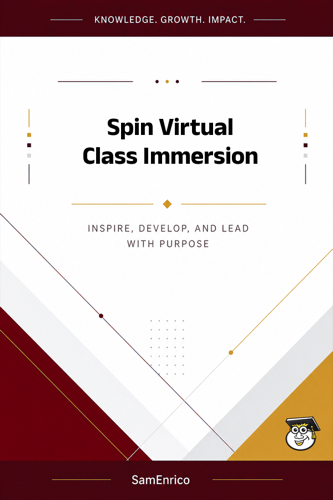
Spin Virtual Class Immersion eBook
Maximize at-home spin classes with screen placemen
Maximize at-home spin classes with screen placement, fan setup, and audio cues.
Formats
Free sample
Chapter 1: The Sweaty Epiphany–- It happens to almost everyone who brings a spin bike into their home. You spend $1,500 on a bike, $39 a month on a streaming subscription, and another $200 on padded shorts, a mat, and a heart rate monitor. You clear a space in the garage, the spare bedroom, or the corner of the basement. You set everything up with the enthusiasm of a child on Christmas morning. And then, sometime between the second and third week, you realize something terrible: you hate riding indoors.Not all the time.
Not every ride. But enough of them that the bike starts to feel less like a gift you gave yourself and more like an expensive, dusty monument to failed intentions. The rides feel harder than they should. Your neck aches twenty minutes in. You find yourself staring at the timer, willing the seconds to move faster.
You quit early more often than you admit. And worst of all, you start to wonder if you're just not as fit as you thought you were.Here is the truth that the bike manufacturers and the app subscriptions do not want you to hear: the problem is almost certainly not you. The problem is your environment.This chapter is about why that happens and, more importantly, why almost every at-home cyclist gets it backwards. We assume that if we just pedal harder, stay consistent, and follow the instructor's cues, the results will come. But indoor cycling is fundamentally different from outdoor cycling, and treating your living room like a road is a recipe for frustration, injury, and eventual abandonment of the sport altogether.By the end of this chapter, you will understand exactly why your indoor rides feel harder than they should, why your brain fights you after fifteen minutes, and how a simple shift in perspective—from fighting your environment to engineering it—will unlock performance you did not know you had.
This is not motivational fluff. This is exercise physiology, environmental psychology, and a concept called sensory substitution, all working together to turn your spare room into a high-performance studio.The Great Indoors Paradox Let us start with a simple question. If you are a reasonably fit cyclist who can comfortably ride forty miles outdoors at a steady pace, why does a forty-five-minute indoor ride at the same perceived effort leave you completely drained, often before the class is even over?The answer lies in something exercise physiologists call the "indoor effort paradox." Study after study has shown that cyclists produce the same or even slightly lower power outputs indoors compared to outdoors, yet they report significantly higher ratings of perceived exertion. In plain English: you work just as hard or slightly less hard indoors, but it feels a lot harder.Joe Friel, one of the most respected voices in endurance training and author of the bestselling Ride Inside, puts it bluntly: "Indoor riding removes the three critical inputs that your brain uses to regulate effort—road feedback, natural wind, and terrain variation." Without these inputs, your brain is flying blind. It cannot tell if you are climbing a hill or coasting on a flat.
It cannot feel the cooling effect of wind rushing past your skin. It cannot make the micro-adjustments to power output that happen automatically outdoors.Your brain, it turns out, is not designed to pedal in place. It is designed to navigate a dynamic, ever-changing environment. When you take away that environment, the brain does not simply shrug and carry on. It panics.
Not consciously—you will not feel afraid—but deep in the autonomic nervous system, something is off. The lack of expected sensory input triggers a low-grade stress response. Cortisol rises slightly. Perceived effort spikes. And that little voice in your head that says "maybe stop now" gets a lot louder a lot faster than it would if you were climbing a real hill with the sun on your face and the wind at your back.This is the Great Indoors Paradox.
You are not weaker indoors. You are not less motivated. You are not secretly out of shape. You are simply riding in an environment that your brain was never designed to handle, and no amount of willpower will fix that. Only environmental engineering will.The Three Missing Inputs To understand what needs to be fixed, we must first understand what is missing.
Friel's research identifies three specific inputs that disappear when you move from outdoor to indoor cycling. Each one plays a distinct role in how your brain regulates effort, and each one can be replaced—not perfectly, but effectively—with deliberate environmental design.Missing Input #1: Road Feedback When you ride outdoors, your body is constantly receiving tactile information from the road surface. Small vibrations travel up through the tires, the frame, the handlebars, and the saddle. These vibrations are not random noise. They are data.
They tell you whether you are on smooth asphalt or rough chip seal. They tell you when you are drifting onto the shoulder. They tell you, subtly but unmistakably, how much power you are actually delivering to the ground.On a stationary trainer, all of that feedback vanishes. The bike is bolted to a floor that does not move. The flywheel spins smoothly, sometimes too smoothly, and your brain receives none of the micro-vibrations it expects.
The result is a phenomenon that indoor cyclists call "the spin-down effect"—you keep pedaling, but you lose the sense of connection to the bike. Your form degrades. Your pedal stroke becomes sloppy. And because you cannot feel the resistance in the same way, you tend to either over-push (wasting energy) or under-push (coasting without realizing it).Missing Input #2: Natural Wind This one seems obvious, but its importance is almost always underestimated. Outdoors, your forward motion creates wind that rushes past your face, chest, and arms.
That wind serves two critical purposes. First, it provides evaporative cooling, carrying away the sweat that your body produces to regulate core temperature. Second, it provides a psychological cue—the faster you go, the more wind you feel, which creates a direct sensory link between effort and sensation.Indoors, there is no natural wind. Even if you have a ceiling fan running, the air movement is vertical or diffuse, not directed at your face and chest. Without that wind, your body overheats faster.
Much faster. Research suggests that indoor riders reach critical core temperatures up to forty percent sooner than outdoor riders at the same power output. That means you are not quitting because you are weak. You are quitting because your brain is literally cooking inside your skull and is trying to save your life.Missing Input #3: Terrain Variation Outdoor rides are never perfectly flat. Even on the flattest roads, there are micro-changes in grade—a slight rise here, a gentle descent there—that force you to make constant, almost unconscious adjustments to your power output.
These micro-adjustments keep your brain engaged. They break the monotony. They give you small victories (cresting a hill) and small recoveries (rolling down the other side).On a trainer, none of that exists. Even when you change resistance manually or follow an app that simulates hills, the transitions…
This is the end of the free sample. Get the eBook to keep going. Buy now
About this book
Details
- Author
- Christie Keesha
- Publisher
- SamEnrico
- Language
- English
- Genre
- Non-Fiction, Health & Wellness, Home Fitness
- Released
- 2026-06-06
- Pages (approx.)
- 145
- Available as
- eBook, Audiobook

Read better in the ZLOADR app
Your eBooks on your phone or tablet. Sign in with your SamEnrico account and start reading.
More by Christie Keesha
 Loneliness Social PrescribingChristie Keesha$11.99
 Wholesaling Nextdoor GuideChristie Keesha$11.99
 Lucid Dreaming for Recurring DreamsChristie Keesha$11.99
 Wholesaling Text Message GuideChristie Keesha$11.99
 Drive Through Rage GuideChristie Keesha$11.99
 Office Door Signal SystemChristie Keesha$11.99
 Left Behind in the WoodsChristie Keesha$11.99
 Eating Mindful Breath PracticeChristie Keesha$11.99
 The Last Whistle of the Delphic MineChristie Keesha$11.99
 The Frozen Hoax: How Prehistoric Explorers Tricked the WorldChristie Keesha$11.99
 The Four Days' Fury: The Battle of the Downs That Shattered Dutch Invincibility (1639)Christie Keesha$11.99
 How to Start a Compound Fertiliser Business (Beginners Guide)Christie Keesha$11.99
You may also like
 Resistance Band Full Body WorkoutLoftis Prudence$11.99
 At Home HIIT Equipment FreeFarias Nobuko$11.99
 Zumba on Demand SuccessWhitney Georgene$11.99
 Zumba Party in PracticeDobbs Eldon$11.99
 Bodyweight Home Gym Zero CostBusch Lexie$11.99
 Beginner Bodyweight WorkoutMccullough Leann$11.99
 Home Gym Muscle BuildingConnelly Liza$11.99