
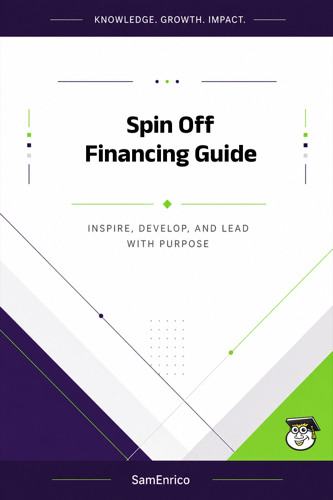
Spin Off Financing Guide Audiobook
Documents capital structure for newly independent
Documents capital structure for newly independent public company.
Formats
Free sample
Chapter 1: The Dual-Edged Trade...--–- On a Tuesday morning in March, the chief financial officer of a diversified industrial conglomerate received an email that would consume the next eighteen months of her life. The board had just approved a strategic review of the company's underperforming automotive parts division. The mandate was simple on its face: maximize shareholder value. The implications were anything but. Within weeks, the investment bankers had lined up three options: a sale to a private equity firm at a discount to book value, a carve-out IPO that would leave the parent company with a minority stake, or a tax-free spin-off that would create two independent public companies.
The bankers favored the sale—it was faster, the fees were certain, and the execution risk was low. The CFO favored the spin-off. She believed the division had been starved of capital for years, buried beneath the corporate overhead of a parent that never understood its business. Set free, she argued, it could trade at a higher multiple, access its own capital markets, and create more value for shareholders than any sale could deliver. But there was a catch.
A spin-off required a capital structure. And that capital structure required the division to take on debt—debt it had never carried before, debt that would transform its balance sheet from pristine to leveraged overnight. The parent company wanted to push down as much debt as possible to clean up its own books. The division wanted to take on as little as possible to preserve its flexibility. That tension—between the parent's desire to shed debt and the spin-off's need to survive—is the central conflict of every spin-off financing.
And the resolution of that conflict determines whether the spin-off creates value or destroys it.This chapter establishes the strategic, financial, and tax rationale for pursuing a spin-off and explains why capital structure is the single most important decision in the process. It introduces the concept of debt pushdowns as a dual-edged transaction: while debt pushdowns optimize the parent company's credit profile, they simultaneously create leverage and tax challenges for the newly independent entity. Understanding this trade-off is the first step toward structuring a spin-off that works for both companies.The Strategic Landscape: Why Spin-Offs Exist The modern spin-off market traces its roots to the conglomerate era of the 1960s and 1970s, when companies like ITT, Gulf+Western, and Textron assembled portfolios of…
This is the end of the free sample. Get the Audiobook to keep going. Buy now
About this book
Details
- Author
- Philbrook Joie
- Publisher
- SamEnrico
- Language
- English
- Genre
- Non-Fiction, Capital & Valuation Register
- Released
- 2026-06-06
- Pages (approx.)
- 152
- Available as
- eBook, Audiobook

Listen in the VoxFlicks app
Audiobooks and audio dramas wherever you go. Sign in with your SamEnrico account and press play.
More by Philbrook Joie
 Parenting Anxiety Spiral GuidePhilbrook Joie$11.99
 Alcoholism and Hoarding Dual Recovery ManualPhilbrook Joie$11.99
 Retail Therapy Recovery PlanPhilbrook Joie$11.99
 The African Dream: How a Forgotten Tournament Sparked a Basketball RevolutionPhilbrook Joie$11.99
 Ultimate Handbook Guide to Donetsk : (Ukraine) Travel GuidePhilbrook Joie$11.99
 Product Listing Localization PrimerPhilbrook Joie$12.99
 How to Produce Anchoring AdhesivePhilbrook Joie$11.99
 Tattoo Studio ManagerPhilbrook Joie$11.99
You may also like
 Distressed LBO StructureCrowl Raymond$11.99
 Exit Financing GuidePrimavera Lesli$11.99
 DIP Financing DatabaseSolum Matthew$11.99
 Debt Service Coverage RatiosLeone Queen$11.99
 Catch Up Provision DBDerr Samual$11.99
 Leveraged ESOP GuideErickson Archie$11.99
 Debt Buyback DatabaseStrand Penney$11.99
 Deal By Deal ModelMontana Glenn$11.99
 Buy and Build HandbookScoggins Elissa$11.99
 Leverage Covenant DatabaseFiore Lea$11.99
 Rollover Option DatabaseGreenberg Weldon$11.99
 TVPI Database GuideQuintanilla Hilde$11.99