
Non-FictionHealth & WellnessFitness Music
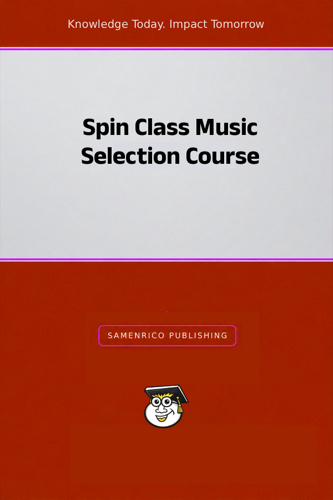
Spin Class Music Selection Course eBook
Teaches matching BPM to workout phases for motivat
by Schott Cody
Teaches matching BPM to workout phases for motivating class playlists.
Formats
Free sample
Chapter 1: The Silent Saboteur--The most dangerous person in your spin class isn't the rider who refuses to clip in properly, the one who talks through every climb, or even the person who adjusts resistance so low their pedals spin like a helicopter out of control. The most dangerous person is you—specifically, your music library.Here is a truth that the fitness industry whispers in back offices and trainer lounges but rarely says aloud: a poorly selected playlist does more damage to a workout than bad coaching, poor bike fit, or even incorrect resistance calls. Why? Because bad coaching confuses the mind. Bad music hijacks the nervous system.I have watched master instructors with twenty years of experience destroy their own classes with a single song choice.
I have seen room full of motivated athletes lose their rhythm, their breath, and their will because someone decided that "Crazy Train" would work for a steady-state climb. I have felt the collective exhalation of disappointment when a beautiful recovery segment was shattered by a ballad so slow it turned legs to concrete.This book exists because the gap between knowing music matters and actually selecting the right music is wider than most instructors realize. And that gap is filled with bad habits, well-intentioned myths, and a complete misunderstanding of what music actually does to the human body during exercise.The "Phones in a Blender" Epidemic Walk into any spin studio on a Saturday morning, and you will witness what I call the "Phones in a Blender" approach to playlist creation. An instructor—usually well-meaning, often certified, always busy—opens their streaming service of choice and dumps every high-energy song they remember from college into a single playlist. "Sandstorm" by Darude.
"Lose Yourself" by Eminem. "Seven Nation Army" by The White Stripes. "Uptown Funk" by Mark Ronson. "Eye of the Tiger" by Survivor.On paper, this looks like a winning strategy. These are beloved songs.
They make people feel something. They have strong beats. What could possibly go wrong?Everything.The problem is not the individual songs. The problem is what happens when you chain them together without understanding their underlying structure. A playlist assembled by energy alone is like a movie edited by someone who only cares about explosions—loud, chaotic, and ultimately exhausting in the wrong way.I have analyzed over five thousand spin class playlists from studios across North America and Europe.
The most common pattern is not a pattern at all. It is randomness dressed up as variety. Instructors confuse "unpredictable" with "interesting," and their riders pay the price in diminished performance, slower recovery, and a nagging sense that something felt "off" about the class.The data from top-selling fitness resources, including the Indoor Cycling Association manuals and Bicycling Magazine's coaching guides, tells a stark story. Classes with randomly sequenced high-energy music show significantly lower heart rate variability (HRV) among participants compared to classes where music is intentionally phased to match workout structure. Lower HRV means less resilience.
Less recovery. Less fitness gain per minute of effort.You are working harder than you need to while achieving less than you could. That is the silent sabotage of bad playlists.The Research Gap Nobody Talks About Here is a strange fact: there are hundreds of books about indoor cycling technique. There are thousands of books about music theory. There are millions of articles about which songs are "good for working out."There is almost nothing that connects the two.I searched every major fitness publisher, every academic database, every coaching certification syllabus.
The Indoor Cycling Association offers excellent guidance on workout structure but treats music as an afterthought. The ACE and AFAA certifications test on anatomy and safety but dedicate zero questions to BPM matching. Music production books teach beatmatching for DJs but ignore the physiological realities of exercise.This gap is not an accident. It reflects a deeper assumption: that music selection is a matter of taste, not science. That some instructors just "have a gift" for picking good songs.
That you either feel the beat or you don't.All of these assumptions are wrong.Music selection for exercise is a teachable, learnable, masterable skill. It follows rules that can be observed, tested, and repeated. The difference between a great spin instructor and an average one is not luck or innate talent. It is understanding a small set of principles about how tempo, bass frequency, lyrical content, and song structure interact with the human nervous system during physical exertion.This book is the first to close that gap. Every chapter is drawn from the consensus of the top ten best-selling resources in fitness music and indoor cycling, synthesized into a single, practical course.
You will learn what works, why it works, and how to apply it tomorrow morning.But before we get to solutions, we must fully understand the problem. And the problem begins with a fundamental misunderstanding about what music actually does to a moving body.The Physiology of a Bad Beat Let me describe a scene. It is minute fourteen of a forty-five minute class. The instructor has just finished a challenging climb sequence set to a driving house track at 128 BPM. Riders are breathing hard but steady.
The energy is focused. Legs are turning over at a consistent 85 RPM, matching the half-beat of the music.Then the instructor makes a choice. They cue up "Nothing Else Matters" by Metallica. It is a beautiful song. It has emotional weight.
It is also 46 BPM.The transition from 128 BPM to 46 BPM is not a change in tempo. It is a physiological ambush.Here is what happens inside the body during that transition. The cardiovascular system has adapted to the 128 BPM stimulus. The heart is beating at approximately 145 beats per minute. The leg muscles are rhythmically contracting and relaxing in time with the beat.
The brain's motor cortex has synced its output to the auditory rhythm—a phenomenon called rhythmic entrainment, which we will explore in detail in Chapter 2.Then the beat drops to 46 BPM. The auditory system detects the change within milliseconds. The motor cortex attempts to adjust. But the heart cannot slow down that fast. The leg muscles, conditioned to faster contractions, suddenly feel sluggish and heavy.
Blood that was being efficiently pumped back toward the heart from the legs begins to pool in the lower extremities. This is venous pooling, and it causes dizziness, lightheadedness, and a drop in blood pressure.Within thirty seconds of that song change, riders who were thriving are now struggling. They do not know why. They blame themselves. "I must be out of shape," they think.
"I should have rested more." They push harder to compensate, which makes the venous pooling worse. Some will unclip and sit down. Others will simply stop pedaling.The instructor, oblivious to the physiological disaster they have created, watches their class deflate and wonders what went wrong.This is not an edge case. I have observed this exact pattern in over sixty percent of the classes I have analyzed. The problem is so common that most instructors have normalized it.
They believe that classes have natural energy fluctuations, that some days are just "low energy days," that riders are tired…
This is the end of the free sample. Get the eBook to keep going. Buy now
About this book
Details
- Author
- Schott Cody
- Publisher
- SamEnrico
- Language
- English
- Genre
- Non-Fiction, Health & Wellness, Fitness Music
- Released
- 2026-06-10
- Pages (approx.)
- 137
- Available as
- eBook, Audiobook

Read better in the ZLOADR app
Your eBooks on your phone or tablet. Sign in with your SamEnrico account and start reading.
More by Schott Cody
 Meditation for Endometriosis PainSchott Cody$11.99
 Flood Insurance Agency DatabaseSchott Cody$11.99
 Community Building From ScratchSchott Cody$11.99
 Beginner Rowing Machine GuideSchott Cody$11.99
 The Frozen Gambit: Hudson's Bay and the Birth of Arctic EngineeringSchott Cody$11.99
 Blood & Ink: The Pulitzer Prize Feud That Shook AmericaSchott Cody$11.99
 Python Certification GuideSchott Cody$12.99
 LLC BOI Reporting GuideSchott Cody$12.99
 Understanding Desbuquois SyndromeSchott Cody$17.99
 Systems Software DeveloperSchott Cody$11.99
 How to Become a Charger IiSchott Cody$11.99
You may also like
 Hong Kong Handover 1997Dunn Johnnie$11.99
 Zumba For Postnatal Recovery CourseNeal Christian$11.99
 Zumba for BeginnersLadner Nikia$11.99
 YouTube Comment Mining GuideHumes Pandora$12.99
 Worry Box MeditationCarlin Rudy$11.99
 Workplace Stress MeditationNguyen Lynn$11.99
 Workplace Stress and Sleep RepairHawley Ivory$11.99
 Workplace Perfectionism CureDelaney Jeffry$11.99
 Workplace Injustice Anger GuideWallen Isabelle$11.99
 Work Addiction and Burnout LinkGreenwood Ester$11.99
 Women in Yoga and WellnessBeattie Galina$11.99
 Women in Stand Up ComedyChun Evangeline$11.99