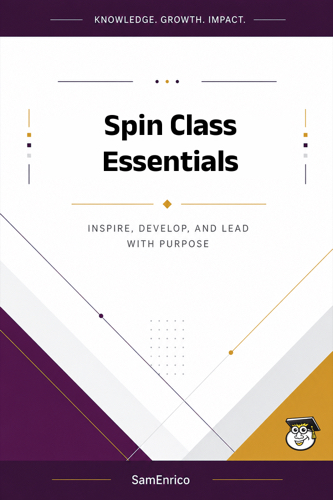
Spin Class Essentials eBook
Proper bike setup, cadence drills, and climbing te
Proper bike setup, cadence drills, and climbing techniques for indoor cycling.
Formats
Free sample
Chapter 1: The $2,000 Mistake--You have just paid $34 for a 45-minute spin class. The lights drop to a dim purple haze. The first bass note vibrates through the concrete floor. You clip in—or slide your feet into cages—and glance at the rider next to you. She is lean, wearing matching socks and a studio-branded tank top.
She looks like she belongs here. You do not.Within ninety seconds, your knees ache. Not a deep, muscular burn—a sharp, wrong-feeling sting just above or below the kneecap. Your hands go numb. You shift your grip, shake out your fingers, but the tingling returns.
The instructor shouts into a headset microphone: “Add more resistance! Feel the burn!” You obey. Now your lower back is on fire. You glance at the clock. Forty-two minutes remain.This is not an anomaly.
This is the average spin experience for the majority of indoor cyclists. And it is entirely preventable.This chapter is not about motivation. It is not about playlists or cool-down stretches. It is about a single, uncomfortable truth: You have been tolerating pain that you should never have accepted. And that tolerance has cost you—not just in discomfort, but in real money, lost fitness gains, and years of unnecessary wear on your joints.Let us calculate the cost.The Mathematics of Silent Suffering Take your average spin class attendance: two times per week.
That is 104 classes per year. At $34 per class (the median boutique studio price in major US cities as of 2025), you are spending $3,536 annually. Over two years, that is $7,072. Now add the hidden costs: the knee brace you bought for $45. The three physiotherapy sessions at $150 each ($450).
The over-the-counter anti-inflammatories—$20 per month, $480 over two years. The compression gloves for hand numbness ($30). The new saddle you purchased because you thought the studio’s saddle was the problem ($80). The massage gun you justified as a “recovery tool” ($120).Total: approximately $8,277.Now subtract the value of what you actually gained. If you have been riding with poor form, incorrect setup, and bouncing at cadences that damage your patellofemoral joint, your fitness gains have been compromised by an estimated 40-60%, according to biomechanics studies from the Journal of Sports Sciences.
You have been working harder, not smarter. Your body has been adapting to dysfunction—strengthening the wrong muscles (overactive quads, underactive glutes) while grinding down cartilage.Your net loss over two years: roughly $2,000 in wasted spending and another $3,000 in lost fitness potential. Hence the title of this chapter. The $2,000 mistake is not a single purchase. It is the accumulated cost of riding wrong and calling it effort.The Three Lies Spin Instructors Tell You (And One They Don’t Mean To)Before we fix anything, we must name the enemy.
The enemy is not your instructor. Most spin instructors are well-intentioned, energetic, and underpaid. They are given twelve hours of training (sometimes less) and a playlist. They are told to “keep the energy high” and “cue resistance often.” They are not taught biomechanics. They are not taught how to spot a saddle that is 5mm too low.
They are taught to shout.But the system perpetuates three lies. Let us name them so we can unlearn them.Lie #1: “Stand up for more power.”This is false for the vast majority of riders. When you stand, your bodyweight presses into the pedals, which can increase torque. However, standing also increases heart rate by 10-15 beats per minute for the same power output (measured via power meters in multiple studies). It recruits more upper body musculature, which fatigues you faster.
And it introduces lateral hip sway, which can irritate the iliotibial band and the patellofemoral joint. Standing is a tool—for very short climbs, for stretching your back, for changing muscle recruitment. It is not a default “more power” position. The strongest riders in the world (professional track cyclists) produce their highest sustained power seated.Lie #2: “Go faster! Higher cadence!”Higher cadence (above 100 RPM) is not intrinsically better.
It is metabolically more costly—you burn more oxygen to produce the same wattage. And for riders with poor pedal stroke mechanics, high cadence amplifies every inefficiency. You bounce. You lose contact with the pedals. Your knees track sideways.
The instructor shouting “Go faster!” is asking you to amplify your mistakes, not fix them. The optimal cadence for most recreational riders is 80-90 RPM. This is not lazy. This is efficient.Lie #3: “More resistance makes it more real.”Indoor cycling is not outdoor cycling. A real hill requires continuous torque against gravity.
If you stop pedaling on a 12% grade, you stop immediately. An indoor flywheel stores momentum. You can stop pedaling for a split second at the top and bottom of each stroke—the “dead spots”—and the wheel keeps spinning. Adding resistance does not make indoor climbing “more real.” It simply makes it harder to turn the pedals. That is a different variable.
The goal is not to max out resistance. The goal is to maintain smooth, consistent torque through all 360 degrees of the pedal stroke, at a resistance that allows you to do so without form breakdown.The Unspoken Truth (Not a Lie, But a Silence)What instructors do not say is this: Most of you are riding on poorly adjusted bikes, and we do not have time to fix each one before class. A typical studio has 15 minutes between classes. Thirty bikes. One instructor.
It is logistically impossible to check every rider’s saddle height, fore/aft, handlebar reach, and cleat position. The system is designed for throughput, not precision. That is not malice. That is reality. And that reality means the responsibility falls on you.The Anatomy of a Preventable Injury Let us look at the four most common spin-related injuries, their causes, and their long-term consequences.
If you have never experienced any of these, consider yourself lucky—and read carefully, because your luck will run out.1. Anterior Knee Pain (Patellofemoral Pain Syndrome)Location: Front of the knee, around or under the kneecap.Cause: Saddle too low (most common), cleats too far forward, or pedaling with excessive quadriceps dominance without glute engagement.Mechanism: When the saddle is too low, your knee never reaches full extension. The patella (kneecap) is compressed against the femur at an angle it was not designed for. Each pedal stroke grinds the cartilage slightly. Over time, this becomes chronic inflammation.Long-term consequence: Patellofemoral arthritis.
This is not reversible. Once cartilage is gone, it is gone.2. Posterior Knee Pain (Behind the Knee)Location: Back of the knee, often described as a “pulling” sensation.Cause: Saddle too high. When you reach for the pedal at the bottom of the stroke, you hyperextend your knee slightly. The hamstring tendons and popliteal muscle are stretched beyond their comfortable range with every rotation.Long-term consequence: Hamstring tendinopathy, which can take months to resolve with rest and eccentric strengthening.3.
Lower Back Pain Location: Lumbar spine, usually one side or central.Cause: Handlebar reach too long (forcing spinal flexion) or saddle nose tilted down (forcing you to brace with your arms and lower back).Mechanism: The spine is designed to bear weight in a neutral or slightly extended position. When you round your lower back to reach far-forward handlebars, the intervertebral…
This is the end of the free sample. Get the eBook to keep going. Buy now
About this book
Details
- Author
- Langdon Brice
- Publisher
- SamEnrico
- Language
- English
- Genre
- Non-Fiction, Health & Wellness, Indoor Cycling
- Released
- 2026-06-08
- Pages (approx.)
- 133
- Available as
- eBook, Audiobook

Read better in the ZLOADR app
Your eBooks on your phone or tablet. Sign in with your SamEnrico account and start reading.
More by Langdon Brice
 Romantic Boundary SettingLangdon Brice$11.99
 Parent Death Dreams GuideLangdon Brice$11.99
 Napping for DepressionLangdon Brice$11.99
 Hypnotherapy For SmokingLangdon Brice$11.99
 Arthritis MeditationLangdon Brice$11.99
 Sold at Fourteen SurvivorLangdon Brice$11.99
 Amazon Seller Financing GuideLangdon Brice$11.99
 Teen Child Loss GriefLangdon Brice$11.99
 The Siege of the British Embassy: Petrograd's Forgotten StandLangdon Brice$11.99
 The Phantom of the Stock Exchange: How a Teenage Whiz Kid Scammed Wall StreetLangdon Brice$11.99
 The Phantom of Wall Street: How a Rogue Trader Almost Toppled a BankLangdon Brice$11.99
 Thinkific Course Growth SystemsLangdon Brice$11.99