
Non-FictionHealth & WellnessEndurance Sports
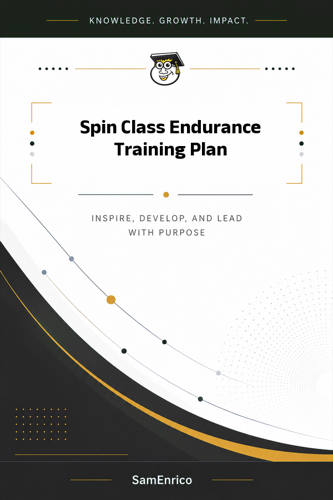
Spin Class Endurance Training Plan eBook
Build cardiovascular stamina for 60-minute rides u
by Fine Lorrie
Build cardiovascular stamina for 60-minute rides using heart rate zones, interval patterns, and recovery week strategies.
Formats
Free sample
Chapter 1: Your Beating Lie Detector--–- The fluorescent lights of the spin studio flicker overhead as you clip in, positioning your sweaty palms on the handlebars. To your left, a woman in matching Lululemon is already sprinting during the warm-up, her ponytail whipping like a metronome of anxiety. To your right, a man who looks like he commutes by Ironman adjusts his resistance knob with the grim determination of someone preparing for dental surgery without anesthesia. The instructor bounds onto her bike like a caffeinated gazelle and shouts, “Give me 100 percent from the very first song!” The bass drops. Your legs churn.
Within four minutes, your throat tastes like copper, your vision blurs at the edges, and you spend the remaining fifty-six minutes bargaining with God about which limb you would trade for the ride to end. You leave the studio convinced you are either dramatically out of shape or secretly asthmatic. Neither is true. You are simply riding blind.You have been lied to, but not maliciously. The lie is baked into the culture of indoor cycling, whispered in every “no excuses” Instagram caption and shouted in every “push through the pain” class mantra.
The lie is this: effort equals results. More sweat, more burn, more suffering – these must translate to more stamina, right? Wrong. Effort without precision is just exhaustion with a fancy playlist. You have been grinding your body into a paste while the rider next to you, the one who seems annoyingly fresh during the final climb, has discovered a secret that most instructors either do not know or will not teach: your heart rate is not a suggestion.
It is a dashboard. And you have been driving with your eyes closed.This chapter will teach you to read that dashboard. By the time you finish these pages, you will understand why “220 minus your age” is a mathematical joke that has ruined more fitness journeys than fried food, how to find your actual Max Heart Rate (MHR) without expensive lab equipment, and why the five Energy Zones – properly understood – are the difference between spinning your wheels and building an engine that can sustain sixty minutes of powerful, rhythmic riding. You will also learn the Rate of Perceived Exertion (RPE) scale, a free and remarkably accurate backup system for days when your heart rate monitor is dead or you simply cannot stand another piece of plastic strapped to your chest. And you will walk away with a printable Zone Chart that belongs on your handlebars, your refrigerator, and perhaps tattooed on the inside of your eyelids.Let us begin with the lie you have been sold.The 220 Funeral: Burying a Bad Formula Walk into any gym, any spin studio, any corporate wellness fair, and you will find it posted on a faded laminated poster near the water cooler: *220 – Age = Maximum Heart Rate*.
For a forty-year-old, this formula claims a max of 180 beats per minute. For a fifty-year-old, 170. For a twenty-five-year-old spinning instructor who has never questioned anything her certification manual told her, 195. The formula is neat, simple, and almost entirely useless for individuals.Here is why. The “220 – Age” equation was never intended to be applied to individual exercisers.
It was derived from a 1971 study by Dr. William Haskell and Dr. Samuel Fox, who observed a loose correlation between age and heart rate across a group of approximately 3,000 people. They never claimed it was a universal truth. They certainly never claimed it could predict an individual’s maximum heart rate with any accuracy.
And yet, fifty years later, it has become the default setting on every cardio machine, every fitness tracker, and every spin instructor’s mental math.The real-world consequences are not merely academic. I have tested this formula on hundreds of riders. A forty-five-year-old woman who has been spinning for eight years might have a true MHR of 195 – fifteen beats higher than the formula predicts. A thirty-year-old sedentary office worker who takes his first spin class might have a true MHR of 175 – twenty beats lower than the formula predicts. The woman, following the formula, would train at zones that feel laughably easy (“Zone 2 at 140 BPM?
I could do this in my sleep”), conclude the plan is worthless, and abandon structured training. The man, following the formula, would be instructed to reach 190 BPM during intervals – a heart rate his body cannot safely achieve – and would experience chest pain, dizziness, or the terrifying sensation that his heart is attempting to relocate to his throat.The error margin of “220 – Age” is approximately plus or minus fifteen to twenty beats per minute for two-thirds of the population. That is not a rounding error. That is the difference between the Recovery Zone and the Anaerobic Zone. That is the difference between a ride that builds endurance and a ride that triggers a cortisol spike, floods your system with stress hormones, and leaves you storing belly fat instead of burning it.So we are going to do something radical.
We are going to find your actual Max Heart Rate. And we are going to do it without a treadmill, without a sports medicine referral, and without spending money you do not have.The Field Test: Finding Your True North You will need three things for this test: a spin bike with a reliable resistance knob, a heart rate monitor that you trust (chest strap preferred – more on that later), and a willingness to suffer for exactly twenty minutes. Not an hour. Not a death march. Twenty minutes.Step One: The Warm-Up (10 minutes)Begin pedaling at a very easy pace – what feels like a 2 or 3 on the RPE scale (we will define this scale shortly).
Your heart rate should stay below 60 percent of whatever you think your max might be, but do not worry about the number yet. Just spin lightly, gradually increasing your cadence from 60 RPM to 90 RPM over the ten minutes. Your muscles should feel warm but not tired. Your breathing should be relaxed enough to hold a conversation about something boring, like tax law or the plot of a movie you did not particularly enjoy.Step Two: The Build-Up (5 minutes)After the ten-minute warm-up, begin increasing your resistance every sixty seconds. Think of this as climbing a staircase.
Each minute, add a quarter-turn of resistance (or one full number on a digital resistance scale). Keep your cadence steady between 80 and 90 RPM. By the end of these five minutes, you should be working at what feels like a “hard but sustainable” effort – approximately 7 or 8 on the RPE scale. Your heart rate will likely be somewhere between 80 and 90 percent of whatever your eventual max will be. You should not be gasping, but you should not be able to say more than three or four words without pausing for breath.Step Three: The All-Out Effort (3 minutes)This is where the test begins in earnest.
Reset your bike computer or watch so you can track minutes. For the next three minutes, you will push as hard as you possibly can. Increase resistance every thirty seconds. Do not worry about cadence – just pedal. Your only goal is to make yourself deeply uncomfortable.
You are looking for the moment when adding even one more watt of power feels physically impossible, when your legs…
This is the end of the free sample. Get the eBook to keep going. Buy now
About this book
Details
- Author
- Fine Lorrie
- Publisher
- SamEnrico
- Language
- English
- Genre
- Non-Fiction, Health & Wellness, Endurance Sports
- Released
- 2026-06-11
- Pages (approx.)
- 153
- Available as
- eBook, Audiobook

Read better in the ZLOADR app
Your eBooks on your phone or tablet. Sign in with your SamEnrico account and start reading.
More by Fine Lorrie
 Needle Phobia Vaccination GuideFine Lorrie$11.99
 Tech Professional Burnout GuideFine Lorrie$11.99
 Cyberstalking Celebrity Victim FilesFine Lorrie$11.99
 Retirement Home Insurance GuideFine Lorrie$11.99
 Echoes of the Ice: The Secret Language of GlaciersFine Lorrie$11.99
 Understanding Distichiasis Heart Congenital AnomaliesFine Lorrie$17.99
 Kickstarter Union GuideFine Lorrie$12.99
 Academic Calendar BrazilFine Lorrie$12.99
 How to Start a Parquet Floor Laying (not By Manufacturer) Business (Beginners Guide)Fine Lorrie$11.99
 Branch Compliance SpecialistFine Lorrie$11.99
You may also like
 Hong Kong Handover 1997Dunn Johnnie$11.99
 Zumba For Postnatal Recovery CourseNeal Christian$11.99
 Zumba for BeginnersLadner Nikia$11.99
 YouTube Comment Mining GuideHumes Pandora$12.99
 Worry Box MeditationCarlin Rudy$11.99
 Workplace Stress MeditationNguyen Lynn$11.99
 Workplace Stress and Sleep RepairHawley Ivory$11.99
 Workplace Perfectionism CureDelaney Jeffry$11.99
 Workplace Injustice Anger GuideWallen Isabelle$11.99
 Work Addiction and Burnout LinkGreenwood Ester$11.99
 Women in Yoga and WellnessBeattie Galina$11.99
 Women in Stand Up ComedyChun Evangeline$11.99