
Non-FictionHealth & WellnessErgonomics
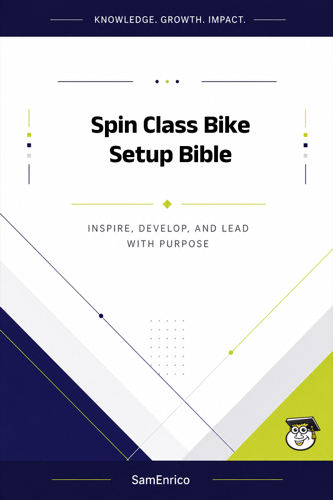
Spin Class Bike Setup Bible eBook
Adjust seat height, handlebar reach, and cleat pos
Adjust seat height, handlebar reach, and cleat position to prevent numbness, knee pain, and lower back strain.
Formats
Free sample
Chapter 1: The Three-Legged Stool--–- The first time Jenna's feet went numb, she was thirty-seven minutes into a forty-five-minute spin class, sweat dripping onto the handlebars, the bass thumping through the studio floor. She ignored it. The second time, her left hand joined the party—ring and pinky fingers tingling like they'd fallen asleep on a long flight. She shook it out, gripped harder, and pushed through. The third time, she almost fell off the bike.It wasn't the intensity that broke her.
It was the walk to the locker room afterward. Her groin felt like she'd been sitting on a garden hose for an hour. Her knees ached with every stair. And her lower back—the kind of dull, gnawing pain that doesn't scream but never shuts up—had settled in for the long haul. Jenna loved spin class.
She loved the music, the camaraderie, the way her lungs burned in a good way. But her body was sending her a message she didn't want to hear: This is not sustainable.Jenna is not real. But her story is. It is the story of millions of spin enthusiasts who walk into a brightly lit studio, clip into a bike, and assume that the machine—and their body—will just figure it out. They don't.
And by the time the pain shows up, the damage is already accumulating.This book exists because of one brutal truth: The number one reason people quit spin class is not lack of fitness, boredom, or time. It is discomfort. Numb feet. Aching knees. Hands that lose feeling.
A lower back that protests every climb. And the single most common response to that discomfort is silence. Riders assume they are doing something wrong. They assume they are not fit enough, not strong enough, not flexible enough. They assume the pain is normal.It is not.Pain is not a sign of virtue.
Pain is not a medal of honor. Pain is data. And in spin class, pain is almost always a symptom of one thing: your bike does not fit you.The Great Misconception Here is the dangerous assumption that ruins more spin careers than any injury: I know how to ride a bike. I've been riding since I was a kid. I can just hop on and go.Outdoor cycling and indoor spin class appear similar.
Both involve pedals, a saddle, handlebars, and circular motion. But the similarities end there. And pretending they are the same is like saying swimming in the ocean is the same as swimming in a pool—technically true, fatally naive.Outdoor bikes move. When you ride outside, the bike tilts, sways, and flexes beneath you. Your body constantly micro-adjusts to road camber, wind gusts, and the natural lateral movement of the drivetrain.
Your hips sway slightly. Your upper body counterbalances. Even your saddle flexes differently because you are never sitting perfectly still for more than a second. These micro-movements absorb small fit errors. If your saddle is 5mm too low on an outdoor bike, you might feel it after two hours.
If your saddle is 5mm too low on a spin bike, you will feel it in ten minutes.Spin bikes are static. The frame is welded steel or aluminum. The bike is bolted to the floor (or weighs over one hundred pounds). There is no lateral give, no flex, no sway. Every imperfection in your fit is amplified with every pedal stroke.
At a cadence of 90 revolutions per minute, a 5mm fit error becomes 450 millimeters of misaligned movement every minute. Over a 45-minute class, that is more than twenty meters of cumulative strain on your knees, hips, and spine.And here is the cruelest irony: spin bikes are more adjustable than most outdoor bikes. They have to be—because they cannot rely on the forgiving physics of motion. But adjustability is a double-edged sword. More levers mean more opportunities to get it wrong.
And most studio bikes are set up by well-meaning instructors who were trained in choreography and motivation, not biomechanics.The Three Anchor Points: Pedal, Seat, Handlebars Every spin bike fit, no matter how advanced, rests on three anchor points. Think of them as a three-legged stool. If any leg is the wrong length, the stool wobbles. If two legs are wrong, you fall. The anchor points are:1.
The Pedal – Where your foot meets the machine. This includes cleat position, Q-Factor (the lateral distance between pedals), and foot alignment. Most riders never adjust their cleats after the first installation. That is a mistake.2. The Seat (Saddle) – Where your pelvis meets the machine.
This includes height, fore/aft position, tilt, and the width of the saddle itself. This is the most adjusted—and most frequently misadjusted—anchor point.3. The Handlebars – Where your hands and torso meet the machine. This includes height, reach (horizontal distance from saddle), and width. Most riders set handlebars based on what looks cool or what the previous rider left behind.
That is a disaster.Here is what almost no one tells you: you cannot adjust these anchor points in isolation. Change your saddle height, and you change the angle of your knee at the bottom of the stroke—which affects your foot pressure. Change your saddle fore/aft, and you change the distance to the handlebars—which affects your back angle. Change your cleats, and you change the tracking of your knee—which affects your hip position.Everything connects to everything. This is the central insight of bike fitting, and it is the organizing principle of this entire book.
You cannot fix numb feet by looking only at your shoes. You cannot fix knee pain by looking only at your saddle height. You have to look at the whole system.The Seated Nerve Tension Screen Before you touch a single adjustment on your bike, you need to know what you are working with. Your body brings its own constraints to the fit—mobility limitations, neural tension patterns, old injuries, asymmetries. Ignoring these constraints is like trying to tune a guitar with broken strings.
No amount of adjustment will make it sound right.This chapter introduces the Seated Nerve Tension Screen. It is not a flexibility test. It is a neural tension test. There is a difference.Flexibility is about muscle length. If your hamstrings are tight, stretching them over time will help.
Neural tension is about how freely your nerves slide through their surrounding sheaths. Nerves are not rubber bands. They do not stretch. But they do need to glide. When a nerve is tethered—stuck to surrounding tissue from scar tissue, inflammation, or simply poor movement patterns—any movement that pulls on that nerve will cause sensations that feel like tightness, pulling, burning, or tingling.
And those sensations will appear long before you reach your true flexibility limit.To perform the Seated Nerve Tension Screen:Sit on a firm chair or the edge of a bench with your back straight and both feet flat on the floor.Extend your right leg straight out in front of you, heel on the floor, toe pointing toward the ceiling.Keep your back straight. Do not slouch. Do not lean back.Now, flex your foot—pull your toes toward your shin as…
This is the end of the free sample. Get the eBook to keep going. Buy now
About this book
Details
- Author
- Hibbard Hortense
- Publisher
- SamEnrico
- Language
- English
- Genre
- Non-Fiction, Health & Wellness, Ergonomics
- Released
- 2026-06-10
- Pages (approx.)
- 146
- Available as
- eBook, Audiobook

Read better in the ZLOADR app
Your eBooks on your phone or tablet. Sign in with your SamEnrico account and start reading.
More by Hibbard Hortense
 Astrophobia Space Fear GuideHibbard Hortense$11.99
 Chronic Illness And Career GuideHibbard Hortense$11.99
 Antwerp Diamond Heist Uncaught Crew MembersHibbard Hortense$11.99
 Stalking Journalist Investigative FilesHibbard Hortense$11.99
 The Vanishing Billionaire: The Enigma of Robert Durst’s Last DaysHibbard Hortense$11.99
 Paws of Justice: The Unsung Hero of the 1993 World Trade Center BombingHibbard Hortense$11.99
 Business Operations CoordinatorHibbard Hortense$11.99
 AI Social Media SchedulerHibbard Hortense$12.99
 Warehouse Worker UnionsHibbard Hortense$12.99
 Understanding Dominant Zonular CataractHibbard Hortense$17.99
 How to Start a Sheer Hosiery Mills BusinessHibbard Hortense$11.99
You may also like
 Hong Kong Handover 1997Dunn Johnnie$11.99
 Zumba For Postnatal Recovery CourseNeal Christian$11.99
 Zumba for BeginnersLadner Nikia$11.99
 YouTube Comment Mining GuideHumes Pandora$12.99
 Worry Box MeditationCarlin Rudy$11.99
 Workplace Stress MeditationNguyen Lynn$11.99
 Workplace Stress and Sleep RepairHawley Ivory$11.99
 Workplace Perfectionism CureDelaney Jeffry$11.99
 Workplace Injustice Anger GuideWallen Isabelle$11.99
 Work Addiction and Burnout LinkGreenwood Ester$11.99
 Women in Yoga and WellnessBeattie Galina$11.99
 Women in Stand Up ComedyChun Evangeline$11.99