
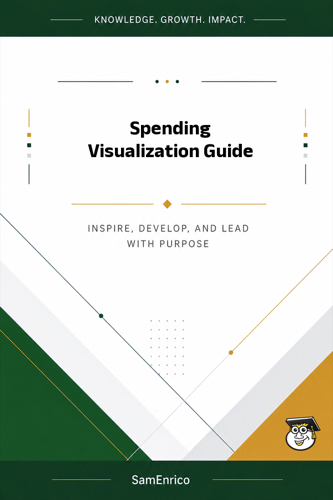
Spending Visualization Guide Audiobook
undefined
by Fain Lyndsey
undefined
Formats
Free sample
Chapter 1: The Pebble Jar...–- Every morning, you wake up, check your phone, and see a number. That number is supposed to represent your security, your freedom, your future. But when you look at it, do you feel anything? Probably not. Not really.
Not the way you feel when you open the refrigerator and see empty shelves, or when you look at your gas gauge hovering just above empty. Those sights trigger something primal: urgency, scarcity, the need to act. A declining bank balance on a screen triggers nothing but a vague sense of unease that you quickly swipe away to check your email or social media.This is the blindness of autopilot. And it is the single greatest reason why otherwise intelligent, capable people remain trapped in cycles of unconscious spending, credit card debt, and end-of-month panic.You have been taught that personal finance is about spreadsheets, budgets, and discipline. You have been told to track every expense, categorize every latte, and force yourself to stick to arbitrary limits.
And when that inevitably fails, you blame yourself. You think you lack willpower. You think you are bad with money. But the truth is far simpler and far more liberating: you have been using the wrong tools. Your brain was not designed to feel urgency from a number on a screen.
It was designed to feel urgency from physical objects, spatial relationships, and tangible consequences.This chapter will introduce the core problem that the entire Spending Visualization Guide exists to solve: spending blindness. You will learn why traditional personal finance tools fail, why small transactions are the most dangerous, and how a simple jar of pebbles can rewire your relationship with money faster than any spreadsheet ever could. You will also meet the Tracking Intensity Guide, which will be your roadmap for using this book without burning out. Because if there is one thing every failed budgeter knows, it is that tracking every penny forever is impossible. This book agrees with you.
That is why we only track intensely for one week.Let us begin by understanding how you became blind to your own money.The Myth of the Rational Spender For decades, personal finance advice has been built on a single, flawed assumption: that human beings are rational calculators of self-interest. Economists call this model Homo economicus—the perfectly logical creature who weighs costs and benefits, discounts future rewards appropriately, and never…
This is the end of the free sample. Get the Audiobook to keep going. Buy now
About this book
Details
- Author
- Fain Lyndsey
- Publisher
- SamEnrico
- Language
- English
- Genre
- Non-Fiction, Self-Help / Visualization
- Released
- 2026-06-07
- Pages (approx.)
- 141
- Available as
- eBook, Audiobook

Listen in the VoxFlicks app
Audiobooks and audio dramas wherever you go. Sign in with your SamEnrico account and press play.
More by Fain Lyndsey
 Eye Contact PersuasionFain Lyndsey$11.99
 Picking Strangers Out of LineupsFain Lyndsey$11.99
 The Sports Event TraffickerFain Lyndsey$11.99
 Cybersecurity Valuation ManualFain Lyndsey$11.99
 Binge Eating and Orthorexia RecoveryFain Lyndsey$11.99
 Ayurvedic Kidney HealthFain Lyndsey$11.99
 SAD Diagnostic GuideFain Lyndsey$11.99
 The Silk Road Blackmail: How a Family Syndicate Ruined Lives (1950s)Fain Lyndsey$11.99
 The Great Airline Heist: How a Single Strike Grounded the SkiesFain Lyndsey$11.99
 How to Start a Aluminium Semi-manufactures Production Business (Beginners Guide)Fain Lyndsey$11.99
 How to Produce TetherballFain Lyndsey$11.99
 A Collector's Handbook to the Ford Taunus 12m(P4)Fain Lyndsey$11.99
You may also like
 Nightmare Visualization GuideSmithson Venus$11.99
 Public Speaking VisualizationCardenas Anabel$11.99
 Morning Visualization GuideManning Bradley$11.99
 Scripting VisualizationsSwitzer Lecia$11.99
 Goal Visualization GuideLemons Dewayne$11.99
 Self Esteem Visualization GuideLemke Audie$11.99
 Resilience VisualizationWillson Trudi$11.99
 Job Loss VisualizationKrieger Janella$11.99
 Imagery Association GuideWade Elias$11.99
 Habit Visualization GuideHiatt Celina$11.99
 Goal Setting VisualizationTaft Micah$11.99
 Financial Stress Visualization GuideOneal Gussie$11.99