
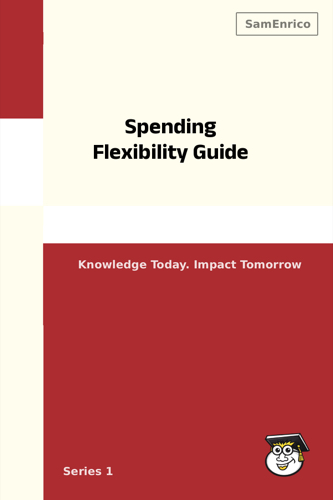
Spending Flexibility Guide eBook
Teaches adjusting expenses during poor market perf
by Mayes Anette
Teaches adjusting expenses during poor market performance.
Formats
Free sample
Chapter 1: The Rubber Band--–- The moment your financial world shatters is rarely loud. There are no sirens, no flashing red lights on your dashboard, no certified letter arriving by mail. For most people, it happens quietly, on a Tuesday night, while checking a retirement account balance they probably should have ignored. The number is smaller than it was last month. Much smaller.
And suddenly, the budget that worked perfectly for three years feels like a trap.This book exists because that moment is coming for you. Not because you are irresponsible or unlucky, but because markets fall. They always have and they always will. The question is not whether you will experience a downturn. The question is whether your spending will bend when it arrives—or whether it will break.Consider two families.
The first, the Harrisons, are meticulous budgeters. They use a popular app, track every dollar, and pride themselves on never overspending their carefully crafted categories. When the market drops, they tighten further. They cut the dining out line item from $200 to $50. They cancel the gym membership.
They put a pause on their child’s music lessons. They feel disciplined, virtuous, and miserable. Three months later, they have fought seventeen times about money, secretly resent each other, and abandoned most of the cuts anyway. Their budget didn’t survive contact with reality.The second family, the Chens, have never tracked a single transaction. They spend roughly the same amount each month, but they don’t categorize or track.
When the market drops, they don’t panic. They don’t cut the music lessons because those bring genuine joy to their child. Instead, they pause their vacation fund, cook at home an extra two nights a week, and delay replacing the older car for another year. They don’t feel deprived because they didn’t cut anything that mattered. Their spending bent.Which family would you rather be?
The Harrisons, with their perfect spreadsheet and shattered peace of mind? Or the Chens, with their messy but functional flexibility?This book argues that the Chens have the right idea, even if they couldn’t articulate it. Spending flexibility is not about tracking every dollar. It is about knowing which dollars matter and which dollars can move. It is about building a system that contracts when the market contracts and expands when the market recovers—without guilt, without spreadsheet paralysis, and without fighting with your spouse.Welcome to the Spending Flexibility Guide.The Glass Rod Fallacy Let me name the enemy.
It is not inflation, though inflation hurts. It is not job loss, though job loss terrifies. The enemy is rigidity itself—the belief that a good budget is a fixed budget, that discipline means sticking to a number regardless of circumstances, that cutting spending is always a moral victory.I call this the Glass Rod Fallacy.A glass rod is beautiful. It is precise, transparent, and satisfying to hold. But apply even moderate pressure, and it shatters into a thousand pieces.
The same is true of rigid budgets. They look perfect on paper. They give you a feeling of control. But the moment life applies pressure—a market crash, a medical emergency, a job transition, an unexpected repair—they explode, leaving you to sweep up the pieces while also managing the crisis.Here is what the personal finance industry does not want you to know. Rigid budgets are not just ineffective during volatility.
They are counterproductive. They train your brain to see spending as the enemy, which leads to deprivation psychology. Deprivation leads to bingeing. Bingeing destroys progress. And the cycle repeats.The research backs this up.
A 2019 study in the Journal of Consumer Research found that people who used strict, line-item budgets were significantly more likely to abandon their financial plans entirely after a moderate financial shock than those who used flexible spending targets. The rigid budgeters didn’t just fail to adjust. They gave up.Why? Because their identity was tied to hitting the numbers. When the numbers became impossible, they experienced what psychologists call “moral licensing” in reverse—if I can’t be perfect, why try at all?
The flexible spenders, by contrast, never expected perfection. They expected adjustment. And adjustment, it turns out, is sustainable.Introducing the Rubber Band Model If rigid budgets are glass rods, flexible spending is a rubber band.A rubber band has three properties that make it an ideal metaphor for managing money during volatility. First, it has a resting state—your normal spending level when markets are calm. Second, it can stretch under tension—contracting your spending during downturns without breaking.
Third, it returns to its original shape when the tension releases—expanding back to normal spending when markets recover, without losing its elasticity for the next cycle.The Rubber Band Model is the central framework of this book. It replaces the question “How do I stick to my budget?” with three better questions:What is my normal spending range? (The resting state)How much can I safely cut without damaging my quality of life? (The stretch capacity)How quickly can I adjust when market signals tell me to? (The response time)Notice what is missing from these questions.
There is no guilt. There is no perfectionism. There is no moral judgment about the coffee you bought or the takeout you ordered. There is only a practical assessment of capacity and speed.The Rubber Band Model does not care whether you track every dime. It cares whether you know your flex range—the distance between your normal spending and your survival spending.
It cares whether you have identified your trigger points—the market conditions that tell you to stretch. And it cares about your response time—the days between a market drop and your spending adjustment.Everything else is noise.Why Most People Fail at Cutting Spending Before we build your rubber band, we need to understand why most attempts at spending flexibility fail. I have analyzed hundreds of case studies across economic cycles, and the failures fall into three predictable patterns.Failure Pattern One: Cutting What Brings Joy Instead of What Costs Money When people panic, they cut the small things that make life enjoyable—the coffee, the streaming service, the dinner with friends—while leaving the large, semi-fixed expenses untouched. This is backward. Cutting a $6 coffee saves $180 a month.
Cutting your grocery bill by 20 percent through smarter shopping saves $200 a week. Which one will you notice more? The coffee cut creates daily deprivation. The grocery optimization creates savings you barely feel.The correct order is always: cut the expensive but low-joy items first, then optimize the big categories, then, only if necessary, consider cuts to high-joy items. Most people do the reverse because small cuts feel easier.
But easy is not effective.Failure Pattern Two: Cutting Too Late The average American household takes forty-four days to reduce discretionary spending after a market peak. By then, the damage is done. The portfolio has already dropped. The emergency fund has already been tapped. The opportunity to preserve capital has passed.Cutting late is often worse than not cutting at all, because it combines the pain of deprivation with minimal financial benefit.…
This is the end of the free sample. Get the eBook to keep going. Buy now
About this book
Details
- Author
- Mayes Anette
- Publisher
- SamEnrico
- Language
- English
- Genre
- Non-Fiction, Business Brief, Spending Flexibility
- Released
- 2026-06-06
- Pages (approx.)
- 155
- Available as
- eBook, Audiobook

Read better in the ZLOADR app
Your eBooks on your phone or tablet. Sign in with your SamEnrico account and start reading.
More by Mayes Anette
 India Green Tax GuideMayes Anette$11.99
 Self Doubt In Journalism GuideMayes Anette$11.99
 From Fixed To Growth GuideMayes Anette$11.99
 The Interruption Cost CalculatorMayes Anette$11.99
 Female Psychopathy Case StudiesMayes Anette$11.99
 Temptation Bundling GuideMayes Anette$11.99
 Cheap Outsourcing GuideMayes Anette$11.99
 The Great Bank Job: How Hackers Stole Millions Before the Internet AgeMayes Anette$11.99
 Bong Joon-ho’s Parasite: The Oscar Upset That Shook HollywoodMayes Anette$11.99
 Understanding Intracranial HypertensionMayes Anette$11.99
 How to Produce Skin Care ToolsMayes Anette$11.99
 How to Produce Furniture SetsMayes Anette$11.99