
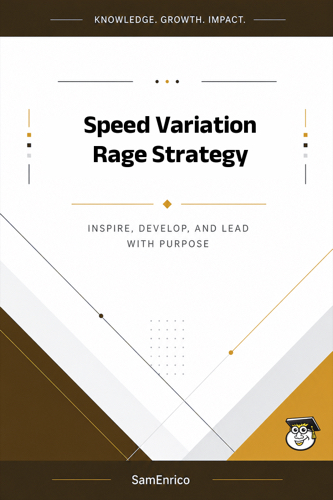
Non-FictionSelf-HelpSpeed Acceptance
Speed Variation Rage Strategy eBook
Accept natural speed fluctuations without needing
Accept natural speed fluctuations without needing to pass everyone.
Formats
Free sample
Chapter 1: The Cruise Control Conspiracy--You are driving home from work on a Friday afternoon. The sun is low and golden, casting long shadows across the asphalt. You set your cruise control to exactly seventy miles per hour—the legal limit, the responsible choice, the adult decision. The engine settles into a quiet hum. The tires whisper against the pavement.
For ten glorious minutes, you feel like a master of the road. You are steady. You are reasonable. You are everything a good driver should be.Then you see it.A dark sedan in the distance, growing larger in your windshield. You are gaining on it.
Not rapidly—just steadily, inexorably, like the hands of a clock moving toward an appointment you did not schedule. Your speedometer still reads seventy. The sedan, you realize, is doing sixty-five. Five miles per hour slower. That is all.But something strange happens inside your body.
Your jaw tightens. Your fingers curl more firmly around the steering wheel, the leather creaking under your grip. Your right foot, which had been resting comfortably on the floor, now hovers over the accelerator like a predator over prey. You feel… angry. Not mildly annoyed.
Not briefly frustrated. Genuinely, viscerally angry. The sedan driver, you decide in a flash of righteous indignation, is an idiot. A moron. A menace to society who has no business being on a public highway.
They are blocking you. Deliberately, it seems. Personally.You check your mirrors. The left lane is clear. You signal, merge, accelerate to seventy-five.
You pass the sedan. You glare at the driver as you go by—a middle-aged woman with both hands on the wheel, staring straight ahead, completely unaware of the war crime you believe she has committed against you. You merge back into the right lane and resume your seventy miles per hour cruise control. Victory. You feel a small rush of satisfaction, a dopamine hit that says: You showed them.
You won.Here is the question this entire book exists to answer: What just happened?You did not arrive home any earlier than you would have if you had simply stayed behind that sedan for the remaining eight miles of your commute. The mathematics are brutal and unforgiving. At a two-mile-per-hour speed differential, passing a single car saves you approximately 2.5 seconds over ten miles. You can blink three times in 2.5 seconds. You just raised your blood pressure, tightened your muscles, and risked a traffic violation for the time it takes to sneeze.And yet it felt urgent.
It felt necessary. It felt like survival.This chapter will show you why. It will reveal the neurological conspiracy engineered into every modern car—a conspiracy designed to make you feel slower than you actually are, angrier than you need to be, and more desperate to pass than mathematics could ever justify. You are not a bad person for feeling road rage. You are not uniquely impatient or flawed.
You are the victim of a sophisticated sensory manipulation that begins the moment you buckle your seatbelt.The Adaptation Effect: Your Brain's Broken Speedometer Let us begin with the biology, because the conspiracy cannot be understood without first understanding the organ the conspiracy targets: your brain.The human body is not designed to sense speed directly. We have no internal speedometer. What we have instead is a vestibular system—a set of fluid-filled canals in our inner ears that detect changes in acceleration and rotation. This system is remarkably sensitive. It can detect a tilt of less than one degree.
It can register a change in velocity as subtle as a gentle breeze. But it has one critical limitation: it cannot maintain a constant signal.Think of it this way. When you first step into a hot shower, the water feels scalding. Your skin's thermoreceptors fire rapidly, sending urgent signals to your brain: Too hot! Danger!
But after a few minutes, the same water feels merely warm. Your thermoreceptors have adapted. They have stopped firing because the stimulus is no longer novel. Your brain has recalibrated its baseline.The same thing happens with speed. When you first accelerate to seventy miles per hour, your vestibular system registers the change.
Your brain notes: We are moving faster now. But within five to ten minutes of sustained speed, your vestibular system adapts. The signal fades. Seventy miles per hour becomes the new baseline—the new zero. Your brain literally forgets how fast you are going.This is called the Adaptation Effect, and it is not a design flaw.
It is a feature of how nervous systems work. Without adaptation, the world would be overwhelming. Every texture of every fabric would feel as sharp as sandpaper. Every sound would be as loud as a fire alarm. Every temperature change would feel like burning.
Adaptation allows us to filter out the constant and attend to the changing. It is essential for survival.But on the highway, it becomes a trap.After ten minutes at seventy miles per hour, your brain has recalibrated. Seventy feels like standing still. So when you encounter a car doing sixty-five—a perfectly reasonable, perfectly legal, perfectly safe speed—your adapted brain interprets that five-mile-per-hour difference not as a small variation but as a catastrophic slowdown. That sedan feels like it is crawling.
It feels like it is moving backward. Your brain, having forgotten what sixty-five feels like, screams at you: We have stopped! Something is wrong! Pass!This is not a metaphor. Functional MRI studies of drivers experiencing the Adaptation Effect show increased activity in the amygdala—the brain's threat detection center—when a slower vehicle is encountered after sustained high-speed driving.
Your brain literally registers a car going five miles per hour slower as a threat. Not an inconvenience. A threat.The gap between perception and reality is enormous. That five-mile-per-hour difference—the difference between seventy and sixty-five—is roughly the speed of a brisk jog. Imagine standing on a sidewalk, watching a person jog past, and feeling your heart rate spike with anger.
Imagine feeling threatened by a jogger. That is what your brain is doing every time you encounter a car going five miles per hour slower than you.The Conspiracy: How Automakers Weaponized Your Biology Now we arrive at the conspiracy. Because automakers know about the Adaptation Effect. They have known for decades. And instead of designing cars to mitigate it—to keep you calibrated to reality—they have systematically engineered vehicles to accelerate and deepen the adaptation, because a driver who feels slow is a driver who wants to go faster, and a driver who wants to go faster is a driver who buys a more powerful car.Let us travel back in time.
In 1985, you are driving a car from that era—say, a Ford Taurus or a Honda Accord. The windows are thin. The engine is loud. There is no active noise cancellation, no sound-dampening glass, no electronic power steering. At seventy miles per hour, the wind roars through the door seals.
The engine whines at three thousand RPM. The tires hum against the asphalt. You can feel the road texture through the steering wheel—every seam in the pavement, every slight imperfection.…
This is the end of the free sample. Get the eBook to keep going. Buy now
About this book
Details
- Author
- Guenther Ward
- Publisher
- SamEnrico
- Language
- English
- Genre
- Non-Fiction, Self-Help, Speed Acceptance
- Released
- 2026-06-09
- Pages (approx.)
- 145
- Available as
- eBook, Audiobook

Read better in the ZLOADR app
Your eBooks on your phone or tablet. Sign in with your SamEnrico account and start reading.
More by Guenther Ward
 Spa Visualization Relaxation MethodGuenther Ward$11.99
 Vacation Work Disconnect GuideGuenther Ward$11.99
 The Tu Youyou Artemisinin QuestGuenther Ward$11.99
 Titian's Palette: Painting the Soul of VeniceGuenther Ward$11.99
 Software Verification EngineerGuenther Ward$11.99
 A Beginners Guide to Freestyle BMX (Volume 1)Guenther Ward$11.99
 Canadian Graduate Startup Visa RouteGuenther Ward$12.99
 Adyen SWOT LibraryGuenther Ward$12.99
 Understanding OsteocraniostenosisGuenther Ward$17.99
You may also like
 Hong Kong Handover 1997Dunn Johnnie$11.99
 Zumba For Postnatal Recovery CourseNeal Christian$11.99
 Zumba for BeginnersLadner Nikia$11.99
 YouTube Comment Mining GuideHumes Pandora$12.99
 Worry Box MeditationCarlin Rudy$11.99
 Workplace Stress MeditationNguyen Lynn$11.99
 Workplace Stress and Sleep RepairHawley Ivory$11.99
 Workplace Perfectionism CureDelaney Jeffry$11.99
 Workplace Injustice Anger GuideWallen Isabelle$11.99
 Work Addiction and Burnout LinkGreenwood Ester$11.99
 Women in Yoga and WellnessBeattie Galina$11.99
 Women in Stand Up ComedyChun Evangeline$11.99