
Non-FictionSelf-HelpSpeed Learning
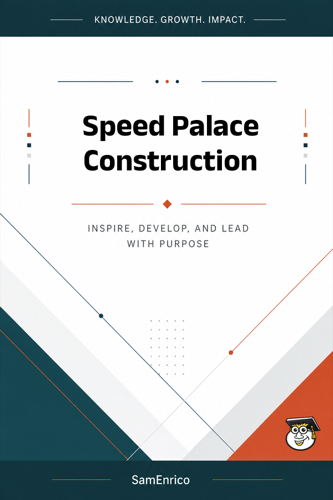
Speed Palace Construction eBook
Build usable memory palaces in under five minutes
Build usable memory palaces in under five minutes for rapid learning.
Formats
Free sample
Chapter 1: The Urgency Algorithm--–- The alarm screams at 5:47 AM. You have a presentation in four hours, thirty-six minutes of commuting, a forgotten lunch to pack, and sixteen slides you haven't memorized. Your pulse quickens. Your palms feel slick. And then, against all logic, you remember everything.This is not an accident.
This is not a miracle. This is your brain's ancient survival system activating exactly as evolution designed it. For millions of years, the difference between life and death was often a single remembered detail—the location of water in a drought, the shape of a predator's footprint, the direction of a seasonal migration. Your brain did not evolve to help you relax. It evolved to help you survive under pressure.
And in the pages ahead, you will learn to weaponize that pressure for the first time in your life.Most memory training begins with a seductive lie: "Relax. Breathe deeply. Visualize slowly. Take your time." This advice sounds wise, feels calming, and produces precisely the opposite result of what you need. When you relax, your brain downregulates its encoding machinery.
When you slow down, you signal to your hippocampus that nothing urgent is happening. When you take your time, you are effectively telling your memory system, "This information doesn't really matter."The truth is uncomfortable but liberating: speed sharpens memory. Mild time pressure increases epinephrine and norepinephrine levels, which sharpen focus, enhance pattern recognition, and dramatically improve memory encoding. The same chemicals that make your heart race before a big exam or an important meeting are the exact chemicals that lock information into long-term storage. You have been fighting your own biology by trying to calm down.
It is time to fight with it instead.The Great Slowing Lie Let us examine the conventional wisdom you have probably heard from well-meaning meditation gurus, study skills coaches, and even some memory competitors. They tell you to relax your body, clear your mind, breathe deeply, and visualize each image with crystalline clarity. They tell you to spend thirty minutes walking through a single memory palace, polishing each locus until it shines. They tell you that memory is a gentle art requiring patience and peace.This is wrong. And worse, it is actively harmful for most people.The scientific literature on arousal and memory is remarkably consistent.
Studies dating back to the 1970s have shown that moderate physiological arousal—the kind produced by a deadline, a competition, or even a mild electric shock—improves memory consolidation for emotionally neutral information. In one landmark 1994 study by Cahill and Mc Gaugh, participants who watched an emotionally arousing film recalled more details than those who watched a neutral version, even when the neutral version was longer and more detailed. The key variable was not time spent encoding. It was the emotional and physiological state of the learner.More recent research has pinpointed the mechanism. When you experience mild time pressure, your adrenal glands release epinephrine, which activates the vagus nerve, which signals the amygdala, which then tells the hippocampus, "This information might be important.
Lock it in." This cascade happens in milliseconds. You do not need to meditate. You do not need to chant. You need only a ticking clock.Yet the "relax and visualize slowly" myth persists because it feels intuitive. If you are stressed about forgetting something, it seems logical to reduce that stress before trying to remember.
But this logic inverts the actual neurochemistry. The stress is not the enemy. The stress is the signal. Your brain is already screaming, "Pay attention!" The worst thing you can do is try to silence that scream.Consider two students preparing for the same medical school exam. Student A follows conventional advice: she finds a quiet room, lights a candle, puts on ambient music, and spends forty minutes carefully constructing a single memory palace with detailed, peaceful images.
Student B follows the Speed Palace method: he sets a five-minute timer, feels his heart rate increase, and rapidly constructs a blurry but functional palace using absurd, violent, and ridiculous images. Who performs better on the exam?The data from cognitive psychology suggests Student B will outperform Student A by a significant margin—not because he is smarter or more disciplined, but because his encoding conditions matched his retrieval conditions. When you learn under mild pressure, you are better able to recall under pressure. When you learn in a relaxed state, you are better able to recall only when relaxed. Since exams, presentations, and high-stakes conversations rarely happen in candlelit rooms with ambient music, the relaxed learner is at a severe disadvantage.The Activation State: Your Brain's Turbo Mode What we are calling "activation" is a specific neurophysiological state characterized by increased heart rate, narrowed attention, heightened sensory processing, and accelerated neural firing in the prefrontal cortex and hippocampus.
This is not the same as anxiety. Anxiety is activation plus catastrophic thinking. Activation alone is simply the brain's way of saying, "Something is happening. I should prepare."You have experienced activation many times without recognizing it. When you are playing a fast-paced video game and you suddenly remember you left the oven on—that is activation.
When you are rushing to finish a work project before a deadline and you effortlessly recall where you left your keys—that is activation. When you are in the middle of a heated argument and you remember an obscure fact from five years ago that perfectly supports your position—that is activation.The common thread in all these examples is urgency. Your brain detected a need for rapid action and unlocked memory resources that are normally unavailable during calm, reflective states. This is not a bug. This is a feature.
Your brain is conserving energy most of the time. It runs in a low-power mode, like a smartphone on battery saver. Only when you need to perform does it switch to high-performance mode.The problem is that most memory training programs keep your brain in battery saver mode. They tell you to relax, which is exactly what your brain wants to do. They tell you to take your time, which signals that nothing urgent is happening.
They tell you to be gentle with yourself, which is the opposite of the competitive, survival-oriented state your brain evolved to learn in.Activation feels different. Your breathing becomes shallower but more rhythmic. Your field of vision narrows slightly. You lose awareness of peripheral distractions. Time seems to speed up or slow down depending on your focus.
You may feel a slight tension in your jaw or shoulders. These are not signs of failure. They are signs that your brain is shifting gears.The challenge, and the opportunity, is learning to access this activation state on command, without slipping into full anxiety. The difference between productive activation and destructive anxiety is entirely about interpretation. Your body produces the same physiological response—increased heart rate, faster breathing, narrowed attention.
Your mind decides whether to label that response "excitement and focus" or "fear and panic."The 60-Second Cognitive Priming Warm-Up Before you build your first speed palace, you need to prime your brain for activation. This is not meditation. This is not breathing exercises for relaxation. This…
This is the end of the free sample. Get the eBook to keep going. Buy now
About this book
Details
- Author
- Turnbull Shanta
- Publisher
- SamEnrico
- Language
- English
- Genre
- Non-Fiction, Self-Help, Speed Learning
- Released
- 2026-06-06
- Pages (approx.)
- 145
- Available as
- eBook, Audiobook

Read better in the ZLOADR app
Your eBooks on your phone or tablet. Sign in with your SamEnrico account and start reading.
More by Turnbull Shanta
 Self Esteem for Ex OffendersTurnbull Shanta$11.99
 The Workaholic's Cognitive TherapyTurnbull Shanta$11.99
 The Mount Carmel DeconversionTurnbull Shanta$11.99
 DuVernay Social VoiceTurnbull Shanta$11.99
 Pyramids of Giza GuideTurnbull Shanta$11.99
 Asthma Emergency Action PlanTurnbull Shanta$11.99
 Solo Descent into the AbyssTurnbull Shanta$11.99
 Perceval SpencerTurnbull Shanta$11.99
 Seams of Power: How a Dressmaker Toppled a Fashion DynastyTurnbull Shanta$11.99
 Hippocrates to Hippocrates: The Legacy of Western MedicineTurnbull Shanta$11.99
 The Hollow Men: Anatomy of a ShadowTurnbull Shanta$11.99
 The Dancer's Guide to AzontoTurnbull Shanta$11.99
You may also like
 Hong Kong Handover 1997Dunn Johnnie$11.99
 Zumba For Postnatal Recovery CourseNeal Christian$11.99
 Zumba for BeginnersLadner Nikia$11.99
 YouTube Comment Mining GuideHumes Pandora$12.99
 Worry Box MeditationCarlin Rudy$11.99
 Workplace Stress MeditationNguyen Lynn$11.99
 Workplace Stress and Sleep RepairHawley Ivory$11.99
 Workplace Perfectionism CureDelaney Jeffry$11.99
 Workplace Injustice Anger GuideWallen Isabelle$11.99
 Work Addiction and Burnout LinkGreenwood Ester$11.99
 Women in Yoga and WellnessBeattie Galina$11.99
 Women in Stand Up ComedyChun Evangeline$11.99