
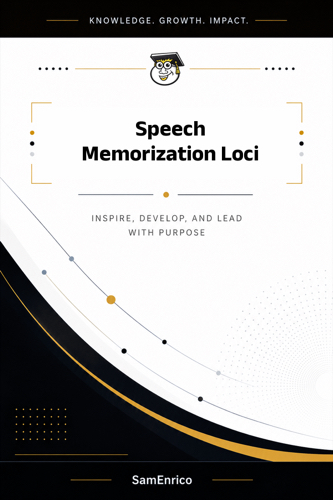
Non-FictionSelf-HelpPublic Speaking
Speech Memorization Loci eBook
Deliver presentations without notes using memory p
by Roney Louie
Deliver presentations without notes using memory palace for scripts.
Formats
Free sample
Chapter 1: The Broken Connection--–- The first time I watched a promising career die on stage, I was sitting in the third row of a hotel ballroom in Austin, Texas. The speaker was a regional sales director named Margaret—brilliant, funny, and utterly unprepared for what happened next. She had delivered the same quarterly presentation twenty-three times before without incident. But on this day, three minutes into her opening, she glanced down at her notecards and froze. Not because she forgot her words.
Because she saw something that shattered her confidence. Her audience wasn't looking at her. They were looking at the cards. And in that moment, she became a narrator reading a script, not a leader commanding a room.Margaret did what most people do when their notes become a prison instead of a safety net. She shuffled.
She cleared her throat. She looked down again, searching for her place, and the silence stretched for six seconds that felt like six minutes. When she finally found her line, the energy in the room had shifted. The audience wasn't leaning in anymore. They were leaning back, arms crossed, waiting for her to finish so they could check their phones.
She lost the deal that day. Not because her product was bad. Not because her data was wrong. But because her notes told the room a story she didn't intend to tell: I don't trust myself, and neither should you.This book exists because that moment should never happen to you.The Lie We Tell About Notes We have been taught, from our first school presentation to our most recent boardroom pitch, that notes are a sign of preparation. Teachers praised us for bringing index cards.
Bosses encouraged us to have a "safety net." The implicit message is that written reminders demonstrate professionalism—that the responsible speaker prepares a script and sticks to it.This is a dangerous half-truth.Notes are indeed a sign of preparation. But they are also a sign of separation. Every time your eyes leave your audience to find a word on a page, you break the neurological bridge that turns a speech into a conversation. And here is what the research shows, though you already know it in your bones: the more you look at your notes, the less your audience trusts you.A 2016 study from the University of British Columbia tracked eye contact patterns across two hundred business presentations. The researchers found a direct, linear relationship between gaze duration and perceived credibility.
Speakers who maintained eye contact for more than seventy percent of their presentation were rated as "highly trustworthy." Those who dropped below forty percent—which is exactly where notecard users typically land—were described with words like "unprepared," "dishonest," and even "slippery."Think about that for a moment. Your audience, sitting in those chairs, has no idea whether you wrote your speech or memorized it. They don't care about your preparation process. What they perceive, unconsciously and instantly, is avoidance. When you look down at a card, you are, in that microsecond, leaving them.
Their mirror neurons—the brain cells that fire both when you perform an action and when you observe someone else performing it—register a disconnection. They feel, on a biological level, that you have turned away from them.And they punish you for it.The Mandela Standard There is a reason so many public speaking coaches invoke Nelson Mandela's name. It is not merely because he was a great orator. It is because he represents the outer limit of what memorization can achieve: a speaker who held the attention of millions without ever appearing to read.Mandela memorized his speeches verbatim. Not the gist.
Not bullet points. Every word, every pause, every rhetorical turn. He considered this a moral obligation. In his autobiography, Long Walk to Freedom, he wrote that reading a speech to an audience was "a form of disrespect"—as if the speaker had not bothered to internalize the message well enough to look the listener in the eye.Consider the Rivonia Trial speech of 1964, three hours long, delivered from the dock of a Pretoria courtroom with the knowledge that the words might be his last. Mandela had written every sentence.
He had rehearsed every gesture. And when he spoke, he did not glance at a single page. He looked at the judge, at the gallery, at the guards—and he held them. The speech became a founding document of modern South Africa not because of its arguments alone, but because of the presence of the man delivering them.I tell you this not to intimidate you. I tell you this because Mandela was not a memory prodigy born with a photographic recall.
He was a lawyer who trained himself. He used techniques very similar to the ones you will learn in this book. And if he could memorize a three-hour speech that might send him to prison, you can memorize a fifteen-minute keynote that might win you a promotion.The difference between Mandela and Margaret—the sales director who lost her deal—was not intelligence, charisma, or luck. It was method. He had one.
She did not.What Mirror Neurons Reveal About Your Audience Let us go deeper into the neuroscience, because understanding why notes damage your credibility will give you the motivation to abandon them.In the 1990s, a team of Italian neurophysiologists led by Giacomo Rizzolatti discovered something extraordinary in the brains of macaque monkeys. Certain neurons fired not only when the monkey performed an action—like reaching for a peanut—but also when the monkey watched another monkey perform the same action. These cells, which they named mirror neurons, were later found in humans as well.The implications are profound. When you watch someone else experience an emotion, your brain simulates that emotion. When you watch someone wince after stubbing their toe, your own pain circuitry activates weakly.
When you watch someone smile, your reward centers light up. This is why laughter is contagious. This is why a good actor can make you cry. Your brain literally cannot distinguish, at a fundamental level, between your own experience and the experience you observe in others.Now apply this to public speaking.When you look at your notes, your audience's mirror neurons simulate your experience of looking away. They feel, in a muted but real way, the act of disengaging.
They do not think, "Oh, she is checking her notes." They feel, Something just broke here. When you look back up, they feel relief—but the damage accumulates. Each glance is a small rupture in the shared emotional space.But when you speak without notes, something magical happens. Your audience's mirror neurons simulate full engagement. They see you looking at them, and they feel seen.
They see you calm and present, and their own anxiety decreases. They see you recalling a complex idea without effort, and they unconsciously trust your expertise.This is not mysticism. This is biology. And it is the single most important reason to learn the techniques in this book. You are not memorizing words.
You are preserving connection.The Eye-Audience Trust Curve Let me give you a concrete framework that you can test for yourself.I…
This is the end of the free sample. Get the eBook to keep going. Buy now
About this book
Details
- Author
- Roney Louie
- Publisher
- SamEnrico
- Language
- English
- Genre
- Non-Fiction, Self-Help, Public Speaking
- Released
- 2026-06-07
- Pages (approx.)
- 128
- Available as
- eBook, Audiobook

Read better in the ZLOADR app
Your eBooks on your phone or tablet. Sign in with your SamEnrico account and start reading.
More by Roney Louie
 Work Addiction in MilitaryRoney Louie$11.99
 Veteran PTSD Night RestRoney Louie$11.99
 The Waco Armored Personnel CarrierRoney Louie$11.99
 Carpenter Synth KingRoney Louie$11.99
 Emergency Evacuation Plan for PetsRoney Louie$11.99
 Elizabeth I's Marriage Negotiation GuideRoney Louie$11.99
 Akhenaten Heretic KingRoney Louie$11.99
 Caregiver Burnout SolutionsRoney Louie$11.99Caregiver Burnout SolutionsRoney Louie$11.99
 The First Brain Surgeons: Prehistoric Trepanation and the Birth of NeuroscienceRoney Louie$11.99
 The Silent Spy: How a Schoolteacher Outwitted the KGBRoney Louie$11.99
 The American Enlightenment: Jefferson, Franklin, and the Birth of a RepublicRoney Louie$11.99
You may also like
 Hong Kong Handover 1997Dunn Johnnie$11.99
 Zumba For Postnatal Recovery CourseNeal Christian$11.99
 Zumba for BeginnersLadner Nikia$11.99
 YouTube Comment Mining GuideHumes Pandora$12.99
 Worry Box MeditationCarlin Rudy$11.99
 Workplace Stress MeditationNguyen Lynn$11.99
 Workplace Stress and Sleep RepairHawley Ivory$11.99
 Workplace Perfectionism CureDelaney Jeffry$11.99
 Workplace Injustice Anger GuideWallen Isabelle$11.99
 Work Addiction and Burnout LinkGreenwood Ester$11.99
 Women in Yoga and WellnessBeattie Galina$11.99
 Women in Stand Up ComedyChun Evangeline$11.99