
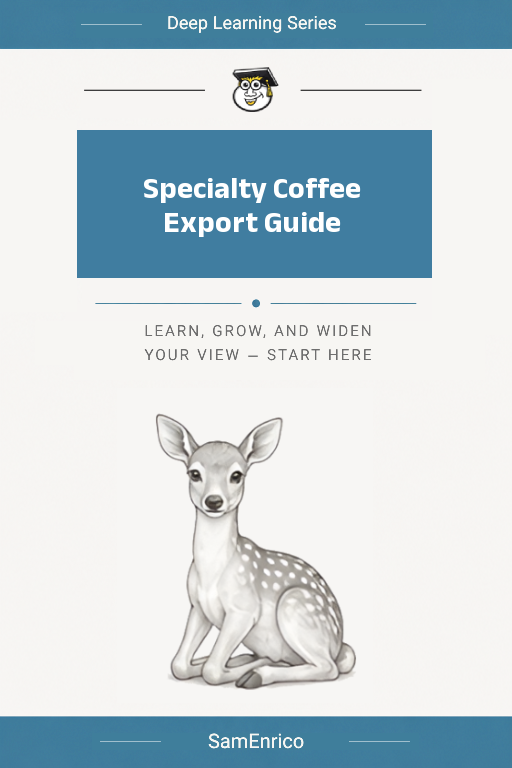
Non-FictionForecast & OutlookCoffee Market
Specialty Coffee Export Guide eBook
Analyze Colombian, Peruvian, and Brazilian high-en
by Pedersen Chi
Analyze Colombian, Peruvian, and Brazilian high-end coffee production, direct trade, and certification.
Formats
Free sample
Chapter 1: The Triangulation Lie--Most coffee exporters learn the hard way that treating Brazil, Colombia, and Peru as interchangeable origins is a costly mistake. I learned it with an $87,000 loss on a single container that should never have been packed the way it was.The year was 2019. I had built what I thought was a smart portfolio: twenty bags of a fruity Brazilian natural from Cerrado Mineiro scoring 86 points, fifteen bags of a washed Colombian Excelso from Huila at 87 points, and ten bags of a high-altitude organic Peruvian from Cajamarca at 88 points. My buyer, a mid-sized roaster in the Netherlands, wanted variety. I wanted to maximize container space.
So I stuffed them all into the same forty-foot container, separated only by cardboard dividers, and sent them off with a sense of efficiency I mistook for expertise.Six weeks later, I received the email that still makes me wince. The buyer had opened the container to find that the Brazilian natural had off-gassed residual moisture during the crossing. The humidity had migrated. The Peruvian organic, dried slowly on raised beds and particularly absorbent, had taken on musty notes. The Colombian washed, normally stable, now carried a faint fermented character that hadn't existed at loading.
The entire container was rejected. Not just the Brazilian. All forty-five bags. The buyer couldn't separate the lots cleanly enough to trust any of them.That shipment taught me what this chapter will teach you: Brazil, Colombia, and Peru are not interchangeable. They are not three versions of the same product.
They are three distinct supply chains with different strengths, different weaknesses, different risk profiles, and—most critically—different buyers. Treating them the same way will cost you money. Treating them strategically will make you money.This chapter introduces the Triangulation Strategy, a framework for building a South American coffee portfolio that leverages each country's comparative advantage while avoiding the costly collisions I learned about the hard way. You will learn why most exporters fail at this, how to match buyer types to specific origins, and why the common advice to "diversify across South America" is dangerously incomplete without a country-specific procurement model.The Three-Country Trap South America produces roughly 45 percent of the world's Arabica coffee. Brazil alone accounts for nearly 40 percent of global production.
Colombia adds another 10 to 12 percent. Peru contributes about 3 to 4 percent but dominates the organic segment. Any exporter looking to build a serious specialty portfolio will eventually need to source from all three. The trap is assuming that what works in one country works in the others.Let me be clear about what does not transfer:Processing infrastructure does not transfer. Brazil's mechanical dryers and massive patios cannot be replicated in Peru's high-altitude, rain-prone farms.
Colombia's wet mills cannot be airlifted to the Cerrado.Traceability systems do not transfer. The FNC's centralized platform in Colombia has no equivalent in Peru, where cooperatives range from highly organized to essentially fictional.Logistics networks do not transfer. Shipping from Santos to Rotterdam is a well-oiled machine. Shipping from Pucallpa to anywhere is an exercise in creative problem-solving.Buyer expectations do not transfer. A roaster buying Brazilian naturals for espresso blends has different quality criteria, price sensitivity, and certification requirements than a roaster buying Peruvian organic for single-origin pourover.The exporters who succeed are not the ones who master one country.
They are the ones who master the differences between countries. They know when to use Brazil's volume advantage and when to avoid it. They know when Colombia's brand equity justifies a premium and when it is just marketing noise. They know how to navigate Peru's organic fragmentation without falling into fraud traps.Comparative Advantage vs. Competitive Advantage Before we dive into country-specific strategies, we need a framework for understanding why these three countries dominate their respective niches.
Economists distinguish between comparative advantage and competitive advantage. The distinction matters more in specialty coffee than almost any other agricultural commodity.Comparative advantage is what a country is naturally good at. Brazil has vast, flat, arable land suitable for mechanization. Colombia has mountainous terrain and a labor force trained over generations in hand-picking. Peru has high altitudes, remote forests, and a history of organic farming by necessity rather than choice.
These are gifts of geography and history. They are difficult to replicate and relatively stable over time.Competitive advantage is what a country strategically develops. Brazil invested in Denomination of Origin certification, mechanized harvesting, and batch consistency technology. Colombia built the FNC into a global marketing machine. Peru invested in organic certification infrastructure and group certification models.
These are choices. They can be copied, improved, or abandoned.The most successful exporters understand both. They leverage comparative advantage for cost efficiency and competitive advantage for differentiation and premiums.Here is how this framework applies to our three countries:Country Comparative Advantage Competitive Advantage Strategic Implication Brazil Flat land, mechanization, consistent climate Cerrado DO, Truthful Traceability, batch consistency tech Volume leadership with a premium sub-segment Colombia Mountain terrain, skilled labor, diverse microclimates FNC brand, regional marketing, cooperative networks Brand-driven traceability with microlot potential Peru High altitude, remote forests, organic by necessity Group certification, organic infrastructure Organic niche leadership with fragmentation risk The exporter who tries to compete with Brazil on volume will lose. The exporter who tries to compete with Colombia on brand recognition will lose. The exporter who tries to compete with Peru on organic price will lose.
But the exporter who understands how to combine all three—using Brazil for consistency, Colombia for differentiation, and Peru for organic access—can build a portfolio that no single-origin specialist can match.Brazil: The Two-Speed Reality Here is where most guides get Brazil wrong. They present Brazil as either "the volume giant" or "the emerging specialty origin." Both are true, but they apply to different segments of the market. Brazil is not one coffee country. It is two coffee countries operating in parallel.Segment One: Commodity-Volume Brazil This is what most people think of when they imagine Brazilian coffee. Large farms, mechanized harvesting, massive drying patios, and production focused on consistency rather than distinction.
The coffee scores 80 to 83 points. It sells at or near C-market prices plus a small differential. The buyers are large roasters, supermarket brands, and commercial espresso blenders. They care about price, availability, and defect tolerance. They do not care about farm-level traceability, processing method, or altitude.For exporters serving this segment, the strategies in this book's later chapters on living income pricing (Chapter 10) and premium traceability (Chapter 11) do not apply.
You cannot charge a living income premium to a buyer who switches suppliers for $0.05 per pound. You are in a margin business, not a relationship business.Segment Two: Premium Brazil This is the Brazil that specialty buyers seek out. Cerrado Mineiro Denomination of Origin, high-scoring naturals, pulped naturals with clean profiles, and an increasing number of experimental microlots. The coffee scores 84 to 89 points. It sells at 0.50to0.50 to 0.50to1.50 above C-market.
The buyers are specialty roasters, espresso-focused companies, and buyers seeking consistent high-quality blending components.For exporters serving this segment, premium pricing, traceability, and certification stacking are essential. You can justify higher prices, but only if you can prove what the buyer is getting.The critical insight is that you cannot…
This is the end of the free sample. Get the eBook to keep going. Buy now
About this book
Details
- Author
- Pedersen Chi
- Publisher
- SamEnrico
- Language
- English
- Genre
- Non-Fiction, Forecast & Outlook, Coffee Market
- Released
- 2026-06-01
- Pages (approx.)
- 143
- Available as
- eBook, Audiobook

Read better in the ZLOADR app
Your eBooks on your phone or tablet. Sign in with your SamEnrico account and start reading.
More by Pedersen Chi
 Police Officer De escalationPedersen Chi$11.99
 New Parent Anger ManagementPedersen Chi$11.99
 The Burnout Assessment HandbookPedersen Chi$11.99
 Only Child Self Worth Dynamics CoursePedersen Chi$11.99
 The Geo Arbitrage Healthcare NavigationPedersen Chi$11.99
 The Healing Hands of the Golden Age: Ancient Nubia's Medical PioneersPedersen Chi$11.99
 How to Become a Dowel-machine OperatorPedersen Chi$11.99
 Executive Summary Transition PhrasesPedersen Chi$12.99
 Howlite MiningPedersen Chi$11.99
 Understanding Lymphedema PtosisPedersen Chi$17.99
You may also like
 Hong Kong Handover 1997Dunn Johnnie$11.99
 Zumba For Postnatal Recovery CourseNeal Christian$11.99
 Zumba for BeginnersLadner Nikia$11.99
 YouTube Comment Mining GuideHumes Pandora$12.99
 Worry Box MeditationCarlin Rudy$11.99
 Workplace Stress MeditationNguyen Lynn$11.99
 Workplace Stress and Sleep RepairHawley Ivory$11.99
 Workplace Perfectionism CureDelaney Jeffry$11.99
 Workplace Injustice Anger GuideWallen Isabelle$11.99
 Work Addiction and Burnout LinkGreenwood Ester$11.99
 Women in Yoga and WellnessBeattie Galina$11.99
 Women in Stand Up ComedyChun Evangeline$11.99