
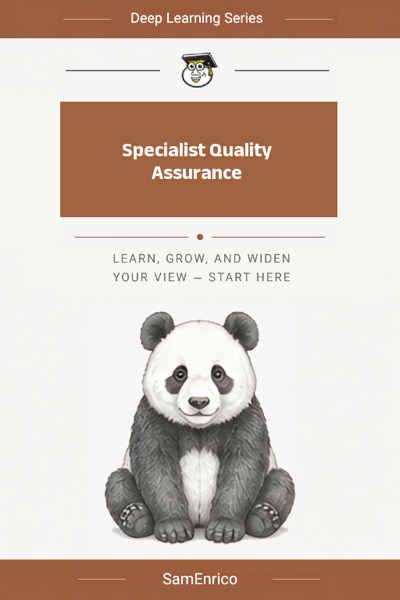
Non-FictionInformativeEducational
Specialist Quality Assurance eBook
A Coursebook on Specialist Quality Assurance
by Tilley Gema
A Coursebook on Specialist Quality Assurance
Formats
Free sample
Chapter 1: The Systems Map...–- On a Tuesday morning in March, a quality assurance manager named Elena Vasquez walked onto a factory floor that had just been evacuated. A batch of pediatric liquid medication had tested positive for trace amounts of a contaminant—not enough to kill, but enough to cause nausea and headache in children. The recall would cost $47 million. Three people would be hospitalized before the last bottle was retrieved. And when the root cause investigation concluded six weeks later, the report would say, in language so sanitized it bordered on fiction: "Inadequate operator training contributed to the event."Elena had been in QA for nineteen years.
She had seen this pattern before, in pharmaceuticals, in automotive parts, in medical devices. The report always blamed the operator. The solution was always retraining. And the problem always came back six months later, like a ghost that refused to stay buried.On that Tuesday morning, standing in the empty factory with the ventilation system still humming and the smell of isopropyl alcohol hanging in the air, Elena realized something she would later describe as her "systems awakening." The operator who had made the error—a twenty-three-year-old named Marcus who had worked the line for fourteen months—was not careless. He was not stupid.
He was not undertrained. He had followed every instruction exactly as written. The problem was that the instruction itself was wrong. The procedure manual showed the wrong valve sequence. The training video showed the wrong gauge reading.
The quality system had signed off on all of it.The system had failed, not the person. But the system could not be written up. The system could not be retrained. The system could not be terminated. So Marcus would take the blame, and nothing fundamental would change.This book is for everyone who has ever stood in Elena's shoes—who has ever known, deep in their gut, that the "root cause" on the official report was a comforting fiction, and that the real cause was hiding in plain sight, baked into the process, the documentation, the metrics, or the culture.The Great Misconception: Quality Assurance as Inspection Most people outside the profession—and, frankly, too many people inside it—believe that quality assurance is primarily about inspection.
You check things. You look for defects. You stamp "PASS" or "FAIL." You are the final gatekeeper, the last pair of eyes before the product goes out the door.This is not merely incomplete. It is actively dangerous.The inspection-centric view of QA emerged during the Industrial Revolution, when mass production first separated the act of making from the act of checking. Frederick Winslow Taylor, the father of scientific management, famously argued that thinking should be separated from doing—managers planned, workers executed, and inspectors verified.
This division of labor was efficient for its time, but it embedded a fatal assumption: that quality could be inspected into a product after it was made.It cannot.By the time a product reaches final inspection, the vast majority of its quality-determining decisions have already been made—the design, the materials, the process parameters, the tooling, the training, the work environment. Inspection at the end of the line is not quality assurance. It is bankruptcy prevention. It catches only the failures that are visible, measurable, and already too late to fix without cost.Consider this from the Cost of Quality framework, which we will return to throughout this book. The Cost of Quality is divided into four categories, and they are not created equal:Prevention Costs are everything you spend to keep defects from happening in the first place: design reviews, training, process validation, error-proofing, supplier qualification, preventive maintenance.
Prevention is the cheapest form of quality, by a factor of ten to one hundred.Appraisal Costs are everything you spend to find defects after they have already been made: inspection, testing, auditing, calibration. Appraisal is more expensive than prevention because you have already incurred the cost of making the defective product before you discover it.Internal Failure Costs are the expenses you incur when you find a defect before it reaches the customer: scrap, rework, retesting, downtime. Internal failures are typically ten times more expensive than appraisal.External Failure Costs are what happen when a defect reaches the customer: returns, warranty claims, lawsuits, recalls, regulatory fines, and—most devastatingly—lost reputation and lost future sales. External failures are typically ten times more expensive than internal failures.Do the math. A dollar spent on prevention prevents approximately ten dollars of appraisal cost, a hundred dollars of internal failure cost, and a thousand dollars of external failure cost.
And yet, most organizations spend the majority of their quality budget on appraisal and failure. They have built a machine that finds problems instead of preventing them.The QA specialist's job is to reverse this flow—to shift investment left, from the right side of the cost curve to the left side. That means spending more time on design reviews and process validation and less time on end-of-line inspection. It means treating a defect found in production not as a failure of the operator but as a failure of the process that allowed that operator to make the mistake. It means recognizing that the most valuable quality activity is the one that happens before the first part is made.The Birth of the Specialist: From Cop to Coach If QA is not primarily about inspection, what is it about?
The answer requires a shift in identity that many quality professionals find uncomfortable.The traditional QA role is often described, even by those who perform it, as a "policing" function. You enforce the rules. You catch the bad guys. You write the non-conformance reports. You are the person everyone else fears because you have the power to stop the line, reject the batch, or escalate the deviation.This identity is seductive because it comes with a kind of authority.
But it is also self-defeating. When you are seen as the police, people hide problems from you. They clean up the evidence before you arrive. They tell you what you want to hear. And the organization loses the single most valuable source of quality information: the truth about what is actually happening on the floor.The most effective QA specialists are not cops.
They are coaches, consultants, and systems thinkers. They understand that their primary leverage is not the authority to stop the line but the ability to help everyone else see the system that is producing the results—good and bad.This shift from "cop" to "coach" is not merely philosophical. It has practical implications for every tool and technique in this book. When you audit, you are not looking for someone to blame; you are looking for the gap between the documented process and the actual process, and you are asking "why" with genuine curiosity rather than accusation. When you investigate a deviation, you are not building a case against an operator; you are building a map of the system that allowed the deviation to occur.
When you write a corrective action, you are not punishing the past; you are redesigning the future.This is not to say that accountability…
This is the end of the free sample. Get the eBook to keep going. Buy now
About this book
Details
- Author
- Tilley Gema
- Publisher
- SamEnrico
- Language
- English
- Genre
- Non-Fiction, Informative, Educational
- Released
- 2026-05-04
- Pages (approx.)
- 154
- Available as
- eBook, Audiobook

Read better in the ZLOADR app
Your eBooks on your phone or tablet. Sign in with your SamEnrico account and start reading.
More by Tilley Gema
 Customer Service Automation ToolkitTilley Gema$11.99
 The Vancouver Citation GuideTilley Gema$11.99
 Job Crafting Burnout PreventionTilley Gema$11.99
 Paleo Diet Food List GuideTilley Gema$11.99
 Teaching Empathy to ChildrenTilley Gema$11.99
 The Blood Moon Murders: Canada's Occult Hostage Crisis (1968)Tilley Gema$11.99
 Learn to Play the CandombeTilley Gema$11.99
 How to Start a Detergent (synthetic) Business (Beginners Guide)Tilley Gema$11.99
 Agile for One Person TeamTilley Gema$12.99
 Climate Insurance for FisheriesTilley Gema$12.99
You may also like
 Hong Kong Handover 1997Dunn Johnnie$11.99
 Zumba For Postnatal Recovery CourseNeal Christian$11.99
 Zumba for BeginnersLadner Nikia$11.99
 YouTube Comment Mining GuideHumes Pandora$12.99
 Worry Box MeditationCarlin Rudy$11.99
 Workplace Stress MeditationNguyen Lynn$11.99
 Workplace Stress and Sleep RepairHawley Ivory$11.99
 Workplace Perfectionism CureDelaney Jeffry$11.99
 Workplace Injustice Anger GuideWallen Isabelle$11.99
 Work Addiction and Burnout LinkGreenwood Ester$11.99
 Women in Yoga and WellnessBeattie Galina$11.99
 Women in Stand Up ComedyChun Evangeline$11.99