
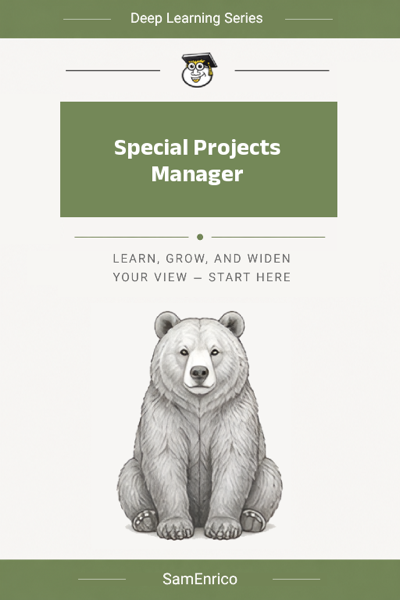
Non-FictionInformativeEducational
Special Projects Manager eBook
A Coursebook on Special Projects Manager
A Coursebook on Special Projects Manager
Formats
Free sample
Chapter 1: The Ambiguity Mandate--–- The email arrived at 11:47 PM on a Sunday. No subject line. The body contained exactly fourteen words: “We have a situation. No one owns it. You start tomorrow.
Conference room 4A.” No signature, no context, no job description. Just the promise of chaos wrapped in corporate politeness. This is how special projects begin for most managers—not with a trumpet fanfare or a promotion party, but with a vague summons to clean up a mess that no one else will touch. If you are reading this book, you have either already received that email or you sense it coming. Perhaps you volunteered for the role, seduced by the title’s ambiguity and the implied proximity to power.
Perhaps you were voluntold, your name surfacing in an executive meeting as someone “good with ambiguity” or “comfortable in the gray.” Either way, you are now a Special Projects Manager. And everything you learned about traditional project management is about to fail you.The First Mistake: Treating Special Projects Like Regular Projects Conventional project management is a beautiful machine. It assumes a known destination, a predictable route, a stable team, and a sponsor who can articulate success in measurable terms. The Project Management Institute’s Body of Knowledge offers you processes, inputs, tools, techniques, and outputs. You learn to build Work Breakdown Structures, calculate critical paths, manage earned value, and produce status reports in three colors of ink.
These tools are not wrong. They are simply wrong for you, at least at the start of a special project. Because a special project, by definition, is what falls through the cracks of conventional project management. It is the initiative that has no pre-existing process, the problem that has resisted all standard solutions, the opportunity that requires moving before anyone has finished arguing about the org chart.Consider the difference. A traditional project manager builds a bridge.
They know where the river is, what materials cost, how many workers are needed, and when the seasons change. A special projects manager builds the first bridge across a river that no one has mapped, using materials that may or may not exist, with a team of volunteers and skeptics, while the client is still debating whether a bridge is what they actually need. Traditional project management is engineering. Special projects management is exploration, negotiation, and improvisation performed simultaneously under a microscope.This distinction is not academic. It determines which tools you reach for first, how you measure progress, and—most critically—how you protect yourself when things go wrong.
The SPM who opens with a Gantt chart will spend weeks building a beautiful fiction, then watch it burn. The SPM who opens with curiosity, mapping not tasks but relationships, not deadlines but decision rights, not dependencies but resistance, will build the conditions under which a Gantt chart might eventually become useful.The Three Faces of Special Projects Not all special projects are alike. Before you take a single action, you must diagnose which species of ambiguity you are dealing with. Through hundreds of case studies across technology, manufacturing, healthcare, and nonprofit sectors, three distinct types emerge. Each demands a different initial posture, different early deliverables, and a different answer to the question, “What does success look like on Day 30?”Type one: the Rescue.
A project that was already underway has gone off the rails. The original manager quit, or the original plan was based on fantasy, or external conditions changed faster than anyone could adapt. Your mandate is stabilization. You are not here to innovate; you are here to prevent catastrophic failure. The rescue requires a forensic mindset.
You must reconstruct what was assumed, what was hidden, and what was simply ignored. Your early deliverables are a “burning platform” assessment (what will break first and most loudly) and a “stop-doing list” (which activities, however well-intentioned, are consuming resources without advancing survival). The rescue SPM does not ask, “What would be ideal?” They ask, “What is the smallest possible intervention that prevents the building from collapsing while we figure out the foundation?”Type two: the Greenfield. A new initiative with no prior structure, no entrenched habits, and no existing team. Your mandate is creation.
This could be a new product line, a new market entry, a new capability that the organization has never attempted. The greenfield requires an architectural mindset. You must design not only the final outcome but the process of designing the outcome. Your early deliverables are a “concept canvas” (one page articulating the problem, the proposed solution, and the key assumptions) and a “minimal viable governance” (just enough decision-making structure to prevent chaos without stifling emergence). The greenfield SPM does not ask, “How do we scale this?” They ask, “What is the smallest version of this that would teach us something true?”Type three: the Exploratory.
An investigation into a fuzzy opportunity or threat. No one knows whether the project will lead anywhere. Your mandate is learning. This is the most ambiguous type and the most psychologically demanding because success is not a delivered outcome but an improved understanding. The exploratory requires a scientific mindset.
You must treat your own plans as hypotheses, your milestones as experiments, and your “failure” as data. Your early deliverables are a “learning agenda” (what we need to know, by when, and what we will do differently based on the answer) and a “kill criteria” (the specific evidence that would justify stopping). The exploratory SPM does not ask, “How do we make this succeed?” They ask, “How do we learn the most relevant truth before we run out of patience or money?”Most SPMs fail in the first month because they apply the wrong type’s playbook. A rescue SPM who acts like a greenfield will over-build and under-stabilize. A greenfield SPM who acts like a rescue will strangle possibility with premature constraints.
An exploratory SPM who acts like either will produce false confidence from insufficient data. Your first job, therefore, is diagnosis. Before you solve the problem, name the type of problem you have.The ICM Framework: Your Rhythmic Anchor Every special project, regardless of type, moves through three rhythmic phases. These are not sequential in a rigid sense—you will cycle through them repeatedly as conditions change—but they provide a permanent structural anchor for everything that follows in this book. The framework is simple enough to remember on your worst day and robust enough to guide you through the most tangled organizational politics.Investigate.
The phase of learning before acting. You map the territory: stakeholders, constraints, hidden agendas, unspoken expectations, available resources, forbidden topics, and forgotten commitments. Investigation feels slow, which makes new SPMs anxious. They want to produce, to show value, to justify their salary. But premature action in an ambiguous environment is not productivity; it is pollution.
Each action you take changes the system, makes some future options impossible, and commits you to a path that may be wrong. Investigation is not procrastination. It is strategic patience. The output of investigation is not a plan. It is a map of known unknowns and, more importantly, a list of the unknown unknowns you have at least identified as categories of risk.Catalyze.…
This is the end of the free sample. Get the eBook to keep going. Buy now
About this book
Details
- Author
- Archuleta Tiffiny
- Publisher
- SamEnrico
- Language
- English
- Genre
- Non-Fiction, Informative, Educational
- Released
- 2026-06-02
- Pages (approx.)
- 125
- Available as
- eBook, Audiobook

Read better in the ZLOADR app
Your eBooks on your phone or tablet. Sign in with your SamEnrico account and start reading.
More by Archuleta Tiffiny
 Misfits Market Produce ComparisonArchuleta Tiffiny$11.99
 Affirmation Morning GuideArchuleta Tiffiny$11.99
 The Arthritis Assistive Device GuideArchuleta Tiffiny$11.99
 Air Cargo Five Year OutlookArchuleta Tiffiny$11.99
 The Devil's Gold: How Cocaine Fueled Colombia's Bloody RiseArchuleta Tiffiny$11.99
 Understanding SialidosisArchuleta Tiffiny$17.99
 How to Become a Police ChiefArchuleta Tiffiny$11.99
 B2B Sales Qatar Market GuideArchuleta Tiffiny$12.99
 Loan Consolidation Rate GuideArchuleta Tiffiny$12.99
You may also like
 Hong Kong Handover 1997Dunn Johnnie$11.99
 Zumba For Postnatal Recovery CourseNeal Christian$11.99
 Zumba for BeginnersLadner Nikia$11.99
 YouTube Comment Mining GuideHumes Pandora$12.99
 Worry Box MeditationCarlin Rudy$11.99
 Workplace Stress MeditationNguyen Lynn$11.99
 Workplace Stress and Sleep RepairHawley Ivory$11.99
 Workplace Perfectionism CureDelaney Jeffry$11.99
 Workplace Injustice Anger GuideWallen Isabelle$11.99
 Work Addiction and Burnout LinkGreenwood Ester$11.99
 Women in Yoga and WellnessBeattie Galina$11.99
 Women in Stand Up ComedyChun Evangeline$11.99