
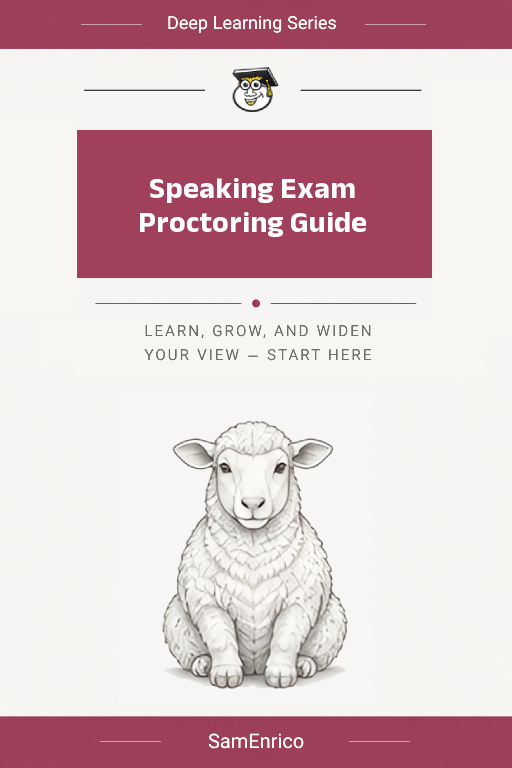
Non-FictionStudent's ShortcutSpeaking ExamAudio Guide
Speaking Exam Proctoring Guide eBook
Complete proctored speaking exams with microphone
Complete proctored speaking exams with microphone position volume check and recording consent procedures.
Formats
Free sample
Chapter 1: The Ten-Thousand-Dollar Pause--It was 2:47 on a Tuesday afternoon when a single three-second silence cost a university $47,000 in legal fees, invalidated an entire semester of language proficiency exams, and ended the career of a proctor who had worked at the same testing center for nineteen years. The proctor had done everything right—or so she thought. She checked IDs, monitored the room, timed the sections perfectly. But she forgot to say four words before pressing the record button: "Do you consent?" No verbal consent. No signed waiver.
Just a quiet assumption that walking into a testing center implied agreement. The judge disagreed.This is not a horror story designed to scare you. It is a true story, and it is the reason this book exists. The modern speaking exam proctor is no longer a passive supervisor who simply watches a clock and reminds candidates to turn off their cell phones. You are now a technical support specialist, a legal witness, and a security enforcer—sometimes all three within the same five-minute window.
The days of "just proctoring" are over. What follows is the first chapter of a complete guide to mastering a role that most people do not understand until something goes catastrophically wrong.The Three Pillars That Hold Everything Together Before we discuss any specific procedure—before we talk about microphones, consent forms, or room scans—we must establish the foundation upon which every single action in this book rests. That foundation is built from three interconnected pillars. Neglect any one of them, and the entire exam collapses. This is not exaggeration.
This is the pattern behind every major proctoring failure documented in the last decade.Audio Integrity is the first pillar. It means capturing clear, uninterrupted, forensically defensible speech from every candidate. If a recording sounds like a candidate was speaking from inside a swimming pool, the exam might as well never have happened. No grader can evaluate what they cannot hear. No appeal can be decided based on muffled static.
Audio integrity requires proper equipment, correct microphone placement, appropriate room acoustics, and calibrated volume levels. It sounds technical because it is technical. But the good news is that audio integrity is also the most solvable problem in proctoring—once you know the steps, eighty percent of failures disappear.Legal Compliance is the second pillar, and it is the one that most proctors neglect until a lawyer gets involved. Recording a person's voice without their explicit, documented consent is illegal in nearly every jurisdiction that matters. In the European Union, a voice recording is classified as biometric data under GDPR, carrying fines that can reach twenty million euros.
In the United States, the same recording is an education record under FERPA, requiring written consent for disclosure to third parties. And in both systems, the simple act of pressing "record" without first hearing the candidate say "I consent" can invalidate every exam in that session. Legal compliance is not a suggestion. It is the difference between a valid assessment and a lawsuit waiting to happen.Environment Control is the third pillar. It means managing the physical or virtual space where the exam occurs to eliminate both distractions and cheating opportunities.
For in-person centers, this means checking that windows are closed, fans are off, and neighboring desks are empty. For online exams, this means verifying that candidates are alone in a quiet room with a blank wall behind them and no unauthorized materials within reach. Environment control is often the pillar that proctors think they understand—but as we will see throughout this book, the relationship between the environment scan and the blank wall rule is more complex than it first appears.These three pillars are not independent. They interact constantly, and when one fails, the others collapse soon after. Consider a proctor who obtains perfect consent (legal compliance) and engineers a silent room (environment control) but places the microphone directly in front of the candidate's mouth, producing explosive pops on every P and T sound.
That exam is legally compliant and distraction-free—but it is also ungradable because the audio is distorted. Pillar one failed, and pillars two and three cannot compensate. Conversely, a proctor who captures pristine audio but forgets to ask for consent has created evidence of a crime. The recording exists, it is clear, and it is illegal.The Three Models of Proctoring and What They Demand From You Not all speaking exams are the same, and not all proctoring roles demand the same skills. Understanding which model you are operating under is the first step toward applying this book's guidance correctly.Traditional In-Person Proctoring is what most people imagine when they hear the word "proctor." You sit in a room with the candidates.
You can see them, hear them, and walk around to check their workstations. Your primary tools are your eyes, your ears, and a clock. In this model, environment control is relatively straightforward because you control the room directly. You can close a window, turn off a fan, or ask a candidate to move away from a noisy radiator. Legal compliance still requires consent, but you can collect signed waivers on paper before the exam begins.
Audio integrity depends on the recording equipment you have installed in the testing center—typically a centralized microphone system or individual USB headsets at each workstation. The biggest challenge in in-person proctoring is consistency: ensuring that every candidate in every seat receives the same instructions, the same equipment check, and the same treatment.Online Live Proctoring is fundamentally different. You are not in the room. You cannot reach out and close a window. You cannot see what is happening outside the camera frame.
Instead, you rely on screen sharing, video feeds, and remote audio monitoring. A candidate in a coffee shop looks very similar to a candidate in a quiet home office on your screen—until you hear the espresso machine. In this model, environment control becomes a negotiation. You must instruct candidates to choose appropriate rooms, then verify their choices through a 360-degree camera scan. You cannot enforce a rule you cannot see, so your instructions must be precise and your verification protocols must be thorough.
Audio integrity becomes more challenging because you are at the mercy of each candidate's personal equipment. Some will have professional USB headsets. Others will use laptop microphones that pick up every keystroke. You need protocols that work across this range of quality. Legal compliance remains essential, but now you must obtain consent remotely—usually through a verbal "I consent" recorded at the start of the session, since signed waivers are harder to collect online.Automated Proctoring removes the human proctor from real-time monitoring and replaces them with artificial intelligence.
The AI flags suspicious behaviors: eyes moving away from the camera, multiple faces appearing in the frame, unexpected audio events like coughing or whispering. Your role shifts from watching the exam in real time to reviewing the AI's alerts after the exam ends. This model offers efficiency—one proctor can review hundreds of flagged events in a day—but it introduces new risks. AI systems are famously bad at distinguishing between a nervous candidate looking at the ceiling and a cheater reading a…
This is the end of the free sample. Get the eBook to keep going. Buy now
About this book
Details
- Author
- Garrison Chante
- Publisher
- SamEnrico
- Language
- English
- Genre
- Non-Fiction, Student's Shortcut, Speaking Exam, Audio Guide
- Released
- 2026-06-01
- Pages (approx.)
- 146
- Available as
- eBook, Audiobook

Read better in the ZLOADR app
Your eBooks on your phone or tablet. Sign in with your SamEnrico account and start reading.
More by Garrison Chante
 Bridge Loan StructuresGarrison Chante$11.99
 Parental Addiction and ParentingGarrison Chante$11.99
 Podcast Overconsumption WorkbookGarrison Chante$11.99
 Sleeve Gastrectomy Long Term SuccessGarrison Chante$11.99
 Gluten Free Baking Basics CourseGarrison Chante$11.99
 The Billionaire's Gamble: Inside the 2018 Tesla Short SqueezeGarrison Chante$11.99
 Echoes of the Last Broadcast: The Mysterious Final Transmission of the RMS TitanicGarrison Chante$11.99
 Energy AnalystGarrison Chante$11.99
 Understanding Cat Eye SyndromeGarrison Chante$17.99
 Business Credit for Non ProfitsGarrison Chante$12.99
 How to Start a Pottery Making Machinery Business (Beginners Guide)Garrison Chante$11.99
You may also like
 Hong Kong Handover 1997Dunn Johnnie$11.99
 Zumba For Postnatal Recovery CourseNeal Christian$11.99
 Zumba for BeginnersLadner Nikia$11.99
 YouTube Comment Mining GuideHumes Pandora$12.99
 Worry Box MeditationCarlin Rudy$11.99
 Workplace Stress MeditationNguyen Lynn$11.99
 Workplace Stress and Sleep RepairHawley Ivory$11.99
 Workplace Perfectionism CureDelaney Jeffry$11.99
 Workplace Injustice Anger GuideWallen Isabelle$11.99
 Work Addiction and Burnout LinkGreenwood Ester$11.99
 Women in Yoga and WellnessBeattie Galina$11.99
 Women in Stand Up ComedyChun Evangeline$11.99