
Non-FictionSelf-HelpProfessional Attire
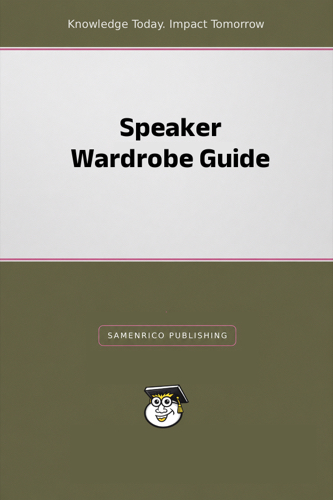
Speaker Wardrobe Guide eBook
Dress appropriately for your audience and the came
Dress appropriately for your audience and the camera.
Formats
Free sample
Chapter 1: The Trust Thermometer--You have exactly seven seconds.Not seven minutes. Not seven slides. Not seven charming anecdotes to win them over. Seven seconds is the average time it takes for a live audience—and less than three seconds for a virtual one—to form a complete, lasting judgment about your credibility, competence, and trustworthiness. This judgment happens before you open your mouth.
Before you click to your first slide. Before you tell your first joke or share your first statistic. Your audience's brain has already decided whether to listen, resist, or dismiss—based entirely on what you are wearing.This is not opinion. It is neuroscience.The amygdala, the brain's ancient threat-detection center, processes visual information approximately 250 milliseconds faster than the prefrontal cortex, the region responsible for rational thought. In plain English: your audience feels whether to trust you before they think about whether to trust you.
And that feeling, once established, is extraordinarily difficult to reverse. Researchers at Princeton University found that judgments made after a one-tenth of a second exposure to a speaker's face predicted with 72 percent accuracy the judgments made after unlimited time. Clothing amplifies this effect because clothing is a choice. Your face is genetics. Your wardrobe is a statement.
And the audience reads that statement as either "I belong here" or "I do not belong here."This chapter introduces the single most important tool you will use throughout this book: The Trust Thermometer. It is a framework for diagnosing, building, and adjusting your speaking wardrobe to maximize the one thing that matters more than any other—trust. Not style. Not fashion. Not personal expression.
Trust. When an audience trusts you, they lean in. They forgive small mistakes. They remember your message. When they do not trust you, they scroll through their phones, check the exit signs, and forget your name before you finish your conclusion.The Trust Thermometer has three dials: Authority, Warmth, and Competence.
Every garment you wear moves these dials up or down. The goal is not to maximize any single dial. The goal is balance. Too much authority without warmth makes you intimidating. Too much warmth without authority makes you a pushover.
Competence without either makes you a machine. This chapter will teach you to read these dials, assess your current wardrobe, and make strategic choices that align with your specific audience and speaking context.Let us begin with a story.The $50,000 Blazer Several years ago, a financial analyst named Sarah was invited to present at her firm's annual shareholder meeting. She had prepared for six weeks. Her deck was immaculate. Her data was bulletproof.
Her rehearsal was flawless. On the morning of the presentation, she stood in front of her closet and faced a decision she had not anticipated: what to wear.Her options were limited. She owned two professional outfits. The first was a charcoal gray pantsuit she had worn for every internal presentation for three years. It fit well.
It was safe. It was boring. The second was a striking emerald green blazer she had bought on impulse and never worn to work. It was bold. It was memorable.
It was risky.She chose the green blazer.The presentation went perfectly—by the numbers. Her slides were clear. Her answers were correct. Her voice did not waver. But after the meeting, the CEO pulled her aside and said something she could not shake: "Sarah, that was excellent work.
But I have to be honest—the blazer threw me. I spent the first five minutes trying to figure out if you were making a statement or if you just didn't know our dress code."Sarah lost a promotion three weeks later. The candidate who got the job wore navy blue.This is not a story about sexism or workplace politics. It is a story about cognitive dissonance—the mental discomfort that occurs when a person encounters something that does not fit their expectations. The CEO expected a conservative financial analyst.
He saw a woman in an emerald green blazer. His brain spent its有限的processing power resolving that conflict instead of listening to her message. Sarah's wardrobe created friction where there should have been flow.The Trust Thermometer would have saved her.Dial One: Authority Authority is the perception that you know what you are talking about and have the standing to say it. It is communicated through structure, formality, and tradition. In clothing, authority lives in sharp lines, dark colors, structured fabrics, and conventional silhouettes.What increases Authority:Tailored fits (clothing that follows the body without hugging it)Dark colors (navy, charcoal, dark brown, forest green)Structured fabrics (worsted wool, crisp cotton, stiff denim)Traditional cuts (notched lapels, flat-front trousers, pencil skirts)Complete outfits (jacket with matching pants or skirt)Leather shoes with defined heels and polished finishes What decreases Authority:Oversized or undersized clothing Bright colors and neons Soft, draping fabrics (jersey, silk charmeuse, thin knits)Trendy cuts (cropped jackets, raw hems, distressed details)Mismatched separates that do not look intentional Sneakers, sandals, or worn shoes The Authority Sweet Spot: For most professional speaking contexts, you want your Authority dial set between six and eight on a scale of one to ten.
Below six, you will not be taken seriously. Above eight, you become intimidating or unapproachable. The exception is high-stakes corporate presentations (boardrooms, investor pitches, regulatory testimony), where you want Authority at nine. The other exception is creative or community settings, where you want Authority at four or five.How to test your Authority dial: Show a photograph of your speaking outfit to three people who do not know you. Ask them one question: "What does this person do for a living?" If they guess a profession that is equal to or higher status than your actual role, your Authority dial is correctly set.
If they guess a lower-status profession, you need more structure, darker colors, or better tailoring. If they guess a completely unrelated profession, your outfit is confusing.Dial Two: Warmth Warmth is the perception that you like your audience and that your audience could like you. It is communicated through softness, approachability, and human connection. In clothing, warmth lives in texture, color temperature, and visible humanity.What increases Warmth:Soft fabrics (cashmere, merino wool, cotton jersey, brushed flannel)Warm colors (cream, camel, rust, olive, soft gold)Texture (tweed, cable knits, bouclé, corduroy)Visible human details (rolled sleeves, open collar, comfortable shoes)Accessories that feel personal (a meaningful brooch, a watch with history)Layers that look chosen, not prescribed What decreases Warmth:Stiff, shiny fabrics (cheap polyester, vinyl, patent leather)Cool, harsh colors (icy blue, stark white, true black)Uniform-like perfection (matching everything, no personal touches)Invisible humanity (covered completely, no skin or personality showing)Accessories that feel corporate (logo-heavy, obviously expensive)Layers that look mandatory (tie choked tight, jacket buttoned under stress)The Warmth Sweet Spot: For most speaking contexts, you want your Warmth dial between five and seven. Below five, you risk being perceived as cold, distant, or robotic.
Above seven, you risk being perceived as unprofessional, unserious, or trying too hard to be liked. The exception is inspirational or motivational speaking, where you want Warmth at eight or nine. The other exception…
This is the end of the free sample. Get the eBook to keep going. Buy now
About this book
Details
- Author
- Armijo Patrice
- Publisher
- SamEnrico
- Language
- English
- Genre
- Non-Fiction, Self-Help, Professional Attire
- Released
- 2026-06-06
- Pages (approx.)
- 140
- Available as
- eBook, Audiobook

Read better in the ZLOADR app
Your eBooks on your phone or tablet. Sign in with your SamEnrico account and start reading.
More by Armijo Patrice
 Subscription Service AuditArmijo Patrice$11.99
 Self Talk For InsomniaArmijo Patrice$11.99
 Wholesale Vendor Credit GuideArmijo Patrice$11.99
 The Substance and Emotion GuideArmijo Patrice$11.99
 Cognitive Reframing DrivingArmijo Patrice$11.99
 Tarcila Rivera Zea Quechua VoiceArmijo Patrice$11.99
 Habit Formation for Weight LossArmijo Patrice$11.99
 The Silent Saboteurs: Mime and the Secret War of Ancient RomeArmijo Patrice$11.99
 Golden Arches & Iron Thrones: The Secret Wars of Fast Food DynastiesArmijo Patrice$11.99
 Service Providers Guide to Fertility ServicesArmijo Patrice$11.99
 How to Produce Travel Converters and AdaptersArmijo Patrice$11.99
 How to Produce Polyurethane Interior PaintArmijo Patrice$11.99
You may also like
 Hong Kong Handover 1997Dunn Johnnie$11.99
 Zumba For Postnatal Recovery CourseNeal Christian$11.99
 Zumba for BeginnersLadner Nikia$11.99
 YouTube Comment Mining GuideHumes Pandora$12.99
 Worry Box MeditationCarlin Rudy$11.99
 Workplace Stress MeditationNguyen Lynn$11.99
 Workplace Stress and Sleep RepairHawley Ivory$11.99
 Workplace Perfectionism CureDelaney Jeffry$11.99
 Workplace Injustice Anger GuideWallen Isabelle$11.99
 Work Addiction and Burnout LinkGreenwood Ester$11.99
 Women in Yoga and WellnessBeattie Galina$11.99
 Women in Stand Up ComedyChun Evangeline$11.99