
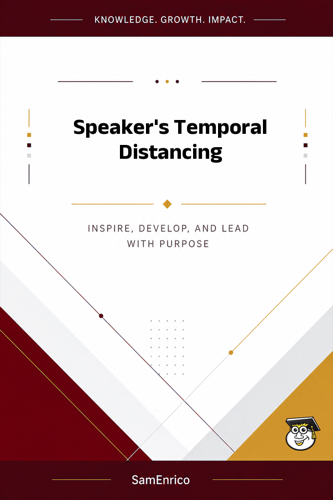
Non-FictionMental WealthPerspective Taking
Speaker's Temporal Distancing eBook
Zoom out on life perspective to shrink presentatio
by Regan Mui
Zoom out on life perspective to shrink presentation significance.
Formats
Free sample
Chapter 1: The Spotlight Lie--–- The first time I watched a speaker faint on stage, I was sitting in the third row of a hotel ballroom in downtown Chicago. The man was a fifty-three-year-old vice president of engineering at a Fortune 500 company. He had two graduate degrees, had managed teams of over two hundred people, and had once testified in front of a congressional subcommittee without flinching. But on this Tuesday morning, in front of sixty-three colleagues and a single projected Power Point slide that read “Q3 Revenue Projections,” his knees buckled, his eyes rolled back, and he collapsed face-first into the podium.The paramedics arrived in seven minutes. He regained consciousness in twelve.
Later, in the emergency room, he refused all offers of psychiatric consultation. “I just needed water,” he told the nurses. “I forgot to eat breakfast.” The lie was so transparent that even the janitor raised an eyebrow. This man had not fainted from dehydration. He had fainted from fear.
Not fear of the audience. Not fear of public speaking in the abstract. He had fainted because he believed, with every fiber of his nervous system, that this forty-five-minute presentation would determine the rest of his life.Here is what actually happened after he fainted. The audience gasped. Two people caught him before he hit the ground.
Someone called 911. And then, within ninety minutes, everyone in that room had returned to their offices and resumed arguing about quarterly forecasts. By the following Monday, three people mentioned it in passing. By the following month, zero. By the following year, the man himself had been promoted to senior vice president, and no one—not his boss, not his peers, not the junior analysts who had watched him fall—could remember which specific presentation had triggered the collapse.
They remembered “the time Mike fainted,” but the content of the speech, the stakes of the moment, the career-defining nature of the disaster? Gone. Erased. As if it had never happened.This chapter is about why that happens. It is about the neurological and psychological mechanism that convinces smart, accomplished, otherwise rational human beings that a forty-five-minute presentation is a life-or-death event.
And it is about the first and most essential move in the entire practice of temporal distancing: recognizing that the spotlight you feel burning your skin is not actually a spotlight at all. It is a mirror. And you are the only one looking into it.The Anatomy of a False Apocalypse Let us name the enemy before we attempt to defeat it. The enemy is not anxiety. Anxiety is a physiological response—heart rate elevation, cortisol release, sweat gland activation—that has evolved over millions of years to keep you alive.
The enemy is not fear. Fear is an emotion that signals threat and mobilizes resources. The enemy is something far more specific and far more pernicious. Let us call it Threat Immersion.Threat Immersion is the cognitive state in which you lose the ability to distinguish between the importance of a situation and the intensity of your own reaction to it. When you are immersed in threat, the stakes feel infinite, the consequences feel permanent, and the audience feels like a jury of executioners rather than a collection of distracted humans who would rather be checking their email.Consider the difference between how you experience a presentation and how you experience almost any other challenging activity.
When you drive in heavy traffic, you do not believe that your entire life will be judged by whether you merge smoothly. When you cook dinner for friends, you do not believe that one burnt appetizer will destroy your reputation forever. When you have a difficult conversation with your partner, you do not believe that a single awkward pause means the relationship is over. But when you stand in front of an audience—even a small one, even a supportive one, even one that has explicitly told you they want you to succeed—your brain abandons all sense of proportion.This is not a character flaw. It is not a weakness unique to introverts or people with clinical anxiety disorders.
It is a predictable, almost mechanical consequence of how the human brain evolved to process social threats.The Neuroscience of the Spotlight To understand Threat Immersion, you must first understand a small almond-shaped structure deep inside your brain called the amygdala. The amygdala’s job is simple and ancient: it scans the environment for potential threats and, when it detects one, initiates a cascade of physiological changes that prepare your body for fight, flight, or freeze. This system worked beautifully for your ancestors on the savanna. A rustle in the grass might be a lion. Better to react first and ask questions later.The problem is that the amygdala cannot tell the difference between a lion and a boardroom.
It cannot distinguish between a genuine physical threat to your survival and a social threat to your reputation. When you stand up to speak, your amygdala registers the dozens of eyes looking at you, interprets their neutral expressions as potential hostility, and concludes that you are being hunted. It then does exactly what it evolved to do: it hijacks your prefrontal cortex (the rational, planning part of your brain) and floods your body with stress hormones.This hijacking has a specific and devastating effect on your perception of time. Under normal conditions, your brain maintains a flexible sense of temporality—you can remember the past, imagine the future, and recognize that the present moment is just one point on a long continuum. But under Threat Immersion, the amygdala collapses your temporal horizon into a suffocating, eternal now.
The next five minutes feel like five hours. The mistake you just made feels like it will last forever. The possibility of embarrassment feels like a permanent stain on your permanent record.I call this phenomenon Temporal Constriction. It is the subjective experience of time narrowing to a single point of terror. And it is the primary mechanism by which a forty-five-minute presentation transforms, inside your skull, into a life-defining apocalypse.Here is the cruel irony.
Temporal Constriction is the very thing that makes you perform worse. When you believe that every second matters infinitely, you cannot afford to relax, to breathe, to pause, to think. You rush. You stumble. You forget your points.
You say things you do not mean. And then you interpret those normal, predictable performance fluctuations as evidence that your original fear was justified. See? I knew this was a disaster. I knew I should have been more afraid.This is the feedback loop of Threat Immersion.
Fear causes constriction. Constriction causes poor performance. Poor performance confirms the fear. And the loop tightens until, for some unlucky speakers, the amygdala wins completely—and they faint in front of sixty-three colleagues in a hotel ballroom in Chicago.The Myth of the Life-Defining Moment Let us pause here and ask a question that sounds almost too simple to matter: How many truly life-defining moments has your life actually contained?Think back. Not the moments that felt life-defining at the time—the job interview you obsessed over for weeks, the first date you rehearsed in the mirror, the presentation…
This is the end of the free sample. Get the eBook to keep going. Buy now
About this book
Details
- Author
- Regan Mui
- Publisher
- SamEnrico
- Language
- English
- Genre
- Non-Fiction, Mental Wealth, Perspective Taking
- Released
- 2026-06-09
- Pages (approx.)
- 139
- Available as
- eBook, Audiobook

Read better in the ZLOADR app
Your eBooks on your phone or tablet. Sign in with your SamEnrico account and start reading.
More by Regan Mui
 The Mindfulness Burnout ShieldRegan Mui$11.99
 Senior Hearing Loop Self Esteem WorkbookRegan Mui$11.99
 Elder Care Sibling Anger GuideRegan Mui$11.99
 The Attachment Wound Self Esteem GuideRegan Mui$11.99
 Galileo's Rebellion: The Man Who Defied the HeavensRegan Mui$11.99
 Understanding Lymphoma, Large-cellRegan Mui$17.99
 Information Security DeveloperRegan Mui$11.99
 Executive Summary Numbers StoryRegan Mui$12.99
 Beauty Personal Care GuideRegan Mui$12.99
 How to Become a Drapery OperatorRegan Mui$11.99
You may also like
 Hong Kong Handover 1997Dunn Johnnie$11.99
 Zumba For Postnatal Recovery CourseNeal Christian$11.99
 Zumba for BeginnersLadner Nikia$11.99
 YouTube Comment Mining GuideHumes Pandora$12.99
 Worry Box MeditationCarlin Rudy$11.99
 Workplace Stress MeditationNguyen Lynn$11.99
 Workplace Stress and Sleep RepairHawley Ivory$11.99
 Workplace Perfectionism CureDelaney Jeffry$11.99
 Workplace Injustice Anger GuideWallen Isabelle$11.99
 Work Addiction and Burnout LinkGreenwood Ester$11.99
 Women in Yoga and WellnessBeattie Galina$11.99
 Women in Stand Up ComedyChun Evangeline$11.99