
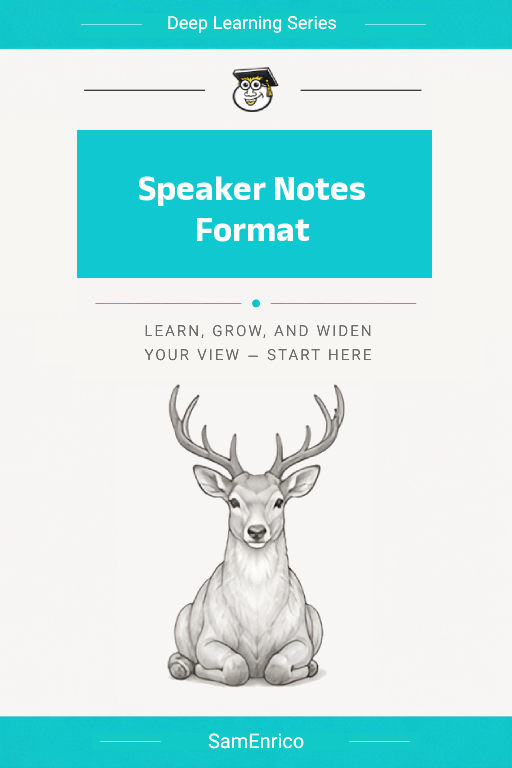
Speaker Notes Format eBook
Use 24-point font and three slides per page to gla
Use 24-point font and three slides per page to glance without looking down.
Formats
Free sample
Chapter 1: The 147 Lies--–- Every time you look down at your notes, you tell your audience a lie. The lie is not malicious. It is not intentional. But it is devastating nonetheless. The lie is this: I am not ready.
I do not believe what I am saying. You should not look at me—look at the screen instead.You would never say those words out loud. But your body says them dozens of times per hour, every time your chin drops toward a piece of paper or a glowing screen. The audience does not consciously register each individual head dip. But their brains notice.
Their trust erodes. And by the end of your presentation, they have concluded something that has nothing to do with your data, your argument, or your expertise. They have concluded that you are unsafe to watch.This chapter is about that lie. It is about the mechanics of why looking down destroys your presence, the cognitive science of how your eyes betray you, and the first step toward a radical alternative. By the time you finish these pages, you will never look at your speaker notes the same way again.The Anatomy of a Downward Glance Let us begin with a simple experiment.
You can do this right now, in whatever chair you are sitting in. Imagine there is an audience of twenty people in front of you. Now, without moving your body, lower your chin toward your chest until you are looking at your lap. Hold that position for three seconds. Then lift your chin back to level.What did you just communicate?If you are like most people, you felt a momentary sense of withdrawal.
Your shoulders may have rounded slightly. Your breath may have shortened. Your face—which a moment ago was available for connection—disappeared behind your own hairline and forehead. In those three seconds, you ceased to be a person speaking to others and became a person reading in front of others.That is the Zigzag of Death.The Zigzag has three stages. Stage one: you finish a sentence while making eye contact with an audience member.
Stage two: you look down at your notes to find your next point. Stage three: you look back up, find a new face, and continue. The entire cycle takes between two and four seconds. Over the course of a twenty-minute presentation, you will perform this cycle approximately one hundred times.One hundred tiny disconnections.One hundred small betrayals.Each one, by itself, is harmless. But together, they form a pattern that your audience's brain cannot ignore.
Cognitive psychologists call this "attentional drift." Every time you break eye contact, your audience's brains begin to wander. After three to five seconds of wandering, they must expend conscious effort to re-engage. After ten to fifteen such re-engagements, their brains simply stop trying. They have learned that you will keep interrupting yourself. So they check their phones.
They check the clock. They check out.What Your Audience Sees (That You Do Not)We have a blind spot about our own downward glances. Literally. The human eye is designed to track moving objects and faces, not to monitor the position of our own chin. Most speakers have no idea how often they look down.
When we videotape presenters and play back the footage, the typical reaction is shock."I only looked down two or three times," they say.The footage shows forty-seven times.This is not dishonesty. It is a failure of proprioception—the body's ability to sense its own position. When you are focused on content, your brain deprioritizes awareness of your head angle. You feel like you looked down once or twice because those were the times you noticed yourself looking down. The other forty-five times were automatic, unconscious, and invisible to you but perfectly visible to your audience.What does the audience actually see during those forty-five unconscious dips?They see a person who appears to be searching for something.
The human brain is exquisitely sensitive to gaze direction because gaze direction predicts social intention. When someone looks directly at you, their brain is signaling openness, honesty, and engagement. When someone looks away, their brain is signaling avoidance, deception, or distraction. This is not cultural. It is hardwired.
Infants as young as six months old prefer faces that make direct eye contact. Toddlers follow the gaze of adults to learn about their environment. Adults rate strangers who maintain eye contact as more intelligent, more trustworthy, and more competent—regardless of what those strangers actually say.When you look down at your notes, you trigger the same neural circuitry in your audience that would trigger if you looked away to hide a lie. They do not consciously think, "This person is lying." But they feel something shift. Their trust meter ticks down one notch.
Forty-seven ticks per presentation. By the end, the meter is empty.The Cost of the Zigzag Let us put a number on it.Researchers at the University of Michigan studied the relationship between eye contact and persuasion. They asked experienced speakers to deliver the same five-minute presentation twice—once while maintaining high eye contact (looking down no more than 10 percent of the time) and once while maintaining low eye contact (looking down more than 50 percent of the time). The content was identical. The slides were identical.
The only variable was where the speaker looked.The results were stark. In the low-eye-contact condition, audience retention dropped by 33 percent. Persuasion (measured by agreement with the speaker's call to action) dropped by 42 percent. And perceived speaker credibility dropped by nearly half—from an average of 8.2 out of 10 to 4.4 out of 10.Half.The exact same words, spoken by the exact same person, were rated as half as credible simply because the speaker looked down too often.This is not a small effect. This is the difference between being believed and being dismissed.
Between closing the sale and losing the deal. Between being invited back and being forgotten.Yet most speakers continue to use notes that force them to look down. They print their scripts in 10-point type. They cram an entire paragraph next to a tiny slide thumbnail. They hold their pages at waist level, which requires a full forty-five-degree chin dip to read.
They have built a system that guarantees failure, and then they blame their nerves, their content, or their audience.The notes are not the problem. The format of the notes is the problem.Peripheral Vision as a Teleprompter Here is the good news. You do not need to memorize your speech. You do not need a teleprompter. You do not need to "just be more confident." You need to understand one surprising fact about human vision.Your peripheral vision can read.Not novels, obviously.
Not dense paragraphs. But short words, short phrases, and single trigger words can be recognized in your peripheral field without moving your eyes. This is because the human retina has two types of photoreceptors: cones, which are concentrated in the fovea (the center of your gaze) and handle fine detail and color, and rods, which are concentrated in the periphery and handle motion, contrast, and rough shape recognition.Rods…
This is the end of the free sample. Get the eBook to keep going. Buy now
About this book
Details
- Author
- Glass Maribeth
- Publisher
- SamEnrico
- Language
- English
- Genre
- Non-Fiction, Professional's Cheat Sheet, Notes Layout, Readability
- Released
- 2026-06-01
- Pages (approx.)
- 148
- Available as
- eBook, Audiobook

Read better in the ZLOADR app
Your eBooks on your phone or tablet. Sign in with your SamEnrico account and start reading.
More by Glass Maribeth
 Creative Block for BurnoutGlass Maribeth$11.99
 Boxing Hand Wrapping GuideGlass Maribeth$11.99
 Wholesaling Outsourcing GuideGlass Maribeth$11.99
 Immigrant Roofing Contractor To EmpireGlass Maribeth$11.99
 Active Listening For ToddlersGlass Maribeth$11.99
 Assertiveness With NeighborsGlass Maribeth$11.99
 Cure Period Enforcement LogGlass Maribeth$11.99
 The Laundry TantrumGlass Maribeth$11.99
 Short Breath Long Breath PracticeGlass Maribeth$11.99
 Operation Midnight Sun: The Secret War to Save the ArcticGlass Maribeth$11.99
 The Troll King's Last Lesson: A Nordic Wisdom SagaGlass Maribeth$11.99
 The Architect of Chaos: How a Shadow Advisor Shaped Modern PoliticsGlass Maribeth$11.99