
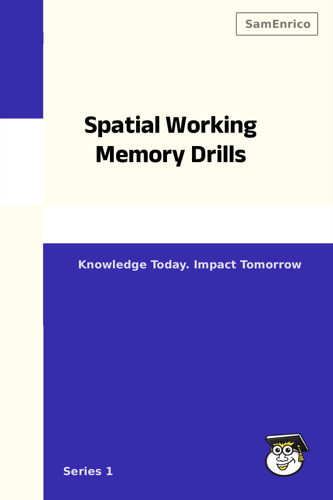
Spatial Working Memory Drills eBook
Enhances navigation and object location recall.
Enhances navigation and object location recall.
Formats
Free sample
Chapter 1: The $10,000 Walk--–- The first time Sarah lost her car in an airport parking garage, she blamed the rain. The second time, she blamed the cheap rental. The third time, with her toddler screaming in the backseat and a missed flight’s worth of shame burning in her chest, she blamed herself. Forty-seven minutes of wandering. Three levels.
Two stairwells. One humiliating call to security. “It happens all the time, ma’am,” the guard said, shining a flashlight across a row of identical sedans. That was supposed to be comforting. It wasn’t.
What Sarah didn’t know—what almost no one knows—is that she wasn’t being careless, distracted, or absent-minded. She was suffering from a specific, measurable, and completely trainable failure of something called Spatial Working Memory. And within twelve weeks, she would never lose her car again.The Hidden Cost of Getting Lost Every day, millions of adults perform the same quiet ritual of spatial failure. They circle parking garages, retrace steps through grocery store aisles, walk past the same hotel room door three times before finding the right one, and stand helplessly in front of elevators trying to remember which floor they parked on. These moments are dismissed as minor annoyances, the inevitable friction of modern life.
But aggregated across a lifetime, the cost is staggering.Consider the arithmetic of being lost. A person who spends just ten minutes per week searching for misplaced objects—keys, phone, glasses, wallet—loses nearly nine hours per year. Over forty years of adulthood, that’s fifteen full days. Fifteen days of your life, spent circling parking lots and rifling through couch cushions. That’s the direct cost.
The indirect costs are harder to measure but far more significant: the low-grade anxiety of uncertainty, the erosion of confidence in unfamiliar environments, the quiet shame of being “the one who always gets lost.”This book exists because those costs are optional. Spatial Working Memory—the brain’s ability to hold and manipulate location-based information over seconds to minutes—is not fixed at birth. It is not a personality trait. It is not something you either have or don’t have, like freckles or musical pitch. Spatial Working Memory is a trainable cognitive skill, as responsive to practice as a golf swing or a foreign language accent.
And the drills in this book will rewire yours in twelve weeks.What This Book Is (And What It Isn’t)Before we go any further, let’s be clear about what you’re holding. This is not a neuroscience textbook, though it draws on decades of peer-reviewed research from labs around the world. It is not a collection of party tricks or mnemonic gimmicks, though the drills are genuinely fun. And it is not a cure for dementia, Alzheimer’s disease, or clinically diagnosed spatial deficits like developmental topographical disorientation—though the exercises have been shown to slow cognitive decline in aging populations and are used in rehabilitation settings.What this book is: a practical, drill-based training program for improving your ability to remember where things are and how to get where you’re going. It is designed for healthy adults who have noticed that their sense of direction is unreliable, that they lose objects more often than they’d like, or that they rely too heavily on GPS to navigate familiar routes.
It is also for anyone who wants to future-proof their brain against the natural decline in spatial ability that comes with age.The program is twelve weeks long, requiring approximately fifteen minutes of practice per day. That’s less time than the average person spends scrolling social media before bed. By the end of those twelve weeks, you will have measurable improvements in your spatial span (the number of locations you can hold in working memory), your ability to encode object positions from cluttered scenes, your path integration accuracy (dead reckoning without landmarks), and your cognitive map flexibility (finding alternate routes without GPS).Spatial Working Memory Defined Let’s anchor ourselves in a definition. Spatial Working Memory is the cognitive system responsible for temporarily storing and manipulating information about the locations of objects and your position relative to those objects. It operates over very short time scales—seconds to minutes—and is constantly being updated as you move through the world.This is different from Long-Term Spatial Memory, which stores enduring knowledge like the layout of your childhood home, the route to your high school, or the location of the nearest hospital.
Long-term spatial memory is the hard drive; Spatial Working Memory is the RAM. You need both. But it’s working memory that fails when you park your car, walk into a store for twenty minutes, and emerge unable to remember which row you parked in. The information was never transferred from the RAM to the hard drive. It was overwritten, never encoded, or actively suppressed by competing information.Consider this experiment, replicated dozens of times in cognitive psychology labs: participants watch a short video of someone walking through a parking garage, then immediately try to point back to where the car was parked.
Accuracy drops by nearly forty percent when a distracting task—even something as simple as counting backward from one hundred—is inserted between the parking and the recall. That’s the fragility of Spatial Working Memory. It holds information just long enough to be useful, then discards it unless you actively consolidate it. Most people never consolidate. They assume their brain will remember.
It won’t.Why Your Brain Loses Your Keys (And Your Car, And Your Way)The mechanisms behind spatial working memory failures are surprisingly specific. Researchers have identified three primary failure modes, each corresponding to a different neural subsystem.The first failure mode is encoding failure. You never actually paid attention to where you put your keys. Your brain was on autopilot, occupied with a podcast, a to-do list, or the argument you had this morning. The information never entered working memory at all.
This is by far the most common failure, and it’s also the easiest to fix with the mindfulness-for-space techniques introduced in later chapters.The second failure mode is decay. You encoded the information—you know you parked on level three, near the elevator—but then you carried groceries, answered a phone call, and argued with a parking attendant. By the time you needed the information, the memory trace had degraded. Decay happens rapidly. Without rehearsal, spatial information degrades by fifty percent within fifteen seconds.
That’s not a metaphor. Researchers have measured it.The third failure mode is interference. You parked in a spot. Then you saw five other identical spots. Then you walked past ten other cars that looked like yours.
Each new similar item interferes with the original memory, a phenomenon called proactive interference. This is why airport parking garages are so disorienting: every row, every level, every concrete pillar looks exactly the same. Your brain cannot distinguish between competing spatial representations, so it defaults to guessing.The drills in this book target each of these failure modes directly. Encoding drills force intentional attention. Decay drills use spaced retrieval to strengthen the memory trace.
Interference drills teach your brain to create distinctive spatial markers that resist confusion.The Neuroscience Promise: Your Brain Can Change If…
This is the end of the free sample. Get the eBook to keep going. Buy now
About this book
Details
- Author
- Ritchie Miles
- Publisher
- SamEnrico
- Language
- English
- Genre
- Non-Fiction, Self-Help, Spatial Cognition
- Released
- 2026-06-05
- Pages (approx.)
- 148
- Available as
- eBook, Audiobook

Read better in the ZLOADR app
Your eBooks on your phone or tablet. Sign in with your SamEnrico account and start reading.
More by Ritchie Miles
 The Remote Email Time GuideRitchie Miles$11.99
 Detox For Dual Diagnosis GuideRitchie Miles$11.99
 Self Esteem Intimacy GuideRitchie Miles$11.99
 Personal Brand for ConsultantsRitchie Miles$11.99
 Flight Response RecoveryRitchie Miles$11.99
 Emotional Regulation TechniquesRitchie Miles$11.99
 Lawyers Professional LiabilityRitchie Miles$11.99
 The Phantom Coachman: The Victorian Highwayman Who Exposed Prison HorrorsRitchie Miles$11.99
 The Great Melbourne Zoo Escape: Tracking the Tiger That Outsmarted PoliceRitchie Miles$11.99
 A Collector's Handbook to the Aston Martin DBSRitchie Miles$11.99
 How to Trade Soybean MealRitchie Miles$11.99
 JEE Focus and Concentration GuideRitchie Miles$12.99