
Non-FictionHealth & WellnessSpace Medicine
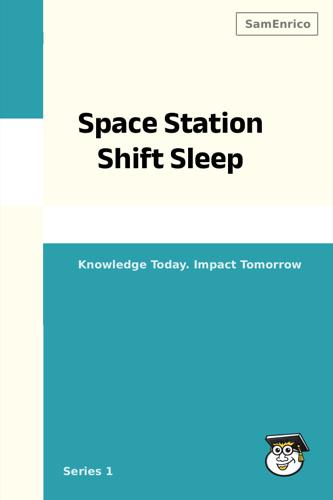
Space Station Shift Sleep eBook
Adapts to 16 sunrises daily in low Earth orbit.
Adapts to 16 sunrises daily in low Earth orbit.
Formats
Free sample
Chapter 1: Sixteen Sunrises Too Many...--The first time astronaut Samantha Cristoforetti tried to sleep in space, she strapped her sleeping bag to the wall of the Columbus module, zipped herself inside like a cocoon, and closed her eyes. Then the sun rose. Forty-five minutes later, it set. Forty-five minutes after that, it rose again. By the fourth sunrise, she stopped counting.
By the eighth, she stopped trying to sleep. By the sixteenth, she had been awake for thirty-six hours, and her hands were shaking so badly that she could not operate the espresso machine she had personally lobbied to bring aboard the International Space Station.That espresso machine—the ISSpresso, a titanium marvel of Italian engineering—had been her pride. On Earth, she had posed for photos with it, grinning beneath the weight of her training helmet. In orbit, it became a cruel joke. She could load the capsule, press the brew button, but her tremor spilled the precious liquid into the air, where it formed a perfect brown sphere that floated past her face like a mocking eyeball.
She watched it drift toward an air vent, and she thought: I am a highly trained test pilot, a veteran of two spaceflights, a woman who has survived centrifuge spins that would make a fighter pilot pass out, and I cannot pour myself a cup of coffee because the sun will not stop rising.This is not a story about coffee. This is a story about the most fundamental biological rhythm on Earth—the 24-hour cycle of light and dark that every living creature has evolved to obey for four billion years—and what happens when you break it. The International Space Station orbits at 17,500 miles per hour, completing a full lap around our planet every ninety minutes. In every twenty-four-hour period, the crew experiences sixteen sunrises and sixteen sunsets. That is thirty-two transitions between light and dark, each one a hammer blow to the brain's ancient timekeeping machinery.The human body is not designed for this.
Nothing on Earth is. The suprachiasmatic nucleus—a cluster of twenty thousand neurons no larger than a grain of rice, buried deep in the hypothalamus—expects a single sunrise per day. It expects darkness to fall gradually, over hours, so the pineal gland can ramp up melatonin production in a gentle curve. It expects the temperature of your core to drop half a degree Celsius as night deepens, signaling to every cell in your body that rest is coming. The space station offers none of this.
It offers strobe-light days and fifteen false nights.And yet, astronauts adapt. Not perfectly—the data shows that even after six months in orbit, crew members sleep an average of only six hours per night, two hours less than on Earth, and their reaction times remain permanently degraded to roughly 0.05% blood alcohol equivalent, enough to be legally impaired behind the wheel of a car. But they adapt enough to pilot robotic arms, conduct spacewalks, perform experiments, and yes, eventually operate espresso machines. The question that drives this book is simple: How?The answer is not simple. It requires us to understand the neuroscience of the master clock, the physics of microgravity, the engineering of light and sound, the pharmacology of sedatives and stimulants, and the psychology of isolation.
It requires us to visit submarines gliding through dark waters, research stations buried in Antarctic ice, and模拟 habitats where volunteers pretend to be on Mars for an entire year. It requires us to ask uncomfortable questions about the limits of human performance—and to find, in those limits, a blueprint for better sleep not just in space, but on the chaotic, shift-work-driven, sleep-deprived planet we call home.This book is called Space Station Shift Sleep because the astronauts' struggle is our struggle. Their sixteen sunrises are the night-shift nurse's twelve-hour rotation, the long-haul trucker's irregular schedule, the new parent's fragmented night, the ER doctor's 3 AM page. The difference is that astronauts have NASA engineers, multi-million-dollar lighting systems, and mandatory cognitive behavioral therapy. You have this book.Let us begin where every astronaut begins: with the first sunrise.The Paradox of Low Earth Orbit To understand why space station sleep is so difficult, you must first understand the physical environment of Low Earth Orbit.
The ISS flies at an altitude of approximately 254 miles—close enough to see the curvature of the Earth, far enough to experience true weightlessness. At this altitude, orbital mechanics dictate that any object must travel at 17,500 miles per hour to maintain altitude. Faster, and you fly off into deep space. Slower, and you re-enter the atmosphere and burn up.This velocity has a consequence: the station completes one full orbit every 90 minutes and 33 seconds, on average. During each orbit, the station passes through two distinct phases.
For roughly 45 minutes, it is in sunlight, the unfiltered glare of the sun reflecting off the station's solar panels and hull. Then it crosses into Earth's shadow, known as the terminator line, and experiences 45 minutes of darkness darker than any night on Earth—because there is no atmosphere to scatter light, no moon that can compete with the blackness of space.Important correction: Some sources incorrectly describe this as a sunrise every 45 minutes. That is a mathematical error that conflates "sunrise" (which occurs once per orbit, every 90 minutes) with "light/dark transition" (which occurs twice per orbit, every 45 minutes). The distinction matters because the brain does not care about semantic precision. The brain experiences thirty-two dramatic light level changes per day—sixteen from dark to light (sunrises) and sixteen from light to dark (sunsets).
That is thirty-two disruptions to the circadian system that evolved to handle one.Astronauts report that the first sunset is beautiful. By the fourth, they have stopped looking. By the tenth, they have started cursing.The Overview Effect and Its Shadow There is a well-known phenomenon in space psychology called the Overview Effect. First described by author Frank White in 1987, the Overview Effect is the cognitive shift that many astronauts report when they see Earth from orbit for the first time: the recognition that our planet is a fragile, interconnected system, that borders are human inventions, that the blue marble is all we have. It is profound.
It is life-changing. It is also, for the purposes of sleep, almost entirely irrelevant.What matters more—and what is far less discussed—is what we might call the Disorientation Effect. This is the biological chaos that results from the constant flashing of light and dark outside the windows, combined with the absence of gravity's orienting cues. The Disorientation Effect manifests as nausea, headache, confusion, and a persistent sense that something is wrong with the passage of time.Cosmonaut Oleg Kotov described it this way: "You look at your watch. It says 2 PM.
You look out the window. It is completely black. Your brain says, 'It must be night.' But your watch says afternoon. You try to eat lunch, but your stomach says it is midnight. You try to sleep, but your eyes say it is noon.
Every system in your body is giving you a different answer."The Disorientation Effect is not merely psychological. It has physiological roots. Without…
This is the end of the free sample. Get the eBook to keep going. Buy now
About this book
Details
- Author
- Tijerina Allene
- Publisher
- SamEnrico
- Language
- English
- Genre
- Non-Fiction, Health & Wellness, Space Medicine
- Released
- 2026-06-07
- Pages (approx.)
- 146
- Available as
- eBook, Audiobook

Read better in the ZLOADR app
Your eBooks on your phone or tablet. Sign in with your SamEnrico account and start reading.
More by Tijerina Allene
 IBS Bloating Relief GuideTijerina Allene$11.99
 Francis Crusade CritiqueTijerina Allene$11.99
 Purpose After AddictionTijerina Allene$11.99
 Fun Icebreaker ActivitiesTijerina Allene$11.99
 Parent Daily Shutdown RoutineTijerina Allene$11.99
 GLP 1 Medications GuideTijerina Allene$11.99
 Catherine French Revolution ReactionTijerina Allene$11.99
 Leaping Into the Void: The Birth of Wingsuit Flying in the Southern SkiesTijerina Allene$11.99
 Nefertiti's Lost Voice: The Silent Pharaoh's CurseTijerina Allene$11.99
 Service Providers Guide to Assisted LivingTijerina Allene$11.99
 A Collector's Handbook to the Hudson Great EightTijerina Allene$11.99
 Portfolio Career Success StoriesTijerina Allene$12.99
You may also like
 Hong Kong Handover 1997Dunn Johnnie$11.99
 Zumba For Postnatal Recovery CourseNeal Christian$11.99
 Zumba for BeginnersLadner Nikia$11.99
 YouTube Comment Mining GuideHumes Pandora$12.99
 Worry Box MeditationCarlin Rudy$11.99
 Workplace Stress MeditationNguyen Lynn$11.99
 Workplace Stress and Sleep RepairHawley Ivory$11.99
 Workplace Perfectionism CureDelaney Jeffry$11.99
 Workplace Injustice Anger GuideWallen Isabelle$11.99
 Work Addiction and Burnout LinkGreenwood Ester$11.99
 Women in Yoga and WellnessBeattie Galina$11.99
 Women in Stand Up ComedyChun Evangeline$11.99