
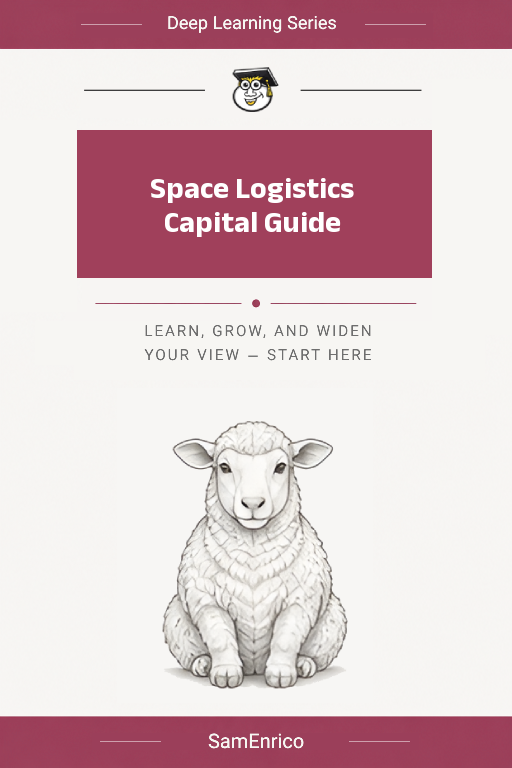
Non-FictionForecast & OutlookSpace Logistics
Space Logistics Capital Guide eBook
Discover orbital transport, debris removal, and in
Discover orbital transport, debris removal, and in-space servicing investment opportunities.
Formats
Free sample
Chapter 1: The Rocket Delusion---– In 2024, a hedge fund manager we will call Daniel Park did everything right. He read the analyst reports, attended the space conferences in Colorado Springs, and vetted the engineering team. He wired $30 million into a launch company that had a working rocket, a manifest of paying customers, and a charismatic CEO who had previously sold a software company for nine figures. Eighteen months later, Daniel Park lost every dollar.Not because the rocket exploded. In fact, the rocket worked perfectly on all three flights during his holding period.
The technology was sound. The team was competent. The customers were satisfied. So what went wrong?Daniel Park made the same mistake that 90 percent of new space investors make. He confused launch with logistics.
He bet on the railroad when he should have bet on the delivery trucks.The rocket he backed succeeded technologically but failed commercially because launch is becoming a commodity. The company’s margins compressed from 40 percent to 12 percent as new entrants flooded the market. Its valuation, once justified by scarcity, evaporated when three competitors demonstrated identical capabilities. The CEO’s exit—a fire sale to a larger aerospace prime—valued the company at less than the total capital raised.Meanwhile, a different investment that Daniel Park had dismissed as “too boring” went on to return 14x. A small startup that never built a rocket, never went to Mars, never touched a satellite.
Instead, it built a refueling port. A standardized valve and coupling that could attach to any satellite. That startup, Orbit Fab, was valued at 60millionwhen Daniel Parkpassedonit.Today,aftersuccessfuldemonstrationsofon−orbitrefueling,itisvaluednorthof60 million when Daniel Park passed on it. Today, after successful demonstrations of on-orbit refueling, it is valued north of 60millionwhen Daniel Parkpassedonit.Today,aftersuccessfuldemonstrationsofon−orbitrefueling,itisvaluednorthof800 million.The rocket company he backed? It is now a footnote in a Lockheed Martin acquisition announcement, its brand dissolved, its investors paid pennies on the dollar.This book exists because that story will repeat hundreds of times over the next decade—unless investors learn to look at the right part of the sky.The Inversion No One Is Talking About For the first sixty years of the space age, from Sputnik in 1957 to the early 2010s, the rocket was the valuable thing.
Launch costs dominated the economics of every space mission. A single launch to geostationary orbit cost 200millionormore.Thesatelliteitselfmightcost200 million or more. The satellite itself might cost 200millionormore.Thesatelliteitselfmightcost300 million. But the launch was the bottleneck, the gating factor, the constraint around which all other decisions revolved.Then something remarkable happened. Space X, followed by Rocket Lab, followed by a dozen international competitors, collapsed the cost of launch by a factor of twenty.
The Falcon 9 today launches payloads for approximately 1,500perkilogram.The Space Shuttle,adjustedforinflation,costroughly1,500 per kilogram. The Space Shuttle, adjusted for inflation, cost roughly 1,500perkilogram.The Space Shuttle,adjustedforinflation,costroughly54,000 per kilogram. That is a 97 percent reduction. For context, that is like the price of a new car dropping from 50,000to50,000 to 50,000to1,500.When a bottleneck vanishes, the value chain inverts. The scarce thing becomes not the launch but the asset already in orbit.Think about the economics for a moment.
A geostationary communications satellite costs 300to300 to 300to500 million to build and takes three to five years to manufacture. Once it is in orbit, it generates 50to50 to 50to100 million per year in revenue. A five-year extension of its operational life—through refueling, servicing, or repositioning—creates 250to250 to 250to500 million of incremental value. The rocket that delivered it? That was a one-time cost of 60to60 to 60to80 million, increasingly replaceable by any of a dozen launch providers.The rocket is the bus ticket.
The satellite is the factory. And yet the investment community remains obsessed with the bus.The Four Pillars of the New Space Economy This book organizes the space logistics opportunity into four interconnected pillars, each with distinct investment characteristics, risk profiles, and return expectations.Pillar One: Transport involves moving goods between orbits after they have already been launched. A rocket drops a satellite at a single "bus stop" orbit—typically a low Earth parking orbit or a geostationary transfer orbit. But the customer needs that satellite at a precise orbital slot, with a specific inclination and altitude. The gap is filled by Orbital Transfer Vehicles (OTVs), small spacecraft that act as last-mile delivery trucks.
This is the highest-volume but lowest-margin pillar, characterized by predictable recurring revenue and intense competition.Pillar Two: Servicing encompasses on-orbit inspection, repair, upgrade, and repositioning of functioning satellites. If a solar array fails to deploy, a servicing vehicle can fix it. If a satellite drifts off station, a tug can reposition it. If software needs updating, a servicer can patch it. This pillar is higher-margin than transport but requires proven rendezvous and proximity operations (RPO) capabilities.
Only a handful of companies have successfully demonstrated RPO.Pillar Three: Refueling is the most capital-efficient pillar because it generates recurring revenue from existing assets. A fuel depot built once can sell propellant hundreds of times. For satellite operators, refueling extends the life of a $500 million asset for a fraction of the replacement cost. This is the "razor and blades" model of space—the razor is the depot, the blades are every subsequent refueling mission. The challenge is technical: storing cryogenic propellants in zero-G for months without boil-off is genuinely hard.Pillar Four: Sustainability covers end-of-life disposal and active debris removal.
This is the only pillar driven primarily by regulation rather than pure economics. The FCC now requires satellites to deorbit within five years of end of mission. Emerging "disposal bonds" may require constellation operators to post financial assurance for cleanup. This creates a forced, non-discretionary market—similar to environmental remediation bonds in terrestrial industries. The customers are not always willing, but they are compelled.Throughout this book, we will drill into each pillar: the key companies, the financial models, the technical risks, and the regulatory drivers.
But before we do, you must understand why almost every space investor is looking in the wrong direction.The Iceberg Principle Here is a mental model that will save you from Daniel Park's fate.Imagine a rocket launch. You see the flame, the smoke, the thunderous ascent. The cameras track the vehicle as it arcs over the Atlantic. Stage separation. Fairing deployment.
Orbit insertion. It is dramatic, visceral, and telegenic. This is the tip of the iceberg—visible, exciting, and utterly misleading.Beneath the waterline, invisible to the cameras and ignored by most analysts, is the other 90 percent of the space economy. The ground stations that communicate with the satellite after deployment. The data processing centers that turn raw telemetry into actionable intelligence.
The logistics network that moves satellites from the factory to the integration facility to the launch pad. The orbital transport system that delivers the satellite from the drop-off orbit to its final slot. The servicing infrastructure that keeps it operational. The refueling network that extends its life. The disposal system that removes it when it dies.This submerged mass is space logistics.
It is less glamorous than launch, which is precisely why it is more profitable. Glamour attracts competition. Competition compresses margins. The boring stuff—the delivery…
This is the end of the free sample. Get the eBook to keep going. Buy now
About this book
Details
- Author
- Keefer Louanne
- Publisher
- SamEnrico
- Language
- English
- Genre
- Non-Fiction, Forecast & Outlook, Space Logistics
- Released
- 2026-05-28
- Pages (approx.)
- 149
- Available as
- eBook, Audiobook

Read better in the ZLOADR app
Your eBooks on your phone or tablet. Sign in with your SamEnrico account and start reading.
More by Keefer Louanne
 Buddhist Sutta Anapanasati StudyKeefer Louanne$11.99
 German Russian Return To Volga MemoirKeefer Louanne$11.99
 Employee Disaster Action Card GuideKeefer Louanne$11.99
 Metta Meditation Daily Practice GuideKeefer Louanne$11.99
 The Body Language for Casino StaffKeefer Louanne$11.99
 The Phantom of the Autobahn: Germany's Truck Stop KillerKeefer Louanne$11.99
 Understanding Mngie SyndromeKeefer Louanne$17.99
 Enargite MiningKeefer Louanne$11.99
 Release Notes Automation GuideKeefer Louanne$12.99
 How to Become a Laborer - Chemical ProcessingKeefer Louanne$11.99
You may also like
 Hong Kong Handover 1997Dunn Johnnie$11.99
 Zumba For Postnatal Recovery CourseNeal Christian$11.99
 Zumba for BeginnersLadner Nikia$11.99
 YouTube Comment Mining GuideHumes Pandora$12.99
 Worry Box MeditationCarlin Rudy$11.99
 Workplace Stress MeditationNguyen Lynn$11.99
 Workplace Stress and Sleep RepairHawley Ivory$11.99
 Workplace Perfectionism CureDelaney Jeffry$11.99
 Workplace Injustice Anger GuideWallen Isabelle$11.99
 Work Addiction and Burnout LinkGreenwood Ester$11.99
 Women in Yoga and WellnessBeattie Galina$11.99
 Women in Stand Up ComedyChun Evangeline$11.99