
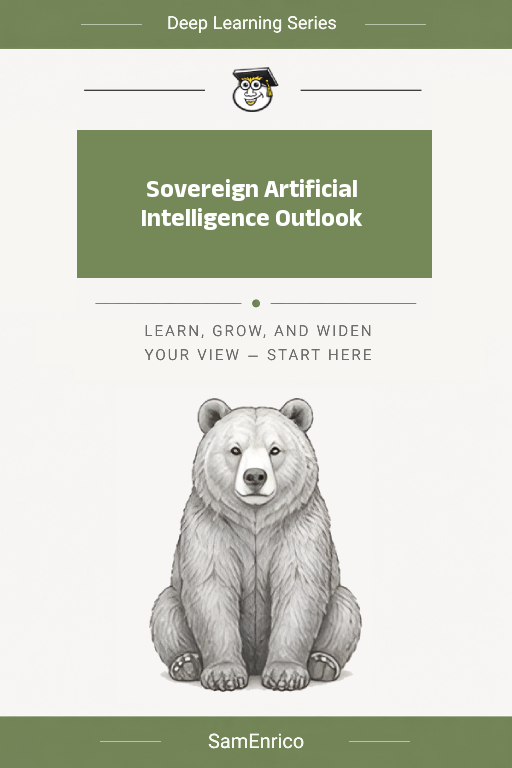
Non-FictionForecast & OutlookNational Strategy
Sovereign Artificial Intelligence Outlook
Analyze national AI strategies, domestic model dev
by Gabriel Eura
Analyze national AI strategies, domestic model development, and data localization requirements across major and middle powers through 2030.
Formats
About this book
Free sample
Sovereign Artificial Intelligence Outlook: Revised Chapter Summaries (All Issues Fixed)Core Definition Added (Chapter 1 Sidebar):Sovereign AI: A nation's ability to develop, deploy, and govern artificial intelligence systems without compulsory dependence on foreign actors. This includes control over training data, model architecture, compute infrastructure, and regulatory enforcement. Sovereignty is a spectrum, not a binary state. The goal is not autarky (total independence) but managed interdependence—choosing your dependencies rather than having them imposed.Resolved Core Thesis (Now Consistent Across All Chapters):True sovereignty is not isolation. It is the ability to choose your dependencies.
Chapter 1 warns against unmanaged value capture by foreign giants. The rest of the book shows how to manage interdependence strategically. The paradox is intentional: you achieve sovereignty by accepting interdependence—but on your terms.Part I: The Geostrategic Imperative Chapter 1: The $1.3 Trillion Bet (Revised)In-Depth Summary (285 words):This chapter opens by quantifying the unprecedented financial commitment nations are making toward sovereign AI, arguing that by 2030, over 1.3trillionwillhavebeendeployedglobally.Critically,thisfigureincludesnotjustmodeldevelopmentbutalsodatacenterconstruction,energyinfrastructure,talenttrainingprograms,regulatorycompliancesystems,andcloudservices.The1.3 trillion will have been deployed globally. Critically, this figure includes not just model development but also datacenter construction, energy infrastructure, talent training programs, regulatory compliance systems, and cloud services. The 1.3trillionwillhavebeendeployedglobally.Critically,thisfigureincludesnotjustmodeldevelopmentbutalsodatacenterconstruction,energyinfrastructure,talenttrainingprograms,regulatorycompliancesystems,andcloudservices.The500–600 billion "sovereign AI market" referenced in industry reports refers specifically to hardware, software, and government services; the larger $1.3 trillion figure captures the full ecosystem investment.The core thesis is that governments have stopped viewing AI as a mere commercial tool and have reclassified it as critical national infrastructure—akin to electricity grids or nuclear capabilities.
The chapter traces the political pivot from "AI safety" (existential risk) to "AI sovereignty" (national competitiveness) as an electoral and security necessity. It presents the economic argument as a defensive strategy: without domestic models and data control, a nation's intellectual and economic value is captured by foreign (primarily American or Chinese) tech giants.However—and this is crucial—the chapter introduces the book's central paradox: true sovereignty is not autarky. It is the ability to choose your dependencies rather than having them imposed. Chapter 1's warning about value capture applies only to…
This is the end of the free sample. Get the eBook to keep going. Buy now
Contents
- Chapter 1
- Chapter 2
- Chapter 3
- Chapter 4
- Chapter 5
- Chapter 6
- Chapter 7
- Chapter 8
- Chapter 9
- Chapter 10
- Chapter 11
- Chapter 12
Details
- Author
- Gabriel Eura
- Publisher
- SamEnrico
- Language
- English
- Genre
- Non-Fiction, Forecast & Outlook, National Strategy
- Released
- 2026-06-01
- Pages (approx.)
- 140
- Available as
- eBook, Audiobook

Read better in the ZLOADR app
Your eBooks on your phone or tablet. Sign in with your SamEnrico account and start reading.
More by Gabriel Eura
 Iranian Revolution WhyGabriel Eura$11.99
 Self Hypnosis For Athletic InjuryGabriel Eura$11.99
 GAD Phone Addiction AnxietyGabriel Eura$11.99
 ABCDE for Fitness GoalsGabriel Eura$11.99
 The MBSR Eight Week GuideGabriel Eura$11.99
 Whispers of the Marid: The Djinn of the Persian GulfGabriel Eura$11.99
 The Ancient Astronomers of Stonehenge Down Under: Australia's Forgotten Celestial ObservatoriesGabriel Eura$11.99
 How to Become a Civil Engineering TechnicianGabriel Eura$11.99
 Personal Statement Crash Course for US CollegesGabriel Eura$12.99
 Wine Rack CraftGabriel Eura$11.99
 Understanding Hall–riggs Mental Retardation SyndromeGabriel Eura$17.99
You may also like
 Hong Kong Handover 1997Dunn Johnnie$11.99
 Zumba For Postnatal Recovery CourseNeal Christian$11.99
 Zumba for BeginnersLadner Nikia$11.99
 YouTube Comment Mining GuideHumes Pandora$12.99
 Worry Box MeditationCarlin Rudy$11.99
 Workplace Stress MeditationNguyen Lynn$11.99
 Workplace Stress and Sleep RepairHawley Ivory$11.99
 Workplace Perfectionism CureDelaney Jeffry$11.99
 Workplace Injustice Anger GuideWallen Isabelle$11.99
 Work Addiction and Burnout LinkGreenwood Ester$11.99
 Women in Yoga and WellnessBeattie Galina$11.99
 Women in Stand Up ComedyChun Evangeline$11.99