
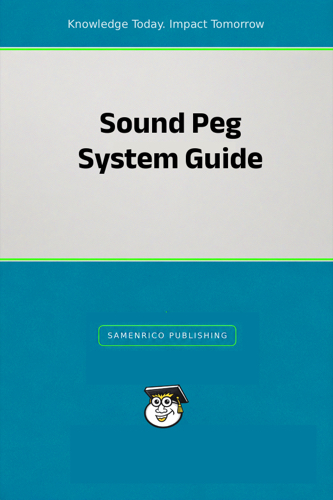
Non-FictionSelf-HelpAuditory Memory
Sound Peg System Guide eBook
Uses auditory pegs like animal sounds for aural le
Uses auditory pegs like animal sounds for aural learners.
Formats
Free sample
Chapter 1: The Grocery Store Disaster--You are standing in aisle seven, staring at the fluorescent lights, and you feel it again—that familiar, hollow ache of having failed at something so simple that everyone else seems to do effortlessly. You know you came here for three things. Maybe four. The list was in your head just five minutes ago, rehearsed perfectly while you were parking the car. Now it is gone.
Vapor. You grab the handle of your shopping cart—the one with the wobbly wheel that pulls left—and you try to reverse-engineer your morning. Coffee. You had coffee. Did you think about milk?
No, milk was yesterday. Eggs? You have eggs. The butter dish was empty. Butter.
You needed butter. And something else. Something important. Your phone is dead because you forgot to charge it last night, and even if it weren't, the grocery store's concrete walls kill the signal anyway. You stand there, a capable adult with a job and a mortgage and people who rely on you, and you cannot remember three items from a list you made thirty minutes ago.This is not about shopping lists.
This is about the quiet, accumulating dread that your memory is somehow broken—that everyone else received a manual for their brain at birth and yours was lost in the mail. You have learned to live with workarounds. Sticky notes on the bathroom mirror. Alarms on your phone for everything from taking out the trash to calling your mother. The careful, exhausting architecture of reminders that turns a simple life into a logistics problem.
You have told yourself that this is normal. Everyone forgets things. But deep down, you suspect that the gap between what you want to remember and what you actually remember is wider for you than for other people.Here is what no one has ever told you: you do not have a bad memory. You have a memory system trained for the wrong channel.Imagine for a moment that you are colorblind. Not entirely—you see the world in shades of gray and the occasional muted blue—but red and green are indistinguishable to you.
Now imagine that every important piece of information you receive is coded in red and green. Traffic lights. Warning signs. Maps. Your phone's battery indicator.
Your entire life would be a struggle not because your eyes are broken but because the world insists on speaking a language your eyes were never built to understand. You would not blame your eyes. You would blame the system that refuses to accommodate how you actually see.That is exactly what has happened to you with memory.For centuries, the dominant memory systems have been overwhelmingly visual. The Method of Loci—that ancient Greek technique where you imagine placing memories in rooms of a familiar building—requires you to think in pictures. The Major System, which turns numbers into consonant sounds and then into images, asks you to visualize a "bun" for one, a "shoe" for two.
Even the popular "memory palace" technique, celebrated in bestsellers and TED Talks, assumes that your brain's native language is imagery. And for about sixty to seventy percent of the population, that assumption works beautifully. Those people can close their eyes, see a giant shoe holding a list of groceries, and remember everything.But you are not one of those people.You are an aural learner. Your brain processes the world not through pictures but through timbre, rhythm, and pitch. You remember the way your grandmother's voice cracked on certain words, not what she was wearing.
You can hum a song you haven't heard in twenty years but cannot picture your childhood bedroom ceiling. When someone gives you directions, you remember "turn left at the sound of the train tracks" but forget the street names written on signs. You are not broken. You are wired differently. And every visual memory system you have ever tried has failed you for one simple, inescapable reason: they force you to translate.The Translation Problem Every time you use a visual memory system, your brain performs a hidden, exhausting series of conversions.
Let me show you what happens inside your head when someone says, "Remember the number two by picturing a shoe."First, you hear the word "two" as a sound. That is your native language—audio. Then your brain has to convert that sound into a meaning (the digit 2). Then it has to convert that meaning into a visual instruction ("picture a shoe"). Then it has to generate the image of a shoe.
Then it has to attach the thing you are trying to remember (milk, a name, a deadline) to that image. Then, when you try to recall, you have to reverse the entire process: see the shoe, remember that it stands for two, convert that back into the digit, and finally retrieve the attached information.That is five to seven extra steps for every single piece of information you want to store. Each step is a chance for failure. Each step adds friction. Each step makes your brain work harder, not smarter.
No wonder you feel exhausted after trying to memorize anything. No wonder you gave up on memory systems before. They were asking you to become a translator in a language you do not speak fluently.Now imagine a different way. What if, instead of converting "two" into a picture of a shoe, you simply attached the number two directly to a sound? Not the word "moo" as a label, but the actual, raw, felt experience of a cow's lowing—the deep, resonant vibration that you feel in your chest when a cow calls across a field.
What if hearing the number two instantly triggered that sound, and that sound alone was enough to hook your memory? No translation. No images. No extra steps. Just sound to sound, the way your brain already works when you remember the chorus of a song or the beep of your microwave telling you that dinner is ready.That is the Sound Peg System.
And before we build it together, I need you to understand why it works at the level of your biology, not just your effort.Your Brain Is a Sound Machine Neuroscientists have known for decades that the human auditory cortex is one of the most sophisticated pattern-matching systems in existence. But recent research—specifically the work of Shamma and Elgueda at the University of Maryland—has revealed something remarkable about how your brain processes sound. They discovered that the higher-order auditory cortex does not simply record sounds like a tape recorder. It actively transforms raw audio into what they call "abstract representations encoding sound behavioral meaning."Let me translate that from academic language into English. Your brain does not just hear a sound.
It instantly decides what that sound means and what you should do about it. This happens in milliseconds, below the level of conscious thought. When you hear a hiss, your brain does not think, "That is a sound with a frequency around 3,000 hertz and a sustained envelope." It thinks, "Snake. Danger. Move." When you hear a beep, your brain thinks, "Microwave.
Food. Ready." When you hear a knock, your brain thinks, "Door. Someone. Pay attention."This is the same reason a dog…
This is the end of the free sample. Get the eBook to keep going. Buy now
About this book
Details
- Author
- Meacham Lilli
- Publisher
- SamEnrico
- Language
- English
- Genre
- Non-Fiction, Self-Help, Auditory Memory
- Released
- 2026-06-11
- Pages (approx.)
- 147
- Available as
- eBook, Audiobook

Read better in the ZLOADR app
Your eBooks on your phone or tablet. Sign in with your SamEnrico account and start reading.
More by Meacham Lilli
 Partner Grief SupportMeacham Lilli$11.99
 Vision Health Brain AgingMeacham Lilli$11.99
 Encoding Failure CasesMeacham Lilli$11.99
 Paleo Dessert Replacement PlanMeacham Lilli$11.99
 Quit Smoking for Anxiety ReliefMeacham Lilli$11.99
 Fear of Failure for LeadersMeacham Lilli$11.99
 Threads of Love: The Maori Weavers Who Defied WarMeacham Lilli$11.99
 Top of the Pops: The Show That Shaped a GenerationMeacham Lilli$11.99
 How to Produce Speaker Stands and MountsMeacham Lilli$11.99
 How to Produce Gloss FinishMeacham Lilli$11.99
 Grantor Retained Annuity TrustsMeacham Lilli$12.99
 Eu Domain Brexit TransitionMeacham Lilli$12.99
You may also like
 Hong Kong Handover 1997Dunn Johnnie$11.99
 Zumba For Postnatal Recovery CourseNeal Christian$11.99
 Zumba for BeginnersLadner Nikia$11.99
 YouTube Comment Mining GuideHumes Pandora$12.99
 Worry Box MeditationCarlin Rudy$11.99
 Workplace Stress MeditationNguyen Lynn$11.99
 Workplace Stress and Sleep RepairHawley Ivory$11.99
 Workplace Perfectionism CureDelaney Jeffry$11.99
 Workplace Injustice Anger GuideWallen Isabelle$11.99
 Work Addiction and Burnout LinkGreenwood Ester$11.99
 Women in Yoga and WellnessBeattie Galina$11.99
 Women in Stand Up ComedyChun Evangeline$11.99