
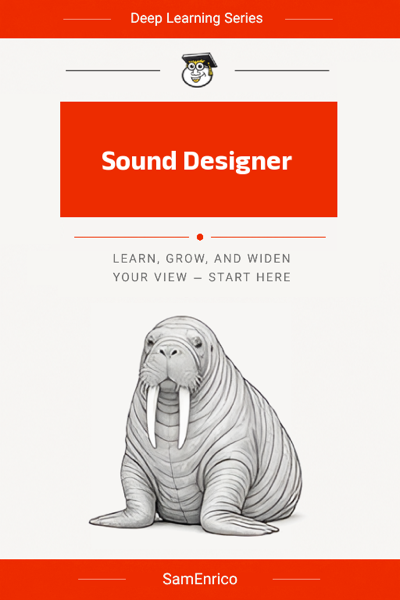
Non-FictionInformativeEducational
Sound Designer eBook
A Coursebook on Sound Designer
A Coursebook on Sound Designer
Formats
Free sample
Chapter 1: The Listening Revolution--–- Most people spend their entire lives surrounded by sound without ever truly hearing it. They walk through rainstorms and notice only the wetness on their skin, missing the symphony of droplets striking a dozen different surfaces. They sit in coffee shops, filtering out the hiss of the espresso machine, the clatter of ceramic cups, the overlapping murmurs of a dozen conversations, treating these textures as noise to be ignored rather than information to be decoded. This is not laziness. This is survival.The human brain evolved to filter.
In any given environment, your auditory system is bombarded with more data than it can possibly process. To function, to hold a conversation, to cross a street without being flattened by a bus, your brain must constantly decide what matters and what does not. This filtering happens automatically, unconsciously, and it is remarkably effective at keeping you alive. But it is also the single greatest obstacle to becoming a sound designer.Because sound design does not begin with a microphone, a synthesizer, or a digital audio workstation. It begins with a decision to stop filtering and start listening.This chapter is not about equipment.
It is not about software. It is about rewiring the relationship between your ears and your brain. Before you can create sounds that move audiences, you must learn to hear the world as it actually is: a dense, layered, constantly shifting tapestry of frequencies, reflections, and textures. The difference between a mediocre sound designer and a master is not the size of their sample library or the cost of their monitors. It is the quality of their attention.Welcome to the listening revolution.The Fundamental Distinction: Hearing Versus Listening Let us begin with a distinction that will serve as the foundation for everything that follows.
Hearing is physiological. It is the mechanical process by which sound waves travel through your ear canal, vibrate your eardrum, and are converted into electrical signals that travel to your brain. If your ears function, you are hearing right now — the hum of your computer, the rumble of traffic outside, perhaps the distant bark of a dog or the murmur of a television in another room. You cannot turn off hearing. It happens whether you want it to or not.Listening is different.
Listening is active, intentional, cognitive. It is the decision to pay attention to specific sounds, to analyze them, to extract meaning from them. You can be in a room full of noise — a crowded party, a busy subway platform — and choose to listen to a single voice. That is listening. You can close your eyes and focus entirely on the texture of a passing car’s engine, noticing the pitch rise and fall, the growl of the exhaust, the hiss of tires on wet pavement.
That is listening.The French composer and acoustician Pierre Schaeffer, a pioneer of what he called musique concrète, developed a concept he named écoute réduite — reduced listening. This is the practice of listening to a sound for its own qualities, stripped of its source and meaning. When you practice reduced listening, you do not hear a bus passing. You hear a low-frequency rumble that rises in pitch, peaks, then falls; you hear the broadband noise of tires; you hear a metallic squeal from the brakes. You listen to the sound itself, not what it represents.This is the core skill of the sound designer.Most of your life, you have listened causally — you hear a sound and immediately identify its source.
A door closing. A dog barking. A car horn. Your brain leaps from sensation to identification in milliseconds, then moves on. Reduced listening asks you to pause at the sensation itself, to dwell in the acoustic event before categorizing it.
A master sound designer can listen to a recording of a gunshot and hear not just “gunshot” but the specific shape of the transient, the length of the reverb tail, the frequency balance between boom and crack, the subtle distortion of the recording medium. They hear the sound in its particularity, not its generality.This chapter will train you to do the same.The Anatomy of Hearing: How Your Ears Construct Reality Before you can understand what you are listening to, you must understand the extraordinary machine that does the listening. The human ear is not a passive microphone. It is an active, non-linear, frequency-analyzing wonder that performs feats of signal processing that no digital algorithm can fully replicate.Your ear is divided into three sections: the outer ear, the middle ear, and the inner ear. Each plays a distinct role in transforming the physical energy of sound waves into the electrochemical language of the nervous system.The Outer Ear: The Pinna and Ear Canal The visible part of your ear, the pinna, is not just decorative.
Its convoluted ridges and curves serve as a direction-sensitive acoustic filter. Sound waves entering the pinna are reflected and diffracted in patterns that change subtly depending on whether the source is in front of you, behind you, above you, or below you. Your brain has learned to decode these patterns, allowing you to localize sounds in three-dimensional space even with one ear covered. This is why you can turn toward an unexpected noise in the dark without seeing it first.The ear canal, approximately 2.5 centimeters long, is a resonant tube. Its length gives it a natural resonant frequency around 3,000 to 4,000 Hertz — the frequency range of human speech and the sound of a crying baby.
Your ear is physically tuned to be most sensitive to the sounds that matter most for survival and communication. This is not coincidence; it is evolution.The Middle Ear: Impedance Matching At the end of the ear canal lies the tympanic membrane — the eardrum. Sound waves striking this thin membrane cause it to vibrate. These vibrations are transferred to three tiny bones, the ossicles: the malleus (hammer), incus (anvil), and stapes (stirrup). These are the smallest bones in the human body, and they perform a critical function: impedance matching.Sound travels efficiently through air but poorly through the fluid-filled inner ear.
Without the ossicles, 99.9 percent of the acoustic energy reaching your eardrum would be reflected away. The ossicles act as a mechanical amplifier, concentrating the force of the eardrum’s vibrations onto the much smaller surface of the oval window, the gateway to the inner ear. This mechanical advantage allows approximately 60 percent of the acoustic energy to transfer into the cochlea — still inefficient, but vastly better than nothing.The Inner Ear: Frequency Analysis The cochlea is a spiral-shaped, fluid-filled structure about the size of a pea. Inside, running along its length, is the basilar membrane. This membrane is not uniform: it is narrow and stiff at the base (near the oval window) and wider and more flexible at the apex (the tip of the spiral).
This variation in mechanical properties creates a remarkable effect. High-frequency sounds cause the basilar membrane to vibrate most strongly near the base. Low-frequency sounds cause it to vibrate most strongly near the apex. The cochlea performs a continuous, real-time frequency analysis of every sound entering your ear.Sitting atop the basilar membrane…
This is the end of the free sample. Get the eBook to keep going. Buy now
About this book
Details
- Author
- Sherwood Reanna
- Publisher
- SamEnrico
- Language
- English
- Genre
- Non-Fiction, Informative, Educational
- Released
- 2026-05-06
- Pages (approx.)
- 141
- Available as
- eBook, Audiobook

Read better in the ZLOADR app
Your eBooks on your phone or tablet. Sign in with your SamEnrico account and start reading.
More by Sherwood Reanna
 Mindful Sobriety: An Alcoholism Recovery CourseSherwood Reanna$11.99
 Creative Professional BurnoutSherwood Reanna$11.99
 Equity Waterfall AnalysisSherwood Reanna$11.99
 Workaholism and ADHDSherwood Reanna$11.99
 Neural Dawn: The Unseen Architect of the First AI UprisingSherwood Reanna$11.99
 How to Produce Airsoft EquipmentSherwood Reanna$11.99
 Cross Border Payment Insurance GuideSherwood Reanna$12.99
 How to Start a Ferrosilicon Chromium Business (Beginners Guide)Sherwood Reanna$11.99
You may also like
 Hong Kong Handover 1997Dunn Johnnie$11.99
 Zumba For Postnatal Recovery CourseNeal Christian$11.99
 Zumba for BeginnersLadner Nikia$11.99
 YouTube Comment Mining GuideHumes Pandora$12.99
 Worry Box MeditationCarlin Rudy$11.99
 Workplace Stress MeditationNguyen Lynn$11.99
 Workplace Stress and Sleep RepairHawley Ivory$11.99
 Workplace Perfectionism CureDelaney Jeffry$11.99
 Workplace Injustice Anger GuideWallen Isabelle$11.99
 Work Addiction and Burnout LinkGreenwood Ester$11.99
 Women in Yoga and WellnessBeattie Galina$11.99
 Women in Stand Up ComedyChun Evangeline$11.99