
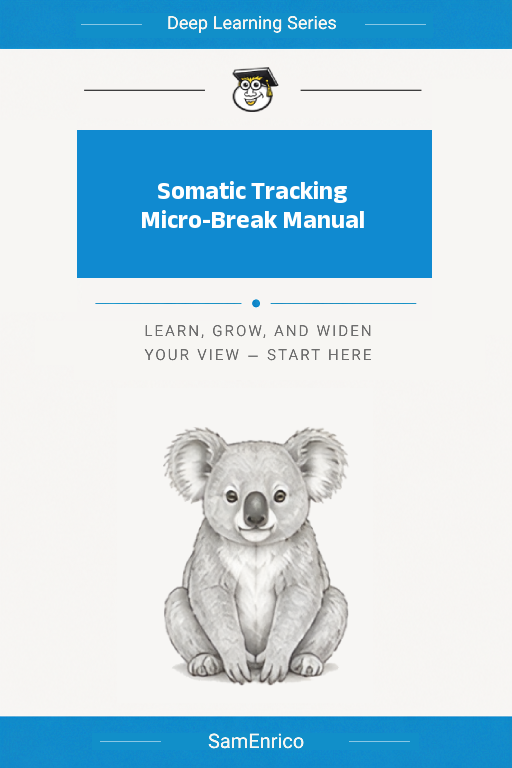
Non-FictionMental WealthSomatic Experiencing
Somatic Tracking Micro-Break Manual eBook
Notice body sensations for 60 seconds to interrupt
by Ruff Jena
Notice body sensations for 60 seconds to interrupt anxiety loops and return to ventral vagal safety.
Formats
Free sample
Chapter 1: The 60-Second Trap--–- It is 3:00 AM. Your eyes snap open. There is no nightmare, no sound, no obvious reason. And yet, somewhere between your sternum and your throat, a heat is rising. Your heart, which was sleeping peacefully moments ago, is now slamming against your ribs like a prisoner demanding release.
Your mind, still groggy, scrambles for an explanation. What did I forget? What email did I send? What is wrong with me? By the time you reach for your phone to check the time, it is 3:02.
By the time you have opened a browser to google "why am I anxious for no reason," it is 3:05. By 3:10, you are fully submerged in a spiral that will leave you exhausted until noon.Here is what no one told you: you had sixty seconds. From that first flicker of heat at 3:00 to the point of no return at 3:01, there was a window. A gap. A small, metabolically distinct period during which your nervous system had not yet committed to the spiral.
And you missed it—not because you are broken, not because you are weak, and certainly not because you are crazy. You missed it because no one ever taught you the window exists.This book exists to close that gap.The Physiology of a Spiral Before we can interrupt a spiral, we have to understand what a spiral actually is. The word "anxiety" gets thrown around so casually that it has lost much of its meaning. We say we are "anxious" about a job interview, a first date, or a medical test. We say we are "anxious" when we are mildly nervous and when we are in the grip of a full-blown panic attack.
But these are not the same thing. They are not even on the same continent.What I am talking about in this book is not the low hum of everyday worry. I am talking about the spiral: the moment when your nervous system moves from a state of relative calm into a full sympathetic nervous system activation. This is the fight-or-flight response. It is ancient, it is powerful, and it is designed to save your life when a predator is chasing you.The problem is that your nervous system cannot tell the difference between a tiger and a text message.Here is what happens inside your body during those first sixty seconds.
A trigger occurs. It might be external—a sound, a sight, a tone of voice. It might be internal—a memory fragment, a body sensation, a thought that appears from nowhere. Your neuroception (a term we will explore in depth in Chapter 2) detects this trigger and evaluates it as a potential threat. This evaluation happens in milliseconds, long before your conscious mind has any idea what is happening.Once the trigger is flagged as a threat, your amygdala—two small, almond-shaped clusters of neurons deep in your brain—sounds the alarm.
It sends a distress signal to your hypothalamus, which acts as the command center for your stress response. The hypothalamus activates your sympathetic nervous system. Your adrenal glands release a flood of epinephrine (adrenaline) and, slightly later, cortisol.Your heart rate spikes. Your blood pressure rises. Your breathing becomes shallow and rapid.
Blood rushes away from your digestive system and toward your large muscles, preparing you to run or fight. Your pupils dilate. Your peripheral vision narrows. Your non-essential systems—digestion, immune response, even your ability to think clearly—shut down.This entire cascade takes approximately sixty to ninety seconds from trigger detection to full activation.Here is the crucial detail that most people miss: there is a latency period. Between the moment the trigger is detected and the moment the sympathetic cascade is fully engaged, there is a gap.
During this gap, your nervous system has not yet committed to fight-or-flight. The alarm has been sounded, but the troops have not yet fully mobilized. This gap is approximately sixty seconds long.That gap is where the micro-break lives.Why Thinking Cannot Save You If you have ever tried to talk yourself out of a panic attack, you already know the futility of it. You sit there, heart pounding, chest tight, mind racing, and you say to yourself: "There is nothing to be afraid of. I am safe.
This is just anxiety. It will pass."And your body ignores you completely.This is not because you are bad at self-talk. It is not because you lack willpower or discipline or positive thinking. It is because the part of your brain that generates thoughts—the prefrontal cortex, responsible for reasoning, planning, and self-control—is not connected to your stress response in the way you think it is.Here is the neuroanatomical reality: the amygdala can activate the stress response without any input from the prefrontal cortex. In fact, the signal from the amygdala to the hypothalamus is faster and more direct than the signal from the prefrontal cortex to the amygdala.
By the time your prefrontal cortex has formed the thought "I am safe," your amygdala has already sounded the alarm, your hypothalamus has already activated your sympathetic nervous system, and your adrenal glands have already released epinephrine.You are trying to reason with a system that does not speak your language.This is why traditional talk therapy, for all its benefits, often fails to help people with panic disorder or generalized anxiety when they are in the middle of a spiral. Talk therapy works on the level of narrative and meaning. It helps you understand the stories you tell yourself about your past, your relationships, and your future. But when you are in the grip of a sympathetic activation, you do not have access to narrative and meaning. You have access to sensation.
Heat. Pressure. Tension. Speed.The only way out of a body loop is through the body.The Micro-Break Defined Now that we understand the problem, let me define the solution.A micro-break is a sixty-second somatic intervention designed to interrupt the anxiety loop during the latency gap. It has three essential characteristics.First, a micro-break is purely somatic.
It does not involve thinking, analyzing, interpreting, or narrating. You do not ask yourself why you feel the way you feel. You do not try to figure out where the trigger came from. You do not attempt to reframe your thoughts or generate positive affirmations. You simply direct your attention to your body—to the raw, pre-interpreted sensations that are arising in real time.Second, a micro-break is timed.
It is not an open-ended meditation. It is not a practice you do when you have "time to relax." It is a precise, sixty-second protocol that you deploy exactly when you feel the first flicker of a spiral. The timing matters because the window closes. If you wait until you are fully activated—until your heart is pounding and your hands are shaking and your thoughts are racing—you have missed the gap. You can still use the tools in this book to recover, but you will have lost the opportunity for interruption.Third, a micro-break requires no special environment, equipment, or preparation.
You do not need a meditation cushion, a quiet room, incense, or a particular posture. You can do a micro-break…
This is the end of the free sample. Get the eBook to keep going. Buy now
About this book
Details
- Author
- Ruff Jena
- Publisher
- SamEnrico
- Language
- English
- Genre
- Non-Fiction, Mental Wealth, Somatic Experiencing
- Released
- 2026-05-30
- Pages (approx.)
- 142
- Available as
- eBook, Audiobook

Read better in the ZLOADR app
Your eBooks on your phone or tablet. Sign in with your SamEnrico account and start reading.
More by Ruff Jena
 Post Trauma Nightmares ChildrenRuff Jena$11.99
 Memory Palace For Theater LinesRuff Jena$11.99
 Social Security for Never MarriedRuff Jena$11.99
 Active Listening De escalationRuff Jena$11.99
 Hinton First Steps Free AirRuff Jena$11.99
 Pomodoro for ArtistsRuff Jena$11.99
 British Malaya Rubber EraRuff Jena$11.99
 Dream Journaling for TherapistsRuff Jena$11.99
 Mami Wata's Lament: The Mermaid and the TricksterRuff Jena$11.99
 How to Start a Commonwealth Institute Business (Beginners Guide)Ruff Jena$11.99
 How to Produce Potty SeatsRuff Jena$11.99
 Corporate Grant Writing GuideRuff Jena$12.99
You may also like
 Hong Kong Handover 1997Dunn Johnnie$11.99
 Zumba For Postnatal Recovery CourseNeal Christian$11.99
 Zumba for BeginnersLadner Nikia$11.99
 YouTube Comment Mining GuideHumes Pandora$12.99
 Worry Box MeditationCarlin Rudy$11.99
 Workplace Stress MeditationNguyen Lynn$11.99
 Workplace Stress and Sleep RepairHawley Ivory$11.99
 Workplace Perfectionism CureDelaney Jeffry$11.99
 Workplace Injustice Anger GuideWallen Isabelle$11.99
 Work Addiction and Burnout LinkGreenwood Ester$11.99
 Women in Yoga and WellnessBeattie Galina$11.99
 Women in Stand Up ComedyChun Evangeline$11.99