
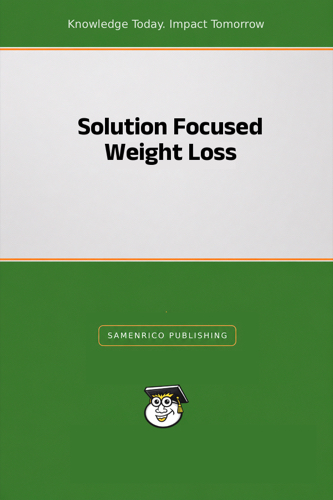
Non-FictionHealth & WellnessSolution Focused
Solution Focused Weight Loss eBook
Focus on exceptions and future solutions rather th
by Will Cris
Focus on exceptions and future solutions rather than past problems.
Formats
Free sample
Chapter 1: The Autopsy Trap--–- The first time I asked a client, “Why do you think you overeat?” she cried for twenty minutes. She told me about her mother’s criticism, a divorce from seven years ago, a job she hated, and the thirty-seven pounds she had gained and lost and gained again. After she finished, I asked a follow-up question: “And now that you understand all of that, what are you going to eat differently tomorrow?” She stared at me, then laughed bitterly. “I have no idea,” she said. “I know exactly why I’m broken, but I don’t know how to fix it.”That moment changed how I think about weight loss entirely.For the last fifteen years, I have watched the weight loss industry sell the same promise dressed in different clothing: If you understand your problem deeply enough, you will finally solve it.
The therapy world calls this the “archaeological approach”—digging through layers of past failure, childhood wounds, emotional triggers, and psychological blocks until you unearth the single root cause of your eating habits. Then, supposedly, the root cause removed, the weight will fall away like dead leaves from a tree.But it doesn’t work. You know it doesn’t work because you have probably tried it. You have probably sat in a therapist’s office, or with a nutritionist, or alone with a journal, and answered the question “Why?” a hundred times. You have catalogued your emotional eating.
You have traced your sugar cravings to your father’s absence. You have identified your stress triggers, your boredom patterns, your late-night rituals. And after all of that understanding, the refrigerator still calls your name at 10:00 PM.This chapter is going to make a radical argument: Stop asking why.Stop asking why you overeat. Stop asking why you can’t stick to a diet. Stop asking why you sabotage yourself.
Stop asking why you gained the weight back. Stop asking why you have no willpower. Stop asking why you are different from people who seem to eat whatever they want and stay thin.All of those “why” questions are not leading you to a solution. They are leading you into what I call The Autopsy Trap.The Autopsy Trap: Why Understanding Your Problem Doesn’t Solve It Imagine you are a detective standing over a crime scene. The body is your failed diet.
You have your magnifying glass, your evidence bags, your notebook. You spend weeks, months, years collecting clues about why the diet died. You interview witnesses (your mother, your ex-partner, your childhood self). You analyze the timeline (the stress at work, the holiday season, the pandemic). You produce a detailed report explaining exactly how the body died.But here is the problem: The body is not getting up.No amount of autopsy brings a dead diet back to life.
No amount of understanding reverses a single pound gained. The autopsy is useful for one thing only—assigning blame and creating a narrative. And for most people, that narrative becomes a prison.The Autopsy Trap has three specific mechanisms that keep you stuck.First, the autopsy creates shame loops. Every time you ask “Why did I eat that cake?” you are implicitly telling yourself that there is a reason, and that reason is probably a character flaw. The answer to “Why?” is almost never neutral.
It is almost always: “Because I’m weak,” “Because I have no self-control,” “Because I’m lazy,” “Because I’m broken.” Even when you intellectualize the answer (“Because I have an anxious attachment to food due to childhood emotional neglect”), the underlying message is still: Something is wrong with me that needs to be fixed before I can succeed.Second, the autopsy delays action. The implicit promise of the archaeological approach is that you should not try to change until you fully understand. How many years have you spent “working on yourself” before actually changing what you put in your mouth? How many books have you read about the psychology of eating while continuing to eat exactly the same way? The autopsy gives you the illusion of progress without any behavioral change.
You feel productive because you are “doing the work.” But the work is not producing results.Third, the autopsy makes the problem the center of your identity. When you spend hours thinking about why you overeat, “overeating” becomes the most important story you tell about yourself. You become the person who struggles with food. You become the person who is trying to understand their triggers. You become the person with a complicated relationship to eating.
Your identity becomes a museum of failures, and you are the tour guide walking yourself through the exhibits again and again.I have worked with hundreds of clients who could give a flawless, psychiatrically sophisticated explanation of their eating disorder. They could diagram their triggers. They could name their childhood wounds. They could predict exactly when they would binge. And none of that knowledge stopped them from bingeing.
Knowing the map of the minefield does not remove the mines.Problem-Talk vs. Solution-Talk: A Critical Distinction Solution-Focused Brief Therapy, the approach that forms the foundation of this entire book, draws a simple but profound distinction: there is Problem-Talk and there is Solution-Talk. These are not just different topics. They are different languages, and they produce different neurochemical and emotional states.Problem-Talk is any conversation (internal or external) that focuses on:The causes of the problem The history of the problem The negative feelings associated with the problem The reasons the problem persists Who is to blame for the problem How the problem has worsened over time When you engage in Problem-Talk, your brain activates the same neural circuits associated with threat detection. Your amygdala (the fear center) lights up.
Your cortisol levels rise. Your body prepares for danger. This is not a metaphor—it is a measurable physiological response. Problem-Talk puts you into a survival state, and in a survival state, your brain craves quick energy (sugar, fat, calories) and seeks comfort (familiar foods, mindless eating). In other words, Problem-Talk literally makes you want to eat.Solution-Talk is any conversation that focuses on:Desired outcomes Times the problem did not happen (exceptions)Resources and strengths already available Small, concrete steps forward What is already working What will be different when the problem is solved When you engage in Solution-Talk, your brain activates different circuits.
The prefrontal cortex (planning, self-regulation) engages. Dopamine (motivation, reward anticipation) increases. Your body relaxes. You become more capable of making intentional choices rather than reactive ones. Solution-Talk literally makes you more capable of healthy eating.Here is the problem that most weight loss books never tell you: You cannot think your way from Problem-Talk to a solution.
The two languages are not on a continuum. They are separate switches. You can spend ten years in Problem-Talk and never accidentally arrive at Solution-Talk. You have to consciously switch languages.This book is that switch.The 95% Lie: Reframing the Statistic That Keeps You Stuck You have heard the statistic before. You have probably cited it yourself: “95% of diets fail.” This number is usually deployed to explain why you shouldn’t bother…
This is the end of the free sample. Get the eBook to keep going. Buy now
About this book
Details
- Author
- Will Cris
- Publisher
- SamEnrico
- Language
- English
- Genre
- Non-Fiction, Health & Wellness, Solution Focused
- Released
- 2026-06-09
- Pages (approx.)
- 133
- Available as
- eBook, Audiobook

Read better in the ZLOADR app
Your eBooks on your phone or tablet. Sign in with your SamEnrico account and start reading.
More by Will Cris
 Parent Death in Jewish TraditionWill Cris$11.99
 Blue Light Sleep ResetWill Cris$11.99
 Shy Person Conversation GuideWill Cris$11.99
 Medicine Nobel Discoveries GuideWill Cris$11.99
 Whispers of the Black Death: The Angel of MarburgWill Cris$11.99
 The Forgotten Mountaineer: How a Tea Merchant Saved Lives in the HimalayasWill Cris$11.99
 One Page Email Marketing PrimerWill Cris$12.99
 Grant Writer CertificationWill Cris$12.99
 Understanding Glycogenosis Type ViiiWill Cris$17.99
 Paid Search SpecialistWill Cris$11.99
 How to Start a Soybean Farming BusinessWill Cris$11.99
You may also like
 Hong Kong Handover 1997Dunn Johnnie$11.99
 Zumba For Postnatal Recovery CourseNeal Christian$11.99
 Zumba for BeginnersLadner Nikia$11.99
 YouTube Comment Mining GuideHumes Pandora$12.99
 Worry Box MeditationCarlin Rudy$11.99
 Workplace Stress MeditationNguyen Lynn$11.99
 Workplace Stress and Sleep RepairHawley Ivory$11.99
 Workplace Perfectionism CureDelaney Jeffry$11.99
 Workplace Injustice Anger GuideWallen Isabelle$11.99
 Work Addiction and Burnout LinkGreenwood Ester$11.99
 Women in Yoga and WellnessBeattie Galina$11.99
 Women in Stand Up ComedyChun Evangeline$11.99