
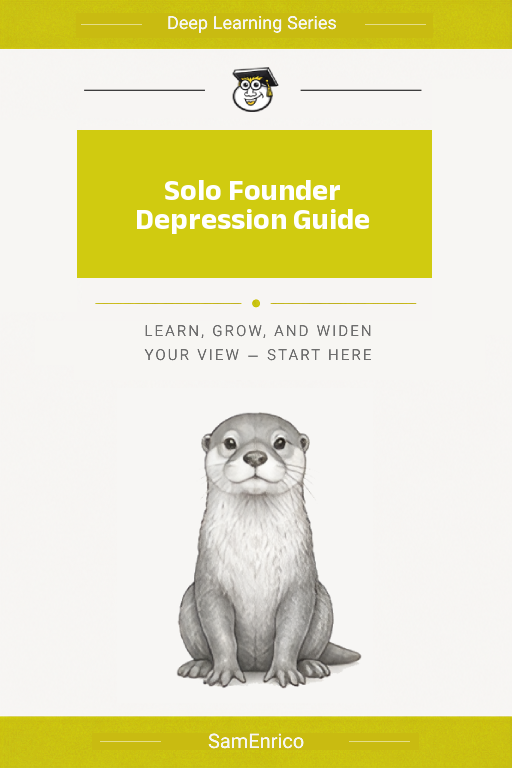
Solo Founder Depression Guide eBook
Survive depression without cofounder support using
Survive depression without cofounder support using outsourced accountability, virtual therapy, and emergency coverage systems.
Formats
Free sample
Chapter 1: The Solo Spectrum--–- Before we fix anything, we have to name the thing that's killing you. It's not depression. Not exactly. Depression is the weather pattern. The thing that's killing you is the silence between storms—the long, unbroken stretch of days where there is no one to tell you that you're wrong about yourself.Let me tell you about the morning I stopped being a "solo founder" and became something else entirely.I was thirty-one years old, sitting on the floor of my home office in sweatpants that hadn't been washed in eleven days.
My laptop was open on the desk above me, screen dimmed to sleep mode. I could hear the faint buzz of the charger—the only sound in the room besides my own breathing. On the floor beside me were three empty coffee mugs, a granola bar wrapper, and my phone. The phone had forty-seven unread messages. I knew this because I had counted them without opening any.
Forty-seven people wanted something from me. Forty-seven people believed I was still the person they had emailed yesterday.I had not replied to anyone in four days.The business—a software company I had built from nothing over five years—was generating approximately $47,000 in monthly recurring revenue. I had no cofounder. No employees. No board.
No investors breathing down my neck. By every external metric, I had achieved the dream of every solo founder: complete autonomy, respectable income, and the freedom to work from anywhere.By every internal metric, I was drowning in three inches of water.The problem wasn't that I couldn't do the work. I had done the work for five years. The problem was that I had spent five years building a machine that required me to be the operator, the mechanic, the customer support line, the product manager, and the janitor. And on that Thursday morning, the operator had stopped showing up.I want to be very clear about what happened next, because it's the kind of detail that gets polished out of most founder stories.
I did not have an inspirational breakdown. I did not cry dramatically or throw my laptop against the wall or call a therapist in a moment of clarity. What I did was much worse, and much more common.I sat on the floor and scrolled through Instagram for two hours.Then I watched forty-five minutes of a You Tube video about restoring antique furniture. Then I ate a granola bar. Then I lay down on the floor—not because I was tired, but because the distance between the floor and my desk chair felt like a moral failure I couldn't cross.
Then I closed my eyes and imagined, very seriously, what would happen if I just never opened my laptop again.Would the customers notice? Eventually. Would the revenue stop? Within thirty days. Would anyone come looking for me?
Maybe a few. Would anyone come looking for me because they loved me, not because they needed something from me? That was the question I couldn't answer. That was the question that kept me on the floor.This book is not about that day. That day is just a photograph.
This book is about the three hundred days that followed—the slow, humiliating, deeply unglamorous process of rebuilding a business and a brain at the same time, without a cofounder to tap in when I froze, without a partner to say "I've got this one," without anyone to witness the small wins that kept me alive.But before I can teach you what I learned, I have to teach you what I was. And what you are. Because most of the advice for solo founders is written by people who have never been truly alone in a room with a failing business and a functioning brain that has turned against them. Those books tell you to meditate, to exercise, to find a cofounder, to trust your gut, to push through. They tell you that you are not alone.That's a lie that feels good.
Here's a truth that doesn't: you are alone. Statistically, operationally, and often emotionally, you are alone. And pretending otherwise is not comfort—it's denial. The question this book answers is not "how do I feel less alone?" The question is "how do I build a business that survives my aloneness?"To answer that question, we first need to understand what kind of solo founder you are. Because the advice for someone who has never hired anyone is different from the advice for someone who runs a small team.
And the advice for someone who can afford a virtual assistant is different from the advice for someone who is still trying to make rent.The Solo Spectrum: A Necessary Distinction After interviewing dozens of solo founders—some thriving, some barely surviving, and several who had crashed and rebuilt—I noticed a pattern that most business books ignore. They treat "solo founder" as a single category, as if the only thing that matters is the absence of a cofounder. But that's like treating "unmarried" as a single category. The difference between a twenty-two-year-old who has never had a serious relationship and a forty-five-year-old divorcé is not captured by the word "single."Similarly, the difference between a solo founder who has never hired anyone and a solo founder who runs a team of ten contractors is not captured by the phrase "solo founder." They face different problems, require different solutions, and experience different forms of depression.I created the Solo Spectrum to make these distinctions visible. It has three categories, and I want you to identify which one describes your current reality before you read another word.Pure Solo: No Employees, No Contractors, No Paid Help You are the definition of the word "solo." You do everything yourself—sales, marketing, product development, customer support, accounting, legal, and janitorial.
You have never hired anyone, not even a virtual assistant. Your business fits entirely inside your head, which is both its greatest strength and its most dangerous vulnerability.What this looks like in practice: You wake up, and every task that needs to be done today requires you. There is no one to delegate to, no one to check your work, no one to cover for you if you decide to take a nap. Your revenue is directly tied to your hours of focused work. If you stop working, the business stops generating money.
If you have a depressive episode that lasts three days, you lose three days of revenue and accumulate three days of customer support backlog.The psychological signature of Pure Solo: You experience what I call the Single Point of Failure Anxiety—the constant, low-grade awareness that your entire business is one bad day away from collapse. This anxiety doesn't feel like panic. It feels like exhaustion. It's the weight of knowing that no one is coming to help, and that every moment you spend not working is a moment your business is degrading.The depression risk: Pure Solo founders are most vulnerable to Task Paralysis—the inability to start any task because every task feels equally urgent and equally dependent on you. When your to-do list has forty-seven…
This is the end of the free sample. Get the eBook to keep going. Buy now
About this book
Details
- Author
- Catron Theresia
- Publisher
- SamEnrico
- Language
- English
- Genre
- Non-Fiction, Mental Wealth
- Released
- 2026-05-30
- Pages (approx.)
- 145
- Available as
- eBook, Audiobook

Read better in the ZLOADR app
Your eBooks on your phone or tablet. Sign in with your SamEnrico account and start reading.
More by Catron Theresia
 Sleep Tracker Wearable UseCatron Theresia$11.99
 Blue Zone Sexual Health GuideCatron Theresia$11.99
 Meeting No Laptop Rule GuideCatron Theresia$11.99
 The Online Brainstorming Tools GuideCatron Theresia$11.99
 Question Asking GuideCatron Theresia$11.99
 The Blood of Carthage: Scipio's Gambit at ZamaCatron Theresia$11.99
 How to Start a Photograph Mounting Business (Beginners Guide)Catron Theresia$11.99
 Understanding Wolman DiseaseCatron Theresia$17.99
 Berlin Wall Falls: Night of CelebrationCatron Theresia$11.99
 SaaS CAC Benchmarks 2025Catron Theresia$12.99
You may also like
 Hong Kong Handover 1997Dunn Johnnie$11.99
 Zumba For Postnatal Recovery CourseNeal Christian$11.99
 Zumba for BeginnersLadner Nikia$11.99
 YouTube Comment Mining GuideHumes Pandora$12.99
 Worry Box MeditationCarlin Rudy$11.99
 Workplace Stress MeditationNguyen Lynn$11.99
 Workplace Stress and Sleep RepairHawley Ivory$11.99
 Workplace Perfectionism CureDelaney Jeffry$11.99
 Workplace Injustice Anger GuideWallen Isabelle$11.99
 Work Addiction and Burnout LinkGreenwood Ester$11.99
 Women in Yoga and WellnessBeattie Galina$11.99
 Women in Stand Up ComedyChun Evangeline$11.99