
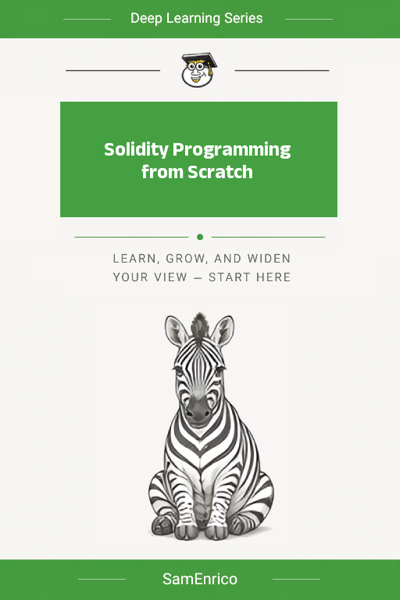
Solidity Programming from Scratch eBook
A Coursebook on Solidity Programming from Scratch
A Coursebook on Solidity Programming from Scratch
Formats
Free sample
Chapter 1: The Billion-Dollar Line…--– In 2016, a single line of code inside a smart contract called “The DAO” accidentally enabled someone to walk away with $150 million worth of Ethereum. The line looked harmless at first glance. It was a withdrawal function that updated a balance after sending funds instead of before. That tiny ordering mistake triggered a reentrancy attack that split the Ethereum community, led to a controversial hard fork, and changed the way smart contracts are written forever. What makes this story remarkable is not the technical sophistication of the attacker, but how elementary the vulnerability was. A developer forgot the “Checks-Effects-Interactions” pattern. One missing state update, and the largest crowdfunding project in history collapsed.If you have never written a smart contract before, that story might sound like a cautionary tale from a distant, exotic world. But the truth is that every professional Solidity developer today lives in the shadow of that line of code. The DAO hack is not ancient history; it is the reason modern security practices exist. It is the reason this book teaches you defensive programming from day one. And it is the reason you need to understand not just how to make a contract work, but how to make it survive in an adversarial environment where anyone can poke at your logic, re-enter your functions, and try to drain your funds.Welcome to the world of Solidity programming. You are about to learn a language that sits at the intersection of software engineering, cryptography, game theory, and finance. Unlike traditional programming, where bugs might crash a website or corrupt a database, bugs in Solidity can move real money, permanently lock user funds, or hand control of a protocol to an anonymous attacker. This is not hyperbole. Every year, millions of dollars are lost to smart contract vulnerabilities, and every year, the community learns from those mistakes and writes better tools, better patterns, and better books.This chapter is not a dry “hello world” tutorial. It is the foundation of everything that follows. By the time you finish reading, you will understand what the Ethereum Virtual Machine actually does, why gas exists, how a transaction travels from your wallet to a miner and finally to the blockchain, and what makes Solidity different from every other programming language you might have encountered. You will write your first smart contract, deploy it to a live test network, and call its functions while watching gas costs in real time. And you will do all of this without installing a single piece of software, because we start with Remix, the browser-based IDE that lets you experiment instantly.The Promise and Peril of Smart Contracts To understand Solidity, you must first understand the problem it solves. In traditional software, applications run on servers you control. If you write a banking app, you manage the database, the authentication system, and the business logic. Users trust you because they have no other choice. They cannot see your source code, they cannot verify that you are not siphoning funds, and they cannot force you to follow the rules you promised.Blockchains flip this model entirely. When you deploy a smart contract to Ethereum, the code becomes public, immutable, and executable by anyone who can pay the gas fee. There is no central server, no database administrator with backdoor access, and no company that can change the rules after the fact. The smart contract alone defines what is possible. If the contract says that funds can only be withdrawn by the owner, then not even the original developer can bypass that rule without deploying a new contract. This immutability is both the greatest strength and the greatest danger of smart contracts. Once your code is on the blockchain, you cannot push a hotfix. You cannot roll back a bad transaction. You can only deploy a new contract and ask users to migrate.Consider a simple example. A traditional bank might have a withdrawal function in its backend code. If a developer accidentally reverses the order of two lines, the bank tests it, notices the bug, and fixes it before deployment. Even if the bug reaches production, the bank can freeze accounts, revert transactions, and apologize to customers. A smart contract has none of these luxuries. The same bug on Ethereum would let an attacker drain the contract before anyone notices. The blockchain does not have an “undo” button. Every transaction is final, and every bug is permanent unless you built upgrade mechanisms into your contract from the start.This is why learning Solidity requires a shift in mindset. You are not writing code for a friendly environment where errors are caught by debuggers and users are forgiving. You are writing code for a hostile environment where every function is a potential entry point for attack, every edge case will be discovered, and every assumption you make about user behavior will be tested by someone trying to prove you wrong. The best Solidity developers think like attackers first and architects second.The Ethereum Virtual Machine: A World Computer At the heart of Ethereum lies the Ethereum Virtual Machine, or EVM. The EVM is a global, deterministic computer that runs the same bytecode on every node in the network. When you write Solidity, your code is compiled into EVM bytecode, a low-level instruction set that the EVM understands. This bytecode is then deployed to the blockchain, where any node can execute it and verify the results.The EVM is stack-based, meaning it uses a last-in-first-out stack to perform operations. Each instruction pushes data onto the stack, pops data off the stack, or manipulates the stack in some way. For example, the ADD instruction pops two values from the stack, adds them together, and pushes the result back onto the stack. The SLOAD instruction pops a storage address from the stack, reads the value stored at that address, and pushes that value onto the stack. The SSTORE instruction pops a storage address and a value from the stack and writes that value to storage.You do not need to become an expert in EVM bytecode to write Solidity. However, understanding the high-level constraints of the EVM will make you a better developer. The EVM has limited instruction types, fixed gas costs for each operation, and a maximum stack depth of 1024. These constraints influence how you write loops, how you manage memory, and how you structure your data.Perhaps the most important feature of the EVM is its deterministic nature. Every node that executes the same bytecode with the same inputs must produce the same outputs and the same state changes. This determinism is what gives blockchains their trustless property. You do not need to trust a specific node because you can run the code yourself and verify the result.Gas: The Fuel of Ethereum Every operation in the EVM costs gas. Gas is a unit of computation that prevents infinite loops, denial-of-service attacks, and resource abuse. When you send a transaction to Ethereum, you specify a gas limit, the maximum amount of gas you are willing to consume, and a gas price, the amount of Ether you are willing to pay per unit of gas. Miners prioritize transactions with higher gas prices because they earn…
This is the end of the free sample. Get the eBook to keep going. Buy now
About this book
Details
- Author
- Bourne Roxana
- Publisher
- SamEnrico
- Language
- English
- Genre
- Non-Fiction, Informative, Educational
- Released
- 2026-05-06
- Pages (approx.)
- 157
- Available as
- eBook, Audiobook

Read better in the ZLOADR app
Your eBooks on your phone or tablet. Sign in with your SamEnrico account and start reading.
More by Bourne Roxana
 Self Esteem for Corporate RestructuringBourne Roxana$11.99
 Notice at Collection ViolationsBourne Roxana$11.99
 Assertiveness For Doctors AppointmentsBourne Roxana$11.99
 The Stepfather's RulesBourne Roxana$11.99
 Immigrant Art Gallery To Auction HouseBourne Roxana$11.99
 Golf Lower Back ProtectionBourne Roxana$11.99
 Mentorship for Return to WorkBourne Roxana$11.99
 Creative Block Success StoriesBourne Roxana$11.99
 Anapanasati Mindfulness of BreathBourne Roxana$11.99
 The Comeback Kid: The Untold Resurrection of Steve JobsBourne Roxana$11.99
 The Comeback Kid: How a Failed Olympian Reclaimed GoldBourne Roxana$11.99
 The Art of War: Julius Caesar's Military GeniusBourne Roxana$11.99