
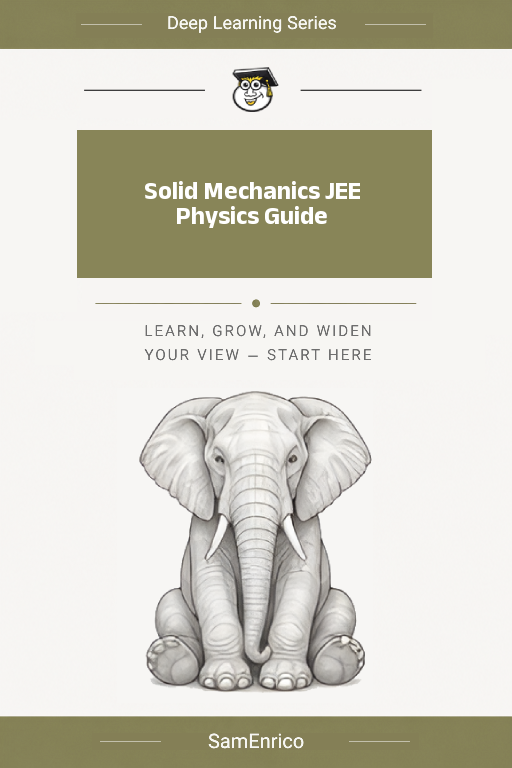
Solid Mechanics JEE Physics Guide eBook
Apply stress strain Young modulus and bulk modulus
Apply stress strain Young modulus and bulk modulus for elasticity and material problems.
Formats
Free sample
Chapter 1: The Breaking Point--Imagine a rope holding a thousand-kilogram boulder at the edge of a cliff. Every fiber strains. The rope stretches — visibly, silently. Now imagine the rope is made of steel. You cannot see the stretch anymore, but it is still there, measured in micrometers.
Now ask yourself: What decides whether the rope holds or snaps? The answer is not strength alone. It is the hidden dialogue between force and deformation — a dialogue governed by the quiet laws of elasticity.Most students begin studying solid mechanics by memorizing formulas: stress equals force over area, strain equals change in length over original length, Young’s modulus is their ratio. They learn to solve problems mechanically, ticking boxes, moving on. But they never truly understand why a bridge bends but does not break, why a metal wire heats up when you stretch it, or why a rubber band returns to its shape while a paperclip does not.
This chapter is not about formulas. It is about that understanding.We begin with a radical idea: there are no perfectly rigid bodies. Every material — steel, diamond, concrete, bone — deforms under force. Sometimes the deformation is too small to see, but it is always there. The only question is whether the deformation is temporary (elastic) or permanent (plastic).
This chapter builds the conceptual foundation for everything that follows. By the end, you will not just know what elasticity means — you will feel it in the way you look at every physical object around you.1.1 The Myth of the Rigid Body Newtonian mechanics begins with a convenient fiction: the rigid body. A rigid body is an object that never changes shape or size, no matter what forces act on it. This assumption simplifies calculations immensely. When you solve a problem about a block sliding down an incline, you treat the block as rigid.
When you calculate the trajectory of a satellite, you treat the satellite as rigid. The approximation works because the deformations are tiny compared to the overall motion.But here is the truth that every engineer and every JEE aspirant must internalize: rigid bodies do not exist. Every real body deforms. A steel beam bends under its own weight. A concrete pillar compresses under the load of a building.
A human bone flexes slightly with every step. Even a diamond, the hardest natural material, compresses by a measurable amount under sufficient pressure.Why does this matter for JEE Physics? Because questions on elasticity test exactly this gap between the idealized rigid world and the real deformable world. When a problem asks, “Find the elongation of a wire under a 100 N load,” it is explicitly rejecting the rigid body assumption. The wire is not rigid.
It stretches. Your job is to calculate how much.The table below contrasts the rigid body model (used in mechanics of particles and rotational dynamics) with the elastic body model (used in this book):Property Rigid Body Model Elastic Body Model Shape under force Unchanged Changes Internal forces Not considered Restoring forces appear Energy storage None (kinetic only)Elastic potential energy Applicability Kinematics, collisions Stress-strain problems The moment a problem mentions “wire,” “rod,” “beam,” “column,” “elongation,” “compression,” “stress,” or “strain,” you are no longer in the world of rigid bodies. You have entered the world of elasticity.1.2 The Two Opposing Forces: Deforming and Restoring Every deformation involves a silent battle between two forces. Understanding this battle is the single most important conceptual step in mastering elasticity.The deforming force is the external agent that tries to change the shape or size of an object. When you hang a weight from a wire, gravity pulls down on the weight, and the weight pulls down on the wire.
That pull is the deforming force. When you squeeze a rubber ball between your palms, your hands apply a deforming force. When you push a book sideways across a table, your finger applies a deforming force (shear). The deforming force is always external.The restoring force is the internal response of the material. When the wire stretches, the atoms inside the wire are pulled apart from their equilibrium positions.
They resist. They pull back. That internal pull is the restoring force. When you squeeze the rubber ball, the polymer chains inside resist compression and try to push back to their original shape. That push is the restoring force.The restoring force arises from interatomic forces — electromagnetic attractions and repulsions between neighboring atoms.
At the equilibrium separation, these forces balance. When you pull atoms apart, attractive forces dominate and pull them back together. When you push atoms together, repulsive forces dominate and push them apart. This is the microscopic origin of elasticity.Key insight: The restoring force is always equal in magnitude to the deforming force — but only as long as the material remains elastic. If you hang a 10 N weight from a wire, the restoring force inside the wire is exactly 10 N.
If you hang a 20 N weight, the restoring force becomes 20 N. The wire “fights back” with exactly the force you apply. This is not magic. This is Newton’s third law operating at the atomic scale.But there is a limit. Beyond a certain point, the restoring force can no longer keep up.
The atomic bonds begin to break permanently. That limit is called the elastic limit, and we will return to it shortly.1.3 Elasticity Versus Plasticity: The Fundamental Distinction If you stretch a rubber band and let go, it returns to its original length. If you stretch a paperclip and let go, it stays bent. Why? Because the rubber band is elastic, and the paperclip is plastic.Elasticity is the property of a material to return to its original shape and size after the deforming force is removed.
The deformation is temporary. The material remembers its original form. Rubber, steel (within limits), bone, and most structural materials are elastic up to a point.Plasticity is the property of a material to retain its deformed shape after the deforming force is removed. The deformation is permanent. The material does not remember.
Clay, putty, lead, and over-stretched steel are plastic.The critical insight for JEE problems: Most materials are elastic for small deformations and plastic for large deformations. There is no such thing as a purely elastic material or a purely plastic material. Steel is famously elastic — but if you pull it hard enough, it stretches permanently and then breaks. Rubber is famously elastic — but if you pull it too far, it tears. Even glass, which seems brittle and inelastic, flexes elastically by a tiny amount before it shatters.The transition from elastic behavior to plastic behavior is not instantaneous.
It happens over a range of deformation, and the boundary is called the elastic limit. Below the elastic limit, the material is elastic. Above it, the material becomes plastic (and eventually fractures).A simple experiment you can visualize: Take a metal paperclip. Straighten it slightly and release. It springs back.
That is elastic behavior. Now bend it fully. It stays bent. That is plastic behavior. The boundary between these two behaviors — the exact angle at which the paperclip no longer returns — is its elastic limit.For JEE problems, you will almost…
This is the end of the free sample. Get the eBook to keep going. Buy now
About this book
Details
- Author
- Soria Angeline
- Publisher
- SamEnrico
- Language
- English
- Genre
- Non-Fiction, Student's Shortcut
- Released
- 2026-06-01
- Pages (approx.)
- 140
- Available as
- eBook, Audiobook

Read better in the ZLOADR app
Your eBooks on your phone or tablet. Sign in with your SamEnrico account and start reading.
More by Soria Angeline
 Nobel Prize X Ray Crystallography GuideSoria Angeline$11.99
 Kobuk Valley MysteriesSoria Angeline$11.99
 Back to School Spending AddictionSoria Angeline$11.99
 Watch Checking as ImpatienceSoria Angeline$11.99
 Living Will Healthcare DirectiveSoria Angeline$11.99
 The Nobel Laureate Industry TiesSoria Angeline$11.99
 Mindful Parenting BeginnersSoria Angeline$11.99
 Hobby Reclamation for WorkaholicsSoria Angeline$11.99
 The Queen’s Last Goodbye: A Nation in MourningSoria Angeline$11.99
 The Doppelgänger Dilemma: When Two Cleopatras Ruled EgyptSoria Angeline$11.99
 Sun Tzu: The Art of War in Blood and InkSoria Angeline$11.99
 Growing Cortaderia (Pampas Grass, Tussock Grass)Soria Angeline$11.99
You may also like
 Hong Kong Handover 1997Dunn Johnnie$11.99
 Zumba For Postnatal Recovery CourseNeal Christian$11.99
 Zumba for BeginnersLadner Nikia$11.99
 YouTube Comment Mining GuideHumes Pandora$12.99
 Worry Box MeditationCarlin Rudy$11.99
 Workplace Stress MeditationNguyen Lynn$11.99
 Workplace Stress and Sleep RepairHawley Ivory$11.99
 Workplace Perfectionism CureDelaney Jeffry$11.99
 Workplace Injustice Anger GuideWallen Isabelle$11.99
 Work Addiction and Burnout LinkGreenwood Ester$11.99
 Women in Yoga and WellnessBeattie Galina$11.99
 Women in Stand Up ComedyChun Evangeline$11.99