
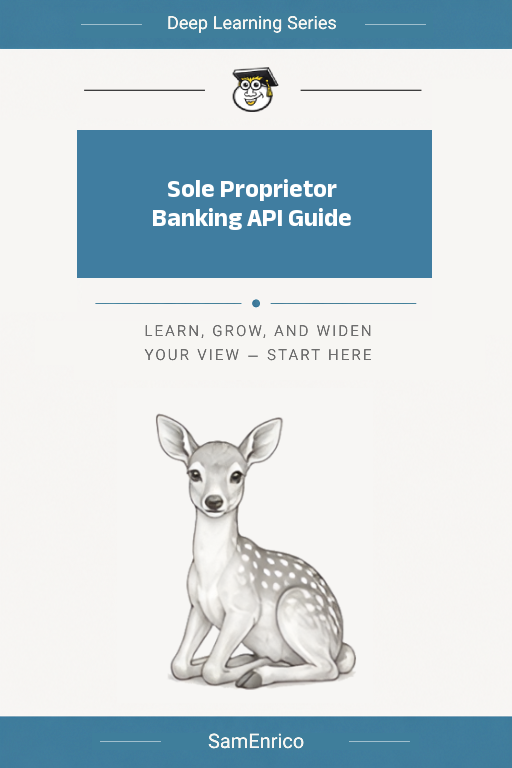
Sole Proprietor Banking API Guide Audiobook
Connect personal and business accounts through API
Connect personal and business accounts through APIs while keeping clean records for tax separation.
Formats
Free sample
Chapter 1: The $11,000 Mistake--–- The envelope arrived on a Tuesday, the kind of thick, government-issued envelope that makes your stomach drop before you even open it. Sarah Chen, a freelance graphic designer in Austin, Texas, had been running her sole proprietorship for four years. She had never missed a tax deadline. She kept every receipt in labeled shoeboxes—one for each quarter, organized by month. She tracked her income in a color-coded spreadsheet that she updated every Sunday evening.
She was, by any reasonable measure, a responsible business owner.The envelope contained an IRS audit notice for tax year 2019. The letter was polite, almost bureaucratic in its calmness. “Your tax return has been selected for examination,” it read. “Please provide substantiation for all expenses claimed on Schedule C totaling $47,200.”Sarah wasn’t panicked. She had the receipts.
She had the spreadsheets. She had never intentionally claimed a personal expense as a business deduction. She called her accountant, who reassured her: “You’re organized. This will be fine. Just send them what they asked for.”Eight weeks later, Sarah received the audit report.
The IRS had disallowed 22,100ofherexpenses.Hertaxbillincreasedby22,100 of her expenses. Her tax bill increased by 22,100ofherexpenses.Hertaxbillincreasedby11,387, including penalties and interest. She owed more than she had in her savings account.What went wrong?Sarah had records. She did not have proof.This is the difference that separates sole proprietors who sleep soundly at night from those who dread tax season. Records are raw data—a receipt from Starbucks, a line item in a spreadsheet, a note on a phone.
Proof is data with context, timestamps, and a contemporaneous connection to a business purpose. Sarah had the former. The IRS demanded the latter.The transaction that broke her audit was an Uber ride. On February 14, 2019, Sarah took an Uber from her apartment to a coffee shop downtown, where she met a potential client. The ride cost 18.50.Shelatertookanother Uberfromthecoffeeshoptoagrocerystore—apersonalerrand—costing18.50.
She later took another Uber from the coffee shop to a grocery store—a personal errand—costing 18.50.Shelatertookanother Uberfromthecoffeeshoptoagrocerystore—apersonalerrand—costing12.30. Both transactions appeared on her bank statement identically: “Uber BV – Ride – 18.50”and“Uber BV–Ride–18.50” and “Uber BV – Ride – 18.50”and“Uber BV–Ride–12.30.” No distinction. No context. No proof of which ride was business and which was personal.The IRS auditor asked Sarah a simple question: “Which of these two Uber charges was for the client meeting?” Sarah could not answer. The receipts…
This is the end of the free sample. Get the Audiobook to keep going. Buy now
About this book
Details
- Author
- Meredith Shirly
- Publisher
- SamEnrico
- Language
- English
- Genre
- Non-Fiction, Business Brief
- Released
- 2026-05-27
- Pages (approx.)
- 159
- Available as
- eBook, Audiobook

Listen in the VoxFlicks app
Audiobooks and audio dramas wherever you go. Sign in with your SamEnrico account and press play.
More by Meredith Shirly
 Passive Aggressive Stress ResponseMeredith Shirly$11.99
 Tumblr Aesthetic Comparison GuideMeredith Shirly$11.99
 Sleep Apnea in Men HandbookMeredith Shirly$11.99
 Jet Lag Reset Meditation GuideMeredith Shirly$11.99
 Financial Stress InsomniaMeredith Shirly$11.99
 TM for Irritable Bowel SyndromeMeredith Shirly$11.99
 Vietnam Remote Tax GuideMeredith Shirly$11.99
 Pomodoro Timer AppsMeredith Shirly$11.99
 Memory Loci for SeniorsMeredith Shirly$11.99
 The Medici Bank: Financing the RenaissanceMeredith Shirly$11.99
 The Puzzle of the Missing Million: The Great Pi Digit HeistMeredith Shirly$11.99
 The Blackout: When the Lights Went Out in New YorkMeredith Shirly$11.99
You may also like
 Hong Kong Handover 1997Dunn Johnnie$11.99
 Zumba For Postnatal Recovery CourseNeal Christian$11.99
 Zumba for BeginnersLadner Nikia$11.99
 YouTube Comment Mining GuideHumes Pandora$12.99
 Worry Box MeditationCarlin Rudy$11.99
 Workplace Stress MeditationNguyen Lynn$11.99
 Workplace Stress and Sleep RepairHawley Ivory$11.99
 Workplace Perfectionism CureDelaney Jeffry$11.99
 Workplace Injustice Anger GuideWallen Isabelle$11.99
 Work Addiction and Burnout LinkGreenwood Ester$11.99
 Women in Yoga and WellnessBeattie Galina$11.99
 Women in Stand Up ComedyChun Evangeline$11.99