
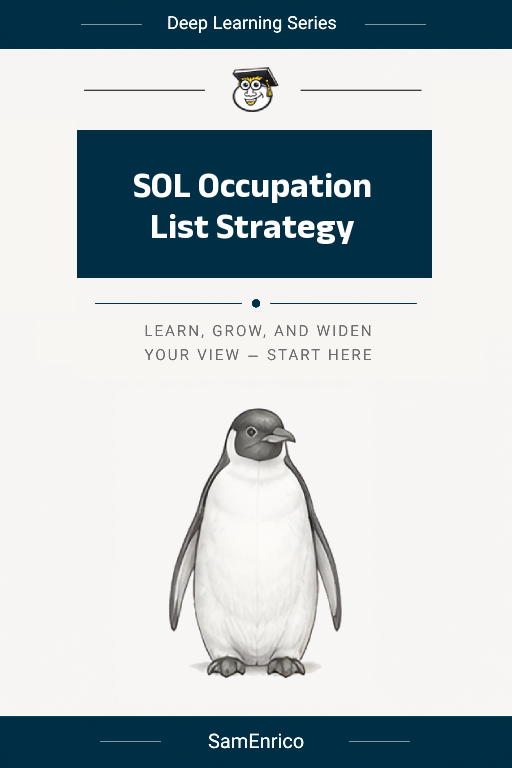
Non-FictionStudent's ShortcutOccupation ListsVisa Strategy
SOL Occupation List Strategy eBook
Choose a degree program on Australia's Skilled Occ
Choose a degree program on Australia's Skilled Occupation List to qualify for the 485 visa and subsequent PR points.
Formats
Free sample
Chapter 1: The $80,000 Mistake--–- Priya arrived in Sydney with two suitcases, a freshly printed acceptance letter for a Master of Information Technology, and a quiet confidence that she had figured out the system. She had done her research—or so she thought. She knew Australia offered post-study work rights. She knew permanent residency was possible. She knew IT was on the Skilled Occupation List.
What she did not know was that three years later, after $80,000 in tuition fees, countless sleepless nights, and an English score that made her friends jealous, she would watch her 485 visa expire with no invitation to apply for permanent residency. Not because she wasn't smart. Not because she didn't work hard. Because she chose the wrong degree on her very first day.This chapter is not an introduction. It is an intervention.Before we talk about points, visas, or occupation lists, you need to understand one brutal truth: the Australian migration system does not reward effort.
It rewards alignment. You can be the hardestworking student in your cohort, graduate with distinction, score Superior English, and still lose to someone with lower grades who simply picked a degree that the Department of Home Affairs actually wants. Most international students discover this too late. You will not be one of them.The Popular Course Trap Every year, tens of thousands of international students make the same decision. They look at university brochures.
They see which courses have the most scholarships, the most marketing dollars behind them, and the most students from their home country. They choose a Master of Business, a Master of Accounting, or a General IT degree because those programs feel safe, familiar, and prestigious. Then they graduate and discover that they are competing against fifteen thousand other people for five hundred invitation spots.Let me show you the numbers.In the 2024-2025 invitation rounds, the Department of Home Affairs issued invitations for the 189 visa at a rate of approximately one thousand per round. Sounds promising. Until you break it down by occupation.
Accountants required 95 points and waited an average of nine months for an invitation. Software engineers required 90 points and waited five months. Construction managers, by contrast, received invitations with 65 points in as little as two weeks. The same system. The same application forms.
Completely different outcomes.This is the Popular Course Trap. You see a degree that thousands of other international students are pursuing, and you assume that popularity means opportunity. In Australian migration, the opposite is true. Popularity means competition. Competition means higher points thresholds.
Higher points thresholds mean longer waits and greater odds of failure.The trap has three layers.The first layer is visibility. Universities promote business and IT degrees aggressively because those programs have high margins and large cohorts. You see glossy brochures, scholarship offers, and alumni testimonials. You do not see the invitation round data showing that 85 percent of applicants in those fields will never receive a PR invitation.The second layer is familiarity. Students from certain countries tend to cluster in the same degree programs because their friends are doing it, their education agents recommend it, and their parents recognize the degree title.
A Master of Business sounds like a real degree. A Bachelor of Community Services sounds like something else. But the Department does not care about degree titles that impress your relatives. It cares about skills shortages.The third layer is the sunk cost fallacy. Once you have spent two years and sixty thousand dollars on a degree, it feels impossible to change course.
So you double down. You take the Professional Year. You retake the English test five times. You pay for a migration agent. You scrape together 90 points and hope.
And every month you wait, another invitation round passes, and the points cutoff creeps higher.Priya fell into all three layers. She chose a Master of IT because her cousin had done the same degree five years earlier and gotten PR. She did not realize that the market had flooded in those five years. When she graduated, the points cutoff for her occupation had risen from 75 to 95. She maxed out her English.
She completed a Professional Year. She found a skilled job. But she never cracked 95 points. Her 485 visa ran out. She went home.The 2026 Reality: What Changed If you have read any migration advice online from 2024 or earlier, much of it is already obsolete.
The Australian government has systematically dismantled the pathways that previous generations of international students used.The first major change is the death of the Post-Study Work stream. Before 2026, international students who graduated from a bachelor's degree or higher could access a visa stream that offered two to four years of work rights, depending on their qualification. That stream is gone. It has been replaced by the Post-Higher Education Work stream. The name change is not cosmetic.
The new stream has stricter requirements, tighter definitions of eligible qualifications, and fewer pathways to extension.The second change, and the one that hurts the most, is the removal of the two-year extension for select degrees. Under the old rules, graduates in fields like nursing, teaching, engineering, and IT could receive an additional two years of work rights on top of their standard post-study visa. That extension is gone. If you graduate in 2026 or later, your work rights are fixed. No bonus years for studying a priority field.
No extra time to scrape together points.This is why the concept of "Visa Reverse Engineering" is no longer optional. It is survival.Here is what most students do. They pick a degree based on interest or prestige. They study for two to four years. They graduate.
They apply for a 485 visa. Then, with the clock ticking, they try to figure out how to get enough points for PR. That is forward planning. And forward planning is a losing strategy in a system where invitation rounds happen quarterly and cutoff points rise faster than most applicants can keep up.Visa Reverse Engineering flips the process. You start at the end.
You look at the most recent invitation rounds. You identify which occupations received invitations with the lowest points and the shortest wait times. Then you work backward to choose a degree that leads directly to one of those occupations. You do not ask, "What do I want to study?" You ask, "What does the Department of Home Affairs want me to study?" Those are two different questions. Only one leads to PR.The SQL: Your New Best Friend You have probably heard of the Skilled Occupation List.
Maybe you have even looked at it. It is a long spreadsheet with hundreds of job titles, ANZSCO codes, and visa eligibility notes. Most students glance at it once, feel overwhelmed, and close the tab.You are going to do something different. You are going to learn how to read the SQL like a data analyst.The Specified Qualifications List, or SQL, is the specific subset of the broader Skilled Occupation List that applies to the Post-Higher Education Work visa. Not every occupation on the SOL qualifies for the 485 visa.
Only those that appear on the SQL with a tick in the "Post-Higher Education Work stream" column. As of 2026…
This is the end of the free sample. Get the eBook to keep going. Buy now
About this book
Details
- Author
- Kimball Rebeca
- Publisher
- SamEnrico
- Language
- English
- Genre
- Non-Fiction, Student's Shortcut, Occupation Lists, Visa Strategy
- Released
- 2026-05-30
- Pages (approx.)
- 147
- Available as
- eBook, Audiobook

Read better in the ZLOADR app
Your eBooks on your phone or tablet. Sign in with your SamEnrico account and start reading.
More by Kimball Rebeca
 The Library CardKimball Rebeca$11.99
 Trauma Stress Relationship RecoveryKimball Rebeca$11.99
 Racing Thoughts Breath AnchorKimball Rebeca$11.99
 Ambient Noise GuideKimball Rebeca$11.99
 Listening In Design ThinkingKimball Rebeca$11.99
 Gratitude for Body AppreciationKimball Rebeca$11.99
 Bipolar Peer Support GuideKimball Rebeca$11.99
 NGO Mental Health ProgramsKimball Rebeca$11.99
 Cristiano Ronaldo CR7Kimball Rebeca$11.99
 The Trial of the Century: The People vs. O.J. Simpson (The Untold Verdict)Kimball Rebeca$11.99
 The Clockwork Oracle: How a 19th-Century Automaton Predicted the FutureKimball Rebeca$11.99
 The Clockwork Oracle: How an Ancient Greek Engineer Predicted the FutureKimball Rebeca$11.99
You may also like
 Hong Kong Handover 1997Dunn Johnnie$11.99
 Zumba For Postnatal Recovery CourseNeal Christian$11.99
 Zumba for BeginnersLadner Nikia$11.99
 YouTube Comment Mining GuideHumes Pandora$12.99
 Worry Box MeditationCarlin Rudy$11.99
 Workplace Stress MeditationNguyen Lynn$11.99
 Workplace Stress and Sleep RepairHawley Ivory$11.99
 Workplace Perfectionism CureDelaney Jeffry$11.99
 Workplace Injustice Anger GuideWallen Isabelle$11.99
 Work Addiction and Burnout LinkGreenwood Ester$11.99
 Women in Yoga and WellnessBeattie Galina$11.99
 Women in Stand Up ComedyChun Evangeline$11.99