
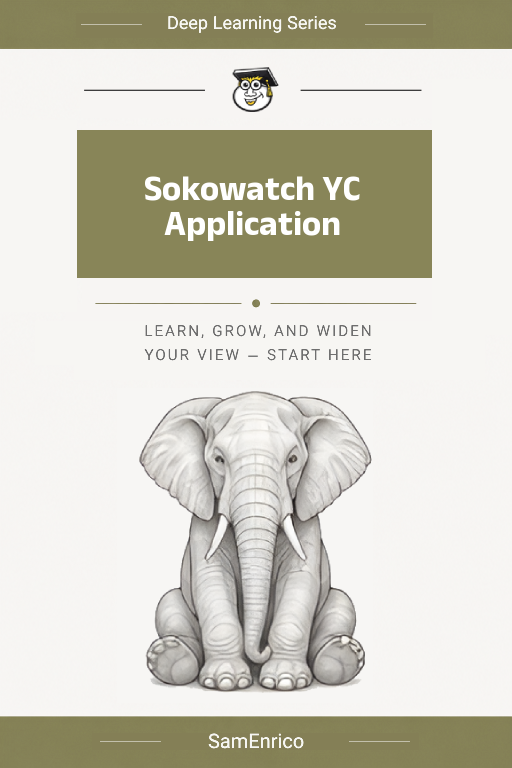
Sokowatch YC Application eBook
Learn Sokowatch Y Combinator B2B ecommerce applica
by Carmona Mimi
Learn Sokowatch Y Combinator B2B ecommerce application and apply their informal retail distribution story.
Formats
Free sample
Chapter 1: The $5 Taxi...--It was 4:47 AM in Kibera, Nairobi, and Mary Achieng had a problem.The sky was still black, the kind of deep darkness that exists only in the hour before dawn when even the roosters are silent. Mary stood in the doorway of her duka—a wooden shack no larger than a prison cell, wedged between a mattress repair shop and a makeshift bar that sold warm beer by the glass. She had been awake since 4:00, counting. Flour: three bags left. Cooking oil: two cartons.
Soap: maybe twenty bars. Sugar: gone. Completely, dangerously, out-of-business-level gone.Mary’s duka was not a store by American standards. It was six feet wide, eight feet deep, with corrugated tin walls that turned into an oven by noon. The inventory sat on rough wooden shelves that her late husband had built fifteen years ago.
A single fluorescent bulb buzzed overhead, flickering with the inconsistent electricity that Kibera was famous for. The floor was dirt packed hard by twenty thousand footsteps.But Mary’s duka was also the lifeline for three hundred families in her section of the slum. When they needed cooking oil for dinner, they came to Mary. When a child needed soap, they came to Mary. When a grandmother needed sugar for her tea—the only luxury many of these families could afford—they came to Mary.
She knew everyone by name. She knew whose husband had lost his job, whose child had malaria, whose rent was overdue. She extended credit informally, tracking debts in a tattered notebook with a pencil stub.And today, she was out of sugar.Without sugar, the morning rush would be a disaster. The construction workers who stopped for sweet tea at 6 AM would go elsewhere. The mothers who needed sugar for porridge would curse her name.
The day’s profit—maybe four dollars on a good day—would evaporate.Mary had a choice. She could close the duka for half the day—losing every sale from 6 AM to noon—and take a taxi to the wholesaler’s market in the city center. The taxi would cost her 500 Kenyan shillings, about five dollars. Then she would haggle for prices, load boxes onto her back, take another taxi back, and reopen in the afternoon, exhausted and poorer. Or she could stay open, sell what little she had, and pray that customers didn’t notice the missing sugar.She pulled on her worn kang dress, tucked her money into a plastic bag hidden in her bra, and locked the duka’s padlock.
The taxi it was.What Mary did not know, as she walked through the muddy paths of Kibera toward the main road, was that her five-dollar taxi ride was the single most important economic fact in East Africa. That taxi was the reason multinational corporations like Unilever, Nestle, and Procter & Gamble could not crack the informal retail market. That taxi was the invisible tax that kept 80% of Kenyan commerce trapped in inefficiency. And that taxi was the problem that a twenty-six-year-old former management consultant named Daniel Yu had decided to solve.This is the story of how he did it.The $600 Billion Blind Spot When Western investors think of Africa, they see poverty, corruption, and risk. When they think of retail, they see Walmart, Carrefour, and Amazon.
They see shiny malls in Johannesburg and Nairobi’s Westlands district. They see the formal economy—the registered businesses, the tax-paying entities, the companies that appear on balance sheets and in IMF reports.But they are looking at the wrong thing.In Kenya, 80% of all retail commerce happens not in malls, but in dukas—tiny, family-owned shops that occupy the ground floor of someone’s home, a converted shipping container, or a wooden shack like Mary’s. There are over 150,000 such shops in Nairobi alone. Across sub-Saharan Africa, the number exceeds 5 million. And every single one of them operates in the informal economy.The informal economy is not a niche.
It is not a poverty trap. It is not a charity case.It is a six-hundred-billion-dollar market.Let that number sink in. Six hundred billion dollars—larger than the entire GDP of Switzerland, larger than the market capitalization of Facebook, larger than the annual budget of the United States Department of Defense. That money flows through millions of tiny transactions: a dollar for soap here, fifty cents for sugar there, two dollars for cooking oil somewhere else. It is the circulatory system of African daily life.And yet, the world’s largest companies have failed to reach it.Walmart tried.
In 2011, they invested heavily in South Africa, acquiring the Massmart chain. They assumed that formal retail would eventually swallow informal retail, just as it had in the United States and Europe. It didn’t work. South African dukas—called spazas—continued to dominate. Walmart retreated.Carrefour tried.
The French retail giant opened gleaming hypermarkets in Nairobi and Dar es Salaam. Middle-class Kenyans flocked to them on weekends. But the dukas remained untouched. The hypermarkets were too far, too expensive, too formal.Amazon tried. Their global expansion strategy has largely bypassed sub-Saharan Africa, with only a modest presence in South Africa.
The reason is simple: Amazon’s model requires addresses, credit cards, and reliable last-mile delivery. Most duka owners have none of these things.Even African startups tried. Between 2015 and 2020, over $2 billion in venture capital poured into B2B e-commerce platforms across the continent. Most of them failed. They built beautiful apps that no one used.
They raised huge rounds and burned through cash. They hired expensive expatriate executives who had never ridden in a matatu or negotiated with a wholesaler in Kibera.Why did they fail? Because they misunderstood the problem.The Problem Is Not Inventory If you ask a typical Silicon Valley founder to describe the retail problem in Africa, they will say something like this: “Small shopkeepers lack access to inventory. They can’t get the products they need because supply chains are broken. We will build an app that connects them directly to manufacturers.
It’s Uber for retail.”This sounds plausible. It is also completely wrong.Mary did not lack access to inventory. Every day, she could walk ten minutes to the main road, flag down a taxi, and be at the wholesaler’s market in thirty minutes. The market had everything she could possibly want—every brand of soap, every grade of sugar, every size of cooking oil. The problem was not availability.
The problem was cost.That five-dollar taxi ride consumed a quarter of Mary’s daily profit. On a bad day, it consumed half. And that was just the transportation. There was also the opportunity cost of closing her shop for four hours—the lost sales, the disappointed customers, the trust eroded one empty shelf at a time.The wholesaler’s market, for all its abundance, was designed for scale. It served large distributors who bought pallets at a time, not duka owners who bought boxes.
Mary was a nuisance to the wholesalers—a small fish who bargained hard, paid in crumpled notes, and took up time that could be spent on bigger customers.But Mary had no alternative. The formal distributors—the Unilevers…
This is the end of the free sample. Get the eBook to keep going. Buy now
About this book
Details
- Author
- Carmona Mimi
- Publisher
- SamEnrico
- Language
- English
- Genre
- Non-Fiction, Startup Guide, Accelerator Prep, B2B Retail
- Released
- 2026-05-30
- Pages (approx.)
- 149
- Available as
- eBook, Audiobook

Read better in the ZLOADR app
Your eBooks on your phone or tablet. Sign in with your SamEnrico account and start reading.
More by Carmona Mimi
 Digital Communication CertificationCarmona Mimi$11.99
 The 30 Second Meeting ExitCarmona Mimi$11.99
 Pinterest VA Client Onboarding SystemsCarmona Mimi$11.99
 Breast Density Screening GuideCarmona Mimi$11.99
 Weekly Time Blocking SystemCarmona Mimi$12.99
 Data Leak Live Chat Response ScriptsCarmona Mimi$11.99
 Beanie Baby Bonanza: The Rise and Fall of a Collectible EmpireCarmona Mimi$11.99
 The Vanishing Highway: The Unsolved Mystery of the 1971 Michigan MurdersCarmona Mimi$11.99
 Biomedical EngineeringCarmona Mimi$11.99Weekly Time Blocking SystemCarmona Mimi$12.99
 Understanding Codas SyndromeCarmona Mimi$17.99