

Non-FictionTrue CrimeSoil Forensics
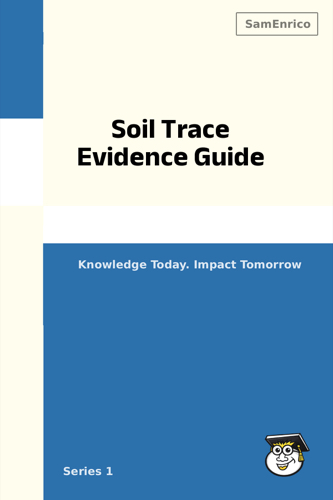
Soil Trace Evidence Guide eBook
Mineral and organic particle comparison from shoes
Mineral and organic particle comparison from shoes and tires.
Formats
Free sample
Chapter 1: Every Contact Leaves a Trace...--–- The call came in at 3:47 on a cold November morning. Detective Sarah Chen of the Chicago Police Department had been asleep for less than two hours when her phone vibrated across the nightstand. On the other end, a dispatcher’s voice delivered the words no investigator wants to hear: a double homicide in the Lincoln Park neighborhood, victims unknown, suspect at large, and the forensic team was already on scene. Chen pulled on her boots, grabbed her coat, and within twenty minutes was standing at the edge of a crime scene tape stretched between two oak trees. The victims—a man and a woman in their early thirties—had been found in the backyard of a townhouse, their bodies partially concealed by overgrown shrubbery.
The initial assessment offered little: no weapon, no witnesses, no surveillance cameras pointing toward the rear of the property. But as Chen watched the crime scene technicians work their flashlights across the damp ground, she noticed something the first responders had overlooked. The victims’ shoes—both pairs—were clean. Spotless, in fact. And in Chicago in November, with rain falling three days straight and mud everywhere, clean shoes were the loudest clue of all.Twenty-three months later, a suspect was arrested based on a single piece of physical evidence: soil recovered from the tread of a pair of work boots found in the suspect’s garage.
That soil contained a specific assemblage of minerals—hornblende, garnet, and a trace of volcanic glass shards—that matched, to a statistical certainty of greater than ten thousand to one, the soil from a rarely visited garden bed behind the victims’ townhouse. The suspect had walked through that garden. He had then cleaned the uppers of his boots with a paper towel, but he had not—could not—clean every grain of sand from the recesses of the tread. Every contact leaves a trace. That principle, first articulated by Dr.
Edmond Locard in 1910, remains the single most important concept in forensic science. And for soil evidence, it is the difference between a cold case and a conviction.This chapter establishes the theoretical foundation for everything that follows in this book. Before we can recover soil from a shoe, identify minerals under a microscope, or testify about likelihood ratios in a courtroom, we must understand why soil is such powerful evidence in the first place. We must understand what soil actually is—not the dirty nuisance tracked across a clean floor, but a complex, multivariate signature of place. And we must understand how that signature transfers from the ground to a shoe or tire, how long it persists, and what factors cause it to change or disappear.
Locard’s principle is not merely a poetic statement about forensic idealism. It is an empirical claim about the physical world, and like all empirical claims, it has limits, exceptions, and nuances. This chapter will explore those nuances in depth, preparing the reader to apply Locard’s insight with precision rather than simply invoking it as a slogan.What Locard Actually Said (And What He Didn’t)Edmond Locard was the director of the first forensic laboratory in existence, operating out of two attic rooms in the Lyon Police Department in France. In a series of papers published between 1910 and 1932, he articulated what would later be summarized—first by his students and later by textbooks—as “Every contact leaves a trace.” But Locard himself never wrote that exact phrase in any surviving document. What he actually wrote, in a 1928 paper on dust analysis, was closer to this: “It is impossible for a criminal to act, especially considering the intensity of a crime, without leaving traces of his presence or his passage.” The difference is subtle but important.
Locard was not claiming that every contact leaves a detectable trace. He was claiming that given the intensity of criminal activity, it is impossible for a perpetrator not to leave some trace. That is a probabilistic statement about the likelihood of evidence transfer given human behavior, not an absolute law of physics.Why does this distinction matter for soil evidence? Because over the past century, investigators and prosecutors have sometimes treated Locard’s principle as a guarantee that evidence must exist if they only look hard enough. When a suspect’s shoes come back from the lab with no soil on them, the principle is invoked to argue that the suspect must have cleaned them—that the absence of soil is itself evidence of a crime.
But this reasoning is flawed. Soil transfer is not inevitable; it depends on substrate conditions, pressure, moisture, surface texture, and a dozen other variables. A person walking across dry pavement on a sunny day may transfer no detectable soil to their shoes at all. Locard’s principle is a guide for where to look, not a guarantee of what will be found.Nevertheless, when conditions are right—when the ground is moist, when the surface is loose or unconsolidated, when the shoe or tire makes firm contact—soil transfer is remarkably reliable. And once transferred, certain components of that soil persist in ways that make them exceptionally valuable as forensic evidence.The Three Components of a Soil Trace Before we can understand how soil transfers, we must understand what soil is.
The average person uses the word “dirt” to describe any dark, crumbly substance on the ground. But to a forensic geologist, soil is a three-component system, and each component carries different evidentiary weight.Mineral particles form the geological backbone of soil. These are fragments of rock, ground down by weathering, transported by water or wind, and deposited in layers. The most common mineral in most soils is quartz—silicon dioxide, Si O₂—because quartz is hard, chemically resistant, and nearly ubiquitous. But soils also contain feldspars, micas, amphiboles, pyroxenes, carbonates, and a host of accessory minerals including garnet, zircon, tourmaline, and rutile.
The specific mixture of these minerals—their identities, their relative abundances, and their grain size distributions—is remarkably variable across geographic space. Two locations separated by only a few hundred meters can have completely different mineral assemblages if they sit on different bedrock, have different drainage histories, or have been subjected to different weathering regimes. This variability is what gives mineral evidence its power. As we will explore in detail in Chapter 2, the probability of two unrelated locations sharing an identical mineral suite is often less than one in ten thousand.Organic components form the biological signature of soil. These include pollen grains from flowering plants, spores from ferns and fungi, phytoliths (microscopic silica bodies formed inside plant cells), fragments of leaves and roots, and chemical compounds such as plant waxes (n-alkanes and fatty acids).
Unlike minerals, which are geologically stable over human timescales, organic components degrade. Pollen grains, for example, have a half-life on a shoe outdoors of approximately three to five days, depending on temperature, humidity, and exposure to ultraviolet light. This degradation is not a weakness—it is a feature. The presence of intact organic material tells the forensic examiner that the soil transfer occurred recently, within days or weeks rather than months. The specific types of pollen…
This is the end of the free sample. Get the eBook to keep going. Buy now
About this book
Details
- Author
- Binder Wilfredo
- Publisher
- SamEnrico
- Language
- English
- Genre
- Non-Fiction, True Crime, Soil Forensics
- Released
- 2026-06-08
- Pages (approx.)
- 159
- Available as
- eBook, Audiobook

Read better in the ZLOADR app
Your eBooks on your phone or tablet. Sign in with your SamEnrico account and start reading.
More by Binder Wilfredo
 SuperMemo To Anki GuideBinder Wilfredo$11.99
 Burnout Prevention for OptometristsBinder Wilfredo$11.99
 The Micronutrient Deficiency SignsBinder Wilfredo$11.99
 Goal Setting Self HypnosisBinder Wilfredo$11.99
 Amílcar Cabral Guinea BissauBinder Wilfredo$11.99
 Child Loss And Work ReturnBinder Wilfredo$11.99
 LGBTQ Pregnancy Loss GuideBinder Wilfredo$11.99
 The Druid's Last Stand: Boudica's Forgotten RebellionBinder Wilfredo$11.99
 Roberto Gómez Bolaños: The Genius Behind Latin America's Longest-Running SitcomBinder Wilfredo$11.99
 How to Become a Safety-clothing-and-equipment DeveloperBinder Wilfredo$11.99
 How to Produce ScoreboardsBinder Wilfredo$11.99
 How to Produce FloatsBinder Wilfredo$11.99
You may also like
 Hong Kong Handover 1997Dunn Johnnie$11.99
 Zumba For Postnatal Recovery CourseNeal Christian$11.99
 Zumba for BeginnersLadner Nikia$11.99
 YouTube Comment Mining GuideHumes Pandora$12.99
 Worry Box MeditationCarlin Rudy$11.99
 Workplace Stress MeditationNguyen Lynn$11.99
 Workplace Stress and Sleep RepairHawley Ivory$11.99
 Workplace Perfectionism CureDelaney Jeffry$11.99
 Workplace Injustice Anger GuideWallen Isabelle$11.99
 Work Addiction and Burnout LinkGreenwood Ester$11.99
 Women in Yoga and WellnessBeattie Galina$11.99
 Women in Stand Up ComedyChun Evangeline$11.99