
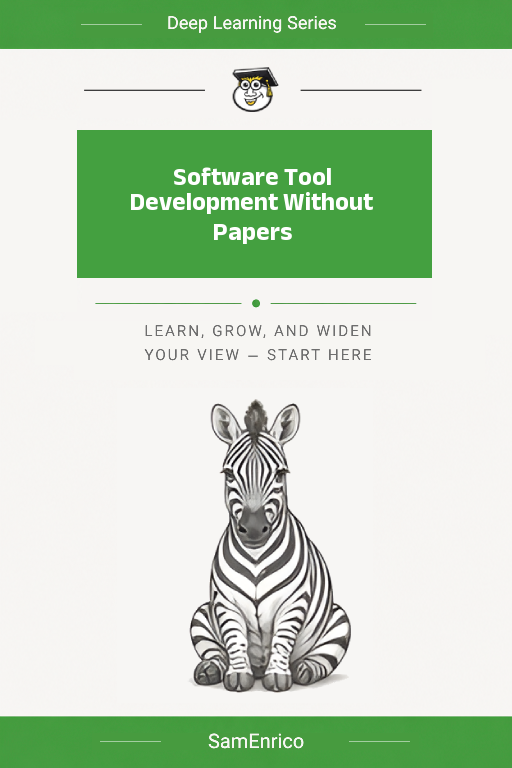
Software Tool Development Without Papers eBook
Share research software or analysis pipelines as c
Share research software or analysis pipelines as citable research products through Zenodo or similar.
Formats
Free sample
Chapter 1: The Ghost in the Laboratory--–- The email arrived on a Tuesday afternoon. Dr. Sarah Chen, a tenured professor of computational biology at a major research university, had just returned from a grant review panel where she had advocated for increased funding for software infrastructure. The email was from the editor of Nature Methods, and its subject line made her stomach drop: "Notice of Retraction – Chen et al. 2021."The retraction was not for fraud.
It was not for data fabrication or image manipulation. It was for a bug. A single, unassuming bug in a 47-line Python script that had been used to normalize gene expression data across three separate experiments. The bug was subtle – a reversed conditional statement that flipped the meaning of "treatment" and "control" when certain batch conditions were met. The results, as published, showed a statistically significant effect that did not exist.
The only reason the bug was discovered at all was that a postdoc in a competing lab had tried to reproduce the results using the publicly available code and noticed that his outputs did not match the paper's figures. When he dug deeper, he found the error.The most painful part for Dr. Chen was not the retraction itself. It was the fact that the script had been written by a graduate student who had graduated two years earlier and left no documentation, no tests, and no record of which version of the code corresponded to which figure in the paper. The repository on Git Hub had last been updated three weeks before the paper's submission.
The student's personal laptop, which contained the only complete development history, had been wiped when he returned it to the university's IT department. The code that had generated the published results – the exact version, with the bug – was gone. What remained was a later version that had partially fixed the bug but broken something else. The lab could not defend itself, could not issue a correction, could not even explain what had happened with certainty. All they could do was retract.The story of Dr.
Chen's lab is not apocryphal. It is a composite drawn from retraction notices, reproducibility audits, and confidential interviews with researchers who have lived through similar disasters. In each case, the common thread is not malice, not incompetence, but the systematic devaluation of research software as a legitimate, citable, and maintainable product of scientific labor.The Software Gap: Where Methodology Meets Invisibility Every year, millions of hours of researcher time are spent writing code. According to a 2020 survey of over 1,600 researchers published in Nature, approximately 70% of scientists use code in their work, and 60% report that writing code is either "important" or "essential" to their research. Yet the same survey found that only 8% of researchers had ever received formal training in software development practices.
The vast majority of research code is written by self-taught graduate students and postdocs, often under extreme time pressure, with no code review, no version control discipline, and no plan for long-term maintenance or citation.This is the software gap: the chasm between the centrality of code to modern research methodology and the near-total invisibility of code in the formal systems of academic credit, evaluation, and preservation. A researcher can spend eighteen months building an analysis pipeline – writing thousands of lines of code, debugging edge cases, optimizing for performance, and documenting usage – and receive zero citations for that work. The paper that uses that pipeline might receive fifty citations. The pipeline itself, if it is mentioned at all, appears as a footnote in the supplementary materials: "Code is available at [Git Hub link that will be dead in three years]."This gap has real consequences for careers. Consider two hypothetical early-career researchers, both five years past their Ph Ds.
Researcher A publishes six papers as first author, each accompanied by a well-documented, persistently archived, citable software package. Each of those six software packages is cited by other research groups an average of twelve times. Researcher B publishes the same six papers, but treats the code as supplementary material – a zip file on a lab website or a Git Hub repository with no DOI, no versioning, no citation metadata. Researcher B's papers receive the same number of citations as Researcher A's papers. But Researcher A's software packages generate an additional seventy-two citations to their work, appearing on Google Scholar, ORCID, and CVs.
When both apply for a faculty position, Researcher A has a citation count that is 40% higher. When both apply for a grant, Researcher A's data management plan demonstrates a track record of creating reusable, citable outputs. When both go up for tenure, Researcher A's dossier includes evidence of research impact beyond traditional papers – software that has been adopted by other labs, integrated into teaching curricula, and cited in policy documents.The gap is not merely a matter of personal career advancement. It is a structural inefficiency in the scientific enterprise. When code is not citable, it is not incentivized.
When it is not incentivized, it is not maintained. When it is not maintained, it rots. When it rots, reproduction fails. When reproduction fails, trust erodes. The replication crisis in psychology, the reproducibility challenges in cancer biology, the computational nightmares in economics – all of these have a common root in the software gap.The Silent Retraction: A Case Study in Uncited Code Let us examine the anatomy of the Chen lab retraction more closely, because it reveals every failure point that this book is designed to prevent.
The case study is anonymized but based on a real retraction that occurred at a major European university in 2019.The lab studied the microbiome – the collection of bacteria, fungi, and viruses that live in and on the human body. They had developed a computational pipeline called "Microbe Tracker" (not its real name) that processed raw DNA sequencing data into counts of microbial species. The pipeline was written in a mix of Python and R, with several custom scripts that glued together standard bioinformatics tools. The graduate student who wrote the pipeline, let us call him Alex, was exceptionally talented but untrained in software engineering. He used Git Hub as a backup tool, committing changes irregularly and often with commit messages like "fix" or "update" or a single emoji.
He did not use branches, did not tag releases, and did not know what a DOI was.When the lab submitted their paper to Nature Methods, the reviewers asked to see the code. Alex uploaded the current state of his Git Hub repository – which happened to be a version where he was actively debugging a new feature – and included the link in the supplementary materials. He did not archive that version anywhere. He did not create a release. He did not preserve the exact state of the code that had generated the paper's results.
He simply assumed that the Git Hub link would work forever.Two years later, Alex graduated and took a job in industry. His university email was deactivated. His Git Hub account, which he had created with his university email address, became inaccessible. The repository was eventually deleted by the university's IT department as part of a routine cleanup of accounts belonging to former…
This is the end of the free sample. Get the eBook to keep going. Buy now
About this book
Details
- Author
- Broughton Herta
- Publisher
- SamEnrico
- Language
- English
- Genre
- Non-Fiction, Student's Shortcut
- Released
- 2026-05-30
- Pages (approx.)
- 143
- Available as
- eBook, Audiobook

Read better in the ZLOADR app
Your eBooks on your phone or tablet. Sign in with your SamEnrico account and start reading.
More by Broughton Herta
 Bipolar Recovery Storytelling ManualBroughton Herta$11.99
 Early Adopter Feedback LoopBroughton Herta$11.99
 Carson Posthumous LegacyBroughton Herta$11.99
 Workplace Stress Journal MethodBroughton Herta$11.99
 Addressing Wedding Planning ConflictsBroughton Herta$11.99
 The Popularity Myth GuideBroughton Herta$11.99
 John Calhoun NullifierBroughton Herta$11.99
 Retail Worker Burnout FixBroughton Herta$11.99
 Habit MeditationBroughton Herta$11.99
 The Double Life of Benjamin Franklin: Spy Master of the American RevolutionBroughton Herta$11.99
 Constantine's Legacy: The Byzantine BulwarkBroughton Herta$11.99
 The Unseen Victory: How a 12-Year-Old Chess Prodigy Defied the OddsBroughton Herta$11.99
You may also like
 LSE Online Program LengthAgee Letisha$11.99
 Harvard Extension School for Working AdultsRoush Yer$11.99
 LSE Online Reading ListAshford Ludivina$11.99
 LSE Online Language RequirementsWhitten Daphine$11.99
 LSE Online Class SizeHughey Garret$11.99
 LSE Online Alumni MentorshipWild Lyla$11.99
 London School of Economics Alumni NetworkDutton Chantal$11.99
 Harvard Extension School Student SupportCantrell Christene$11.99
 Harvard Extension School Library AccessSantana Adah$11.99
 Harvard Extension School Degree CompletionBray Wyatt$11.99
 Harvard Extension School Course AuditingAbbott Craig$11.99
 Harvard Extension School Extension DiplomaNew Joane$11.99