
Non-FictionInformativeEducational
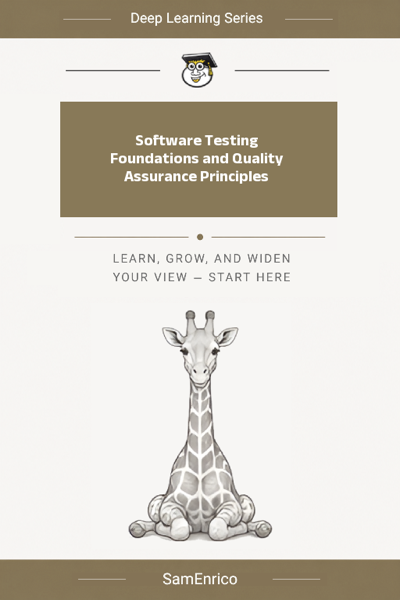
Software Testing Foundations and Quality Assurance Principles eBook
A Coursebook on Software Testing Foundations and Q
A Coursebook on Software Testing Foundations and Quality Assurance Principles
Formats
Free sample
Chapter 1: The Curiosity Discipline--–- The first time Elena filed a bug report, she cried. Not because the bug was complex or the system was critical. She cried because the developer, a man twice her age with a decade more experience, called her report “a waste of his afternoon” in a Slack channel with forty-seven people in it. He didn’t use her name. He didn’t have to.
Everyone knew which junior tester had just suggested that his authentication module might, under very specific circumstances, log users into the wrong account.She sat at her desk for twenty minutes, staring at the screen, wondering if she had made a mistake choosing this career. The test had been correct. She had reproduced the failure three times, documented every step, attached screenshots, even included the version of Chrome she was using. None of that mattered. What mattered was that she had delivered bad news to someone who didn’t want to hear it, and the social cost had been higher than she expected.That was seven years ago.
Today, Elena is the director of quality engineering at a company you have heard of. When I asked her what she wished someone had told her on that first day, she didn’t hesitate: “That testing isn’t about breaking things. It’s about understanding things. The breakage is just evidence.”This chapter is about that distinction. It is about the psychology, the ethics, and the economics of a discipline that is often misunderstood by everyone outside it—and sometimes by the people inside it.
If you take nothing else from this book, take this: software testing is not a bottleneck, a necessary evil, or a career for people who couldn’t become developers. It is a strategic profession that requires intellectual courage, emotional resilience, and a very particular kind of curiosity. The kind that asks not “did this work?” but “how could this fail, and what would that failure mean to the person using it?”The Two Mindsets That Live Inside Every Tester There is an old and destructive dichotomy in the software industry. It goes like this: developers build things, and testers break them. Developers create, testers destroy.
This framing is not only wrong—it is actively harmful to both professions.Let me introduce you to two people. Well, two versions of the same person.Marcus is a tester who believes his job is to prove that the software is broken. He approaches every testing session like a prosecutor building a case. He looks for edge cases that no real user would ever encounter. He delights in finding the obscure, the improbable, the theoretically possible but practically irrelevant failure.
When he finds a bug, he celebrates. When he doesn’t find anything, he assumes the software is either hiding its defects or the developers have outsmarted him. Marcus burns out in eighteen months. Developers avoid him. Product managers dread his reports.
His bug count is high, but his impact on shipped quality is low because most of his bugs are things the business was willing to accept anyway.Priya is also a tester. She approaches her work differently. She starts with a question: “What does this software need to do to be valuable to the person using it?” She tests for the things that would cause real pain—lost money, lost time, lost trust. She finds fewer bugs than Marcus, but the bugs she finds matter. She doesn’t enjoy breaking things.
She enjoys understanding how the system works, and the breakage is simply the evidence that her understanding has deepened. Developers seek her out before releases. Product managers ask for her opinion on whether to ship. Priya has been doing this for twelve years and still loves her job.Here is the secret that the industry doesn’t teach: you need both mindsets. Not one or the other.
Both.The “Validator” mindset (Priya’s default) is essential for confirming that the software meets its requirements and delivers business value. This is the mindset that asks “does it work as intended?” It is the mindset of quality assurance—checking that the team built what they said they would build. Without the validator, you ship software that is buggy in obvious ways and your users leave in frustration.The “Destroyer” mindset (Marcus’s default) is equally essential for finding the gaps that validation misses. This is the mindset that asks “how could this fail in ways the developer didn’t anticipate?” It is the mindset of exploratory testing—following curiosity into the dark corners of the system. Without the destroyer, you ship software that works under ideal conditions and breaks under real ones.The best testers learn to move fluidly between these mindsets.
They validate when they need to confirm. They destroy when they need to discover. And they know which mode they are in at any given moment.But there is a third mindset, and it is the most important one of all. I call it the “Understander.” This is the mindset that transcends the destroyer-validator binary. The understander does not ask “does it work?” or “how can I break it?” The understander asks “how does this actually work, and where are its limits?” This is the mindset of deep systems thinking.
It is the mindset that looks at a login form and sees not just fields and buttons, but session management, token expiration, rate limiting, password hashing, account lockout policies, and the seventeen ways authentication can fail that no one thought to write a requirement for.The understander does not find bugs by accident. They find bugs because they have built a mental model of the system that is more complete than the model the developers used when they wrote the code. Every bug they find is a gap between those two models.This chapter is an invitation to become an understander.The Seven Principles That Will Never Stop Being True Over decades of software testing, practitioners have observed certain truths that hold across industries, technologies, and team structures. The ISTQB (International Software Testing Qualifications Board) codified these into seven fundamental principles. I am going to give them to you not as a list to memorize for a certification exam, but as a set of lenses through which to see your work.Principle One: Testing shows the presence of defects, not their absence.This is the most important principle and the most frequently misunderstood.
When you run a test suite and every test passes, you have not proven that the software is correct. You have only proven that your tests did not find any defects. This might mean the software is perfect. It might mean your tests are shallow. It might mean you tested the wrong things.
The only honest conclusion from a passing test suite is “we did not find anything wrong with what we tested, under the conditions we tested it.”In 1985, the Therac-25 radiation therapy machine killed patients because of a race condition in its software. The machine passed all its safety tests. Those tests did not include the sequence of keystrokes that triggered the race condition. The absence of evidence was not evidence of absence. Forty…
This is the end of the free sample. Get the eBook to keep going. Buy now
About this book
Details
- Author
- Villa Imogene
- Publisher
- SamEnrico
- Language
- English
- Genre
- Non-Fiction, Informative, Educational
- Released
- 2026-05-25
- Pages (approx.)
- 151
- Available as
- eBook, Audiobook

Read better in the ZLOADR app
Your eBooks on your phone or tablet. Sign in with your SamEnrico account and start reading.
More by Villa Imogene
 Five Senses Mindfulness ResetVilla Imogene$11.99
 The One In One Out RuleVilla Imogene$11.99
 Cluster of Cues InterpretationVilla Imogene$11.99
 Metta for PerfectionistsVilla Imogene$11.99
 Stanley DruckenmillerVilla Imogene$11.99
 Affirmations for Self WorthVilla Imogene$11.99
 The Nobel Physics FamilyVilla Imogene$11.99
 Anapanasati for WalkingVilla Imogene$11.99
 Sarajevo Under Siege: The City That Would Not Fall (1992-1996)Villa Imogene$11.99
 The Taylor Swift Ticketmaster Fiasco: A Viral MeltdownVilla Imogene$11.99
 The Iron Genius of the Nok: Forging a CivilizationVilla Imogene$11.99
 Growing ColvilleaVilla Imogene$11.99
You may also like
 Hong Kong Handover 1997Dunn Johnnie$11.99
 Zumba For Postnatal Recovery CourseNeal Christian$11.99
 Zumba for BeginnersLadner Nikia$11.99
 YouTube Comment Mining GuideHumes Pandora$12.99
 Worry Box MeditationCarlin Rudy$11.99
 Workplace Stress MeditationNguyen Lynn$11.99
 Workplace Stress and Sleep RepairHawley Ivory$11.99
 Workplace Perfectionism CureDelaney Jeffry$11.99
 Workplace Injustice Anger GuideWallen Isabelle$11.99
 Work Addiction and Burnout LinkGreenwood Ester$11.99
 Women in Yoga and WellnessBeattie Galina$11.99
 Women in Stand Up ComedyChun Evangeline$11.99