
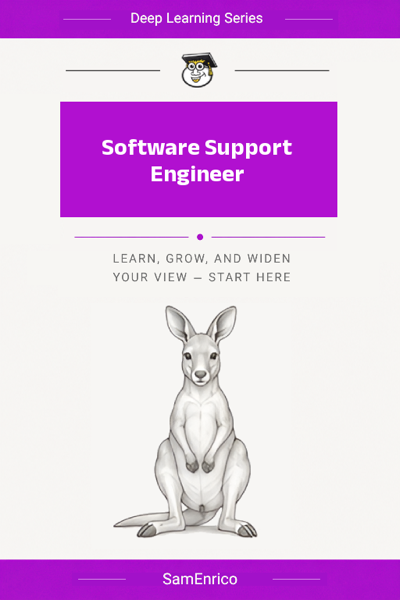
Non-FictionInformativeEducational
Software Support Engineer eBook
A Coursebook on Software Support Engineer
by Royer Omega
A Coursebook on Software Support Engineer
Formats
Free sample
Chapter 1: The Sev1 Wakeup Call--It was 2:17 on a Tuesday afternoon when my phone buzzed with the sound I would later learn to dread: the Sev1 alert. At the time, I didn’t even know what a Sev1 was. I had been a software support engineer for exactly eleven days. My computer science degree had taught me about Big O notation, memory allocation, and the difference between TCP and UDP. It had not taught me what to do when a $50 million e-commerce site suddenly stopped processing orders.The alert read: “Checkout database returning zero rows for all active users.
Revenue stopped. Sev1. Respond immediately.”I stared at the screen. Behind me, I heard footsteps. My manager, a woman named Carla who had done this job for twelve years and had the grey hairs to prove it, appeared at my shoulder.
She didn’t say “fix it.” She didn’t say “hurry.” She said something I have never forgotten: “Take a breath. Then start at the beginning.”That was my first lesson in software support engineering. The beginning is not the code. The beginning is not the logs. The beginning is your own panic.
If you cannot control your own nervous system, you cannot debug anyone else’s.I did not fix that outage. A senior engineer named Marcus—whom I had never met because he worked the night shift and avoided daylight—logged in from his apartment and typed seven commands over fifteen minutes. I watched his terminal output scroll by like ancient runes. I understood maybe half of it. When the orders started flowing again, Carla said, “Now write down everything Marcus just did.
That’s your study guide for the next month.”That night, I transcribed every single command. I looked up the flags I didn’t recognize. I traced each log file path. I learned that Marcus had checked the database replication lag, found a stalled replica, promoted a healthy replica to master, and restarted the connection pool. He did all of this without once looking at the application source code.Here is the truth that no university tells you: most production outages are not caused by bugs in your code.
They are caused by misconfigured databases, exhausted memory, full disks, expired certificates, network partitions, and the slow, silent creep of technical debt. The code is usually innocent. The environment is always guilty until proven otherwise.This book exists because I spent the next four years learning what Marcus knew. I became the person who gets the 2:17 AM calls. I have debugged systems that had not been restarted in four hundred days.
I have explained to furious customers why their API calls were failing when the real problem was a missing comma in their JSON. I have written post-mortems that made grown engineers cry and then fixed the systemic issues that caused those tears.And I have watched brilliant, talented junior engineers burn out within six months because no one taught them the actual job of software support.That ends now.What This Chapter Will Teach You By the time you finish reading this chapter, you will understand:Why software support engineering is not a lesser role but a distinct discipline with its own skills, tools, and career trajectory The critical difference between Level 1, Level 2, and Level 3 support—and why you are aiming for Level 3How Site Reliability Engineering (SRE) principles like error budgets and service level objectives apply directly to your daily ticket queue Why reading code is now mandatory for support engineers, even if you never write production code The single most important question you can ask when any ticket lands in your queue Let me be clear about what this book is not. It is not a certification guide. It will not teach you how to pass the Comp TIA A+ exam or the AWS Solutions Architect test. Those are valuable credentials, but they are not sufficient.
You can pass all of those exams and still freeze when a real Sev1 arrives.This book is a coursebook for the job they don’t teach in school. It is the manual I wished I had on that Tuesday afternoon when my phone buzzed and I had no idea what to do.The Evolution of Software Support Fifteen years ago, software support meant answering phones. A customer would call because their printer wasn’t working or their email client crashed. You would ask them to restart their computer. If that failed, you would escalate to someone who could reinstall the operating system.
The job was reactive, low-status, and required minimal coding ability.That world is gone.Modern software runs in the cloud, serves millions of concurrent users, and depends on dozens of interconnected microservices. When something breaks, it is rarely a single component. It is a cascade: the payment service times out because the database replica is lagging, which causes the order service to queue requests, which exhausts the memory on the API gateway, which returns 503 errors to the customer’s browser. The person who solves this problem cannot just restart a printer. They must read distributed logs, understand replication topologies, and correlate timestamps across six different services.This is the new software support engineer.
You are not a helpdesk technician. You are a detective, a forensic scientist, and a systems thinker.The Three Levels of Support Let me define terms clearly because the industry uses them inconsistently.Level 1 (L1) Support is the front line. L1 engineers handle password resets, basic configuration questions, and known errors with documented workarounds. They do not need access to production systems or source code. Their tools are a ticketing system, a knowledge base, and a script of standard responses.
This is not an insult—L1 is essential. But it is not where you want to stay.Level 2 (L2) Support handles issues that require deeper investigation. L2 engineers can access logs, run diagnostic queries against databases, and restart services. They have read-only access to production monitoring tools. They know the architecture well enough to route a ticket to the correct team.
But they do not change code. When an L2 engineer finds a bug, they document it and hand it to development.Level 3 (L3) Support is where this book lives. L3 engineers can read source code, apply hotfixes, and perform root cause analysis. They work directly with developers during incidents. They write automation to prevent recurrence.
They are trusted to make production changes under controlled circumstances. In many organizations, L3 support engineers are indistinguishable from site reliability engineers (SREs) or platform engineers.Here is the most important career advice in this book: aim for L3. Do not let yourself be trapped in L1 or L2. The difference in salary, autonomy, and job satisfaction is massive. According to the 2024 Stack Overflow Developer Survey, L3 support engineers earn 40% more than L2, and report twice the job satisfaction.
The work is harder, but it is also more respected.The SRE Connection In 2003, a team at Google published a paper that changed the industry. They described a new role called Site Reliability Engineer—someone who applied software engineering practices to operations problems. The SRE mantras included “toil is the enemy,” “hope is not a strategy,” and “every…
This is the end of the free sample. Get the eBook to keep going. Buy now
About this book
Details
- Author
- Royer Omega
- Publisher
- SamEnrico
- Language
- English
- Genre
- Non-Fiction, Informative, Educational
- Released
- 2026-06-03
- Pages (approx.)
- 145
- Available as
- eBook, Audiobook

Read better in the ZLOADR app
Your eBooks on your phone or tablet. Sign in with your SamEnrico account and start reading.
More by Royer Omega
 Recovery From Alcoholism: Daily Steps ForwardRoyer Omega$11.99
 Work Addiction Recovery JournalRoyer Omega$11.99
 Sunday Scare PreventionRoyer Omega$11.99
 Senior Leverage Loan PrimerRoyer Omega$11.99
 The Poisoned Wells of San Luis: Argentina's Deadly Witch Hunt (1950s)Royer Omega$11.99
 Cross Border Payment Tax Implications BriefRoyer Omega$12.99
 How to Produce Airbrushing MediumRoyer Omega$11.99
 How to Become a Gluten-settling TenderRoyer Omega$11.99
You may also like
 Hong Kong Handover 1997Dunn Johnnie$11.99
 Zumba For Postnatal Recovery CourseNeal Christian$11.99
 Zumba for BeginnersLadner Nikia$11.99
 YouTube Comment Mining GuideHumes Pandora$12.99
 Worry Box MeditationCarlin Rudy$11.99
 Workplace Stress MeditationNguyen Lynn$11.99
 Workplace Stress and Sleep RepairHawley Ivory$11.99
 Workplace Perfectionism CureDelaney Jeffry$11.99
 Workplace Injustice Anger GuideWallen Isabelle$11.99
 Work Addiction and Burnout LinkGreenwood Ester$11.99
 Women in Yoga and WellnessBeattie Galina$11.99
 Women in Stand Up ComedyChun Evangeline$11.99