
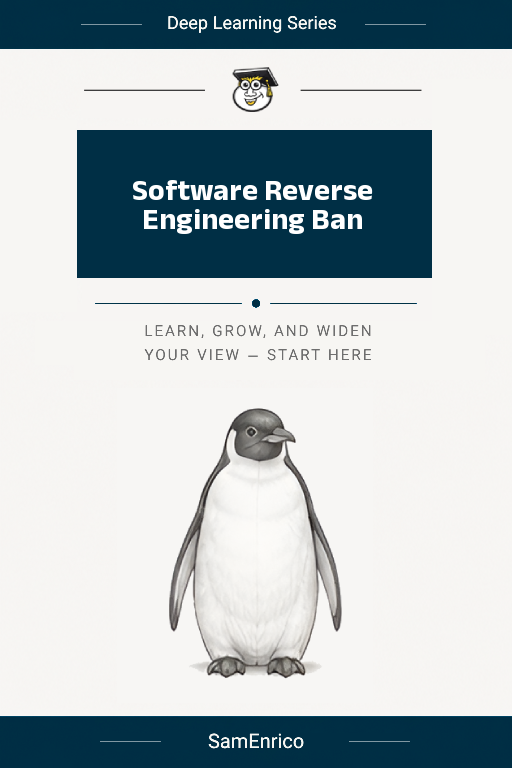
Software Reverse Engineering Ban eBook
Expressly prohibit decompiling or copying your sof
Expressly prohibit decompiling or copying your software to protect intellectual property.
Formats
Free sample
Chapter 1: The Invisible Heist...--–- On a Tuesday morning in March 2021, the founder of a seven-person AI startup in Austin, Texas, did what founders do every day: he opened his laptop, checked his competitors’ product updates, and felt his heart stop. A company he had never heard of—based in a city he had never visited—had just launched a product with the exact same recommendation engine his team had spent eighteen months building. The same algorithm. The same weighting logic. The same obscure fallback behavior when user data was sparse.
His first thought was a desperate hope: maybe it’s coincidence. His second thought, whispered by the knot forming in his stomach, was darker: they didn’t copy my code. They didn’t need to. They just ran my binary through a tool that costs one hundred ninety-nine dollars and reverse-engineered everything that made us special.This chapter establishes the fundamental business case for prohibiting reverse engineering, framing it not as a legal formality but as a core business survival strategy. By the time you finish reading, you will understand the difference between piracy and reverse engineering, the specific techniques competitors use to steal your logic without touching your source code, the staggering economic damage this silent theft causes, and why a reverse engineering ban is the only thing standing between your intellectual property and a competitor’s free ride.The Distinction That Most Executives Get Wrong Let us begin with a clarifying moment that will save you years of confusion and potentially millions in legal fees.
Piracy and reverse engineering are not the same threat. They are not governed by the same laws. They are not detected by the same tools. And they are not defeated by the same strategies. Yet most software executives treat them as interchangeable, which is like treating a pickpocket and a safecracker as the same kind of criminal because both want your valuables.Piracy is the unauthorized copying of your source code.
A pirate steals the actual files, the human-readable instructions you wrote. They may copy your installer, crack your license check, or simply download your software from a torrent site. The forensic evidence is straightforward: your code appears verbatim in their product. This is crude theft, and while it is damaging, it is relatively easy to detect and prosecute. Your strings, your variable names, your comments, your unique bugs—they all travel with the stolen code like fingerprints at a crime scene.Reverse engineering is different.
It is surgical. It is quiet. And in many jurisdictions, it occupies a legal gray area that makes piracy look simple by comparison.Reverse engineering is the process of taking your compiled software—the machine code that your computer executes but humans cannot easily read—and extracting the underlying logic, algorithms, data structures, and trade secrets without ever accessing your source code. The reverse engineer does not need your files. They only need your binary, which you gave them when they purchased or downloaded your product.Consider the AI startup from our opening story.
Their competitor did not steal source code. There was no insider threat, no hacked repository, no leaked build. Instead, the competitor purchased a legitimate copy of the software, ran it through a disassembler, and traced the execution path of the recommendation algorithm. They observed how the software transformed input data into output predictions. They noted the weighting coefficients, the fallback logic, the edge case handling.
Then they reimplemented those behaviors in their own code. No copying. No infringement of literal code. Just a perfect functional clone built from observation alone.This is the invisible heist, and it is happening to thousands of software companies right now without their knowledge.The Two Faces of Reverse Engineering: Clean Rooms and Black Boxes Competitors use two primary methods to reverse engineer your software. Understanding both is essential because each requires a different defensive strategy.Clean Room Techniques: The Legal Clone The clean room method sounds like something from a spy novel, but it is taught in business schools as a legitimate competitive strategy.
Here is how it works.A company that wants to clone your software assembles two separate teams. The first team, often called the analysis team, purchases your software and reverse-engineers it thoroughly. They document every function, every behavior, every edge case, every input-output relationship. They produce a detailed functional specification—essentially a blueprint of what your software does. This team may break your EULA.
They may decompile your code. They may run it through debuggers for weeks. But crucially, they never write any new code.The second team, called the implementation team, receives only the functional specification. They never see your source code. They never see your binary.
They are legally walled off from the analysis team. Then they write new code from scratch that implements the same functionality described in the specification. Because they never accessed your copyrighted expression, their code is legally considered original.The result? A product that behaves identically to yours, competes directly against you, and was built without copying a single line of your source code. Courts have ruled that this method is legal because copyright protects expression, not functionality.
Your idea, your algorithm, your business logic—these are not protected by copyright. Only the specific lines of code you wrote are protected, and if the competitor never saw those lines, they have not infringed.The clean room technique is how IBM-compatible PCs were built. It is how generic pharmaceutical companies create generic drugs after patents expire. And it is how sophisticated software competitors will clone your product while sleeping soundly at night, confident in their legal position.Black-Box Analysis: The Automated Probe Clean room techniques require human analysts and significant time. Black-box analysis automates the process, allowing competitors to reverse engineer your APIs and cloud services at scale.Black-box analysis treats your software as a closed box with known inputs and observable outputs.
The competitor feeds thousands or millions of carefully crafted inputs into your software and records the outputs. Using statistical analysis and machine learning, they can reverse-engineer the internal logic without ever opening the box.This is particularly dangerous for software that exposes an API. Every API call is an opportunity for black-box probing. A competitor can send your API a sequence of requests designed to reveal the boundaries of your validation logic, the weights in your scoring algorithm, or the decision tree in your business rules. With enough probes, they can reconstruct your entire server-side logic without ever seeing your source code.Modern reverse engineering tool suites—some costing as little as a few hundred dollars—include automated black-box analyzers that can send tens of thousands of requests per second, document every response, and generate a functional clone of your API within days.The AI startup from our opening story was likely reverse-engineered using a combination of these methods.
Their competitor probably used static analysis tools to disassemble the local portion of the recommendation engine, then used black-box probing to fine-tune the parameters. The entire process would have taken two to three weeks and cost less than ten thousand dollars. Eighteen months of R&D, cloned for the price of a used car.The…
This is the end of the free sample. Get the eBook to keep going. Buy now
About this book
Details
- Author
- Sager Laquita
- Publisher
- SamEnrico
- Language
- English
- Genre
- Non-Fiction, First 30 Days
- Released
- 2026-05-30
- Pages (approx.)
- 145
- Available as
- eBook, Audiobook

Read better in the ZLOADR app
Your eBooks on your phone or tablet. Sign in with your SamEnrico account and start reading.
More by Sager Laquita
 Psychological Relapse Prevention for SchizophreniaSager Laquita$11.99
 The Adaptor Gesture GuideSager Laquita$11.99
 Time Restricted Eating For RhythmSager Laquita$11.99
 Caregiving for Aging ParentsSager Laquita$11.99
 The Scholarship Anxiety GuideSager Laquita$11.99
 Sandbox Game Addiction HelpSager Laquita$11.99
 Food Addiction Abstinence ModelSager Laquita$11.99
 Childhood Sexual Abuse RecoverySager Laquita$11.99
 Testosterone Growth Hormone SynergySager Laquita$11.99
 Whispers in the Dark: The Underground Press That Defied the NazisSager Laquita$11.99
 The Last Echoes of the Arctic: Knud Rasmussen’s Epic Quest for Indigenous LanguagesSager Laquita$11.99
 The Atlantic Chieftains: Celtic Navigators of the Iron AgeSager Laquita$11.99
You may also like
 Hong Kong Handover 1997Dunn Johnnie$11.99
 Zumba For Postnatal Recovery CourseNeal Christian$11.99
 Zumba for BeginnersLadner Nikia$11.99
 YouTube Comment Mining GuideHumes Pandora$12.99
 Worry Box MeditationCarlin Rudy$11.99
 Workplace Stress MeditationNguyen Lynn$11.99
 Workplace Stress and Sleep RepairHawley Ivory$11.99
 Workplace Perfectionism CureDelaney Jeffry$11.99
 Workplace Injustice Anger GuideWallen Isabelle$11.99
 Work Addiction and Burnout LinkGreenwood Ester$11.99
 Women in Yoga and WellnessBeattie Galina$11.99
 Women in Stand Up ComedyChun Evangeline$11.99